
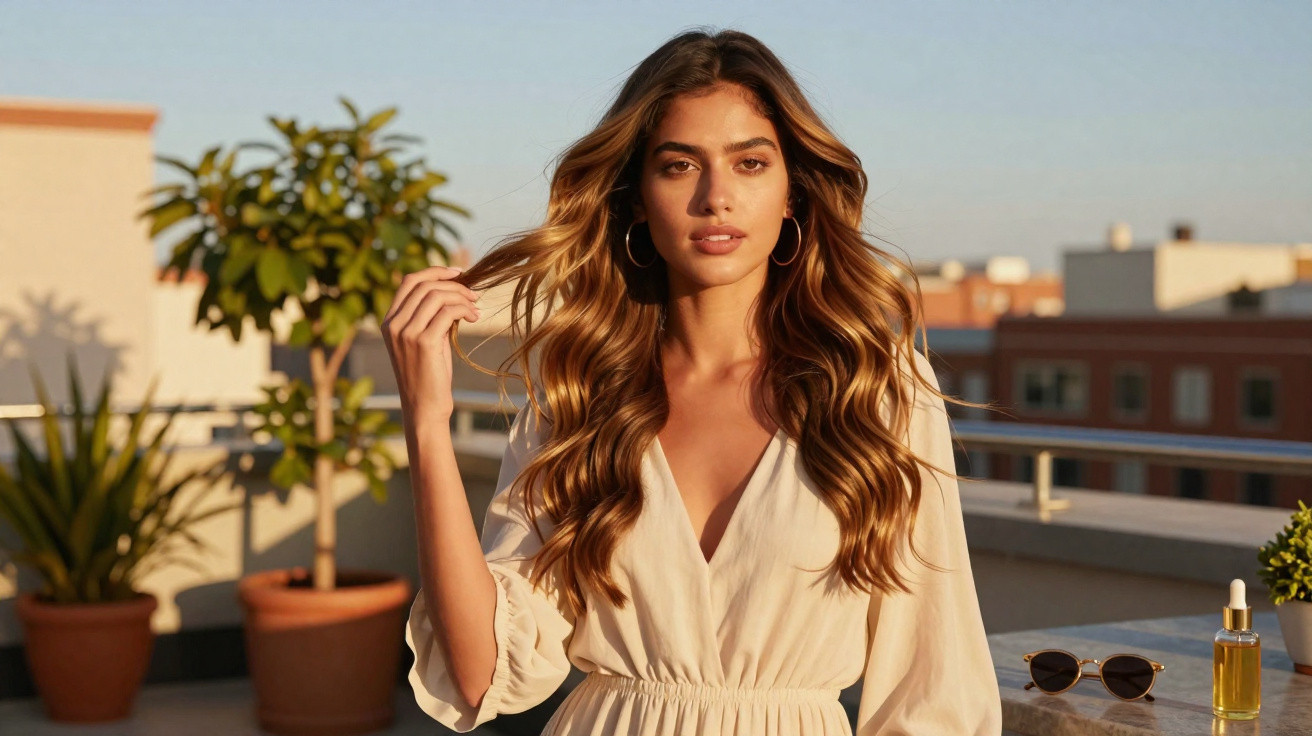
Sunshine may still be playing hard to get, but salons are already buzzing about a new way to replicate that just-back-from-holiday radiance.
With the evenings stretching out, hairdressers across Europe are moving away from deep winter brunettes and towards lighter, sunlit tones that lift the face without over-stressing the hair. For spring–summer 2026, the technique at the heart of this shift is “Indian sun” - a fresh balayage approach that aims for a soft, holiday-style halo, minimal damage and an instant, healthier-looking complexion.
What is Indian sun balayage?
Indian sun is a targeted, low-impact balayage technique created in French salons and strongly promoted for spring–summer 2026 by stylist Franck Provost. Rather than blanketing the hair with blonde ribbons, it concentrates on a small number of brighter pieces placed exactly where the sun would naturally catch.
"Think of Indian sun as a gentle sun filter for your hair: a few precise highlights, carefully positioned to fake a week on the beach."
In practice, the colourist selects six to eight fine sections and lifts them only a few shades above your base colour. These strands are painted around the face and through the lengths to build a soft halo and subtle dimension - not an all-over blonde makeover.
A key point is that Indian sun is designed as an “effet soleil” for both natural hair and previously coloured hair. It works with your existing tone instead of trying to wipe it out, which is why colourists describe it as more polished and contemporary than older, high-contrast balayage looks.
Why Indian sun is gentler on your hair
Compared with traditional salon lightening - which often relies on stronger bleach plus heat - Indian sun is typically carried out without heat and without ammonia. Instead, the colourist uses a clay-based lightener, intended to lift pigment in a more controlled, softer way.
"The goal is glow, not shock: just enough lift to mimic summer light, without pushing the hair to breaking point."
Because the method treats only a limited number of strands, the overall chemical exposure is lower than with a full balayage. The upshot is often less dryness, fewer split ends, and a better chance of keeping bounce and shine - even during a hot summer.
Key features at a glance
- Partial balayage: 6–8 sections instead of a full head of highlights
- No added heat or ammonia in the lightening process
- Clay-based product for more controlled, gentle lift
- Soft, sun-kissed effect rather than a drastic blonde overhaul
- Designed to blend seamlessly into your natural base
Face-framing light: when balayage meets hair contouring
The standout element of Indian sun isn’t only the product choice - it’s the positioning. Colourists often frame it as a hybrid of balayage and “hair contouring”: the hair equivalent of placing bronzer and blusher in exactly the right spots.
"Indian sun behaves like a complexion hack: light where you want lift, depth where you want structure, for a built-in makeup effect."
Instead of simply making hair lighter, the brightened strands are arranged to shape the face. Around the hairline, these soft veils of colour can work like a subtle ring light, lifting luminosity across the cheekbones, around the eyes and along the jaw.
How Indian sun adapts to different face shapes
| Face shape | Typical placement with Indian sun | Visual effect |
|---|---|---|
| Round | Lighter pieces around the cheeks and slightly below | Gives more definition and subtle vertical lines |
| Square | Softer ribbons near the jaw and around the temples | Softens angles and warms up strong features |
| Oval | Delicate halos around the face and through mid-lengths | Enhances natural balance, boosts glow |
| Angular/long | Strategic brightness near the cheekbones and sides | Widens the face visually and adds a “blush” effect |
Colourists frequently liken the finish to a gentle sweep of blusher: a hint of warmth that lifts the entire face without looking overtly “done”. The hair reads sun-kissed; the complexion appears fresher.
A trend built for low-maintenance summer hair
A common complaint with classic blonde balayage is the noticeable regrowth line. Once roots come through, the contrast can look stark, pushing you into frequent top-ups. Indian sun is designed to sidestep that issue.
"Because the lift is moderate and the blending is subtle, the regrowth line blurs into the base instead of screaming for a salon visit."
With only a few strands lightened and woven into the natural shade, hair can grow out for months without a harsh line of demarcation. Rather than turning into a chunky stripe through the mid-lengths, the look gradually softens as it grows.
That’s why Indian sun appeals to anyone wanting a seasonal refresh without signing up to high-maintenance blonde. Many stylists expect clients to keep it well into autumn, booking a refresh when they fancy dialling up the brightness - not because their roots leave them no choice.
Who suits Indian sun best?
Indian sun is chiefly intended for medium to long hair, where there’s enough length to place those ribbons of light and create a believable gradient. A layered cut can also help, as the shimmer catches on movement.
Colour-wise, it suits a wide range - from dark blonde through rich brunette and even deeper brown - provided expectations stay realistic. On very dark hair, the effect tends to read more caramel or hazelnut than icy blonde, which aligns neatly with the trend’s understated feel.
"The technique enhances what you already have: it does not try to turn a deep brunette into a platinum blonde in one sitting."
Skin tone matters too. Because the lift is bespoke, a colourist can steer the tone warmer or cooler to echo your natural undertone. This is where the “good skin day” effect shows up: hair that’s subtly tuned to your undertones can make the face look more rested and softly illuminated.
Talking to your colourist: what to ask for
Outside France, Indian sun is still a relatively new label, so your local salon may not offer it by name. You can still get the same outcome by asking for the effect, not just the terminology.
- Ask for a partial, contouring-style balayage with 6–8 fine pieces around the face and mid-lengths.
- Explain that you want a gentle “sun effect” a couple of shades lighter than your base, with no obvious stripes.
- Say you’d prefer a technique without heat and, if available, a softer lightener such as a clay formula.
- Bring reference photos that show soft, melted highlights rather than heavy, all-over blonde.
It also helps to discuss how you wear your hair in everyday life. If you tie it up often, the stylist may add a touch of brightness at the nape or through the ponytail area. If you part your hair to one side, they’ll tailor the placement to suit how the hair usually falls.
Care, risks and realistic expectations
Even when the product is gentler, any lightening lifts the cuticle slightly and can cause dryness if aftercare is ignored. A weekly moisturising mask, a leave-in cream with UV filters, and rinsing out chlorine or salt water promptly can keep the finish glossy rather than frazzled.
The biggest risk is frustration if you’re expecting a dramatic transformation. Indian sun is designed for nuance. If you want a full blonde overhaul, you’ll need a more intensive plan - ideally spaced over multiple appointments to protect hair condition.
Cost can be a factor too. Although top-ups are typically less frequent than with heavier highlights, the first appointment with a senior colourist may be pricier because of the highly customised placement. For many people, that exchange makes sense: fewer visits overall, and a look that grows out elegantly through the season.
Extra context: what “effect soleil” and “hair contouring” really mean
“Effet soleil” - literally “sun effect” - is a French salon term for colour that appears naturally lightened, as though you’ve just returned from a beach break. The emphasis is on transparency and seamless blending, not strong lines or dramatic contrast.
“Hair contouring” adapts the make-up idea of shaping features with light and shadow. Darker areas add depth or create a slimming impression, while lighter sections bring features forward. Indian sun focuses on the lighter side of that approach: targeted shimmer rather than bold, painted blocks.
Together, they form a subtle but impactful direction for 2026: hair colour that quietly reshapes the face, softens winter fatigue and suggests extra daylight - even on a grey morning commute.




Comments
No comments yet. Be the first to comment!
Leave a Comment