
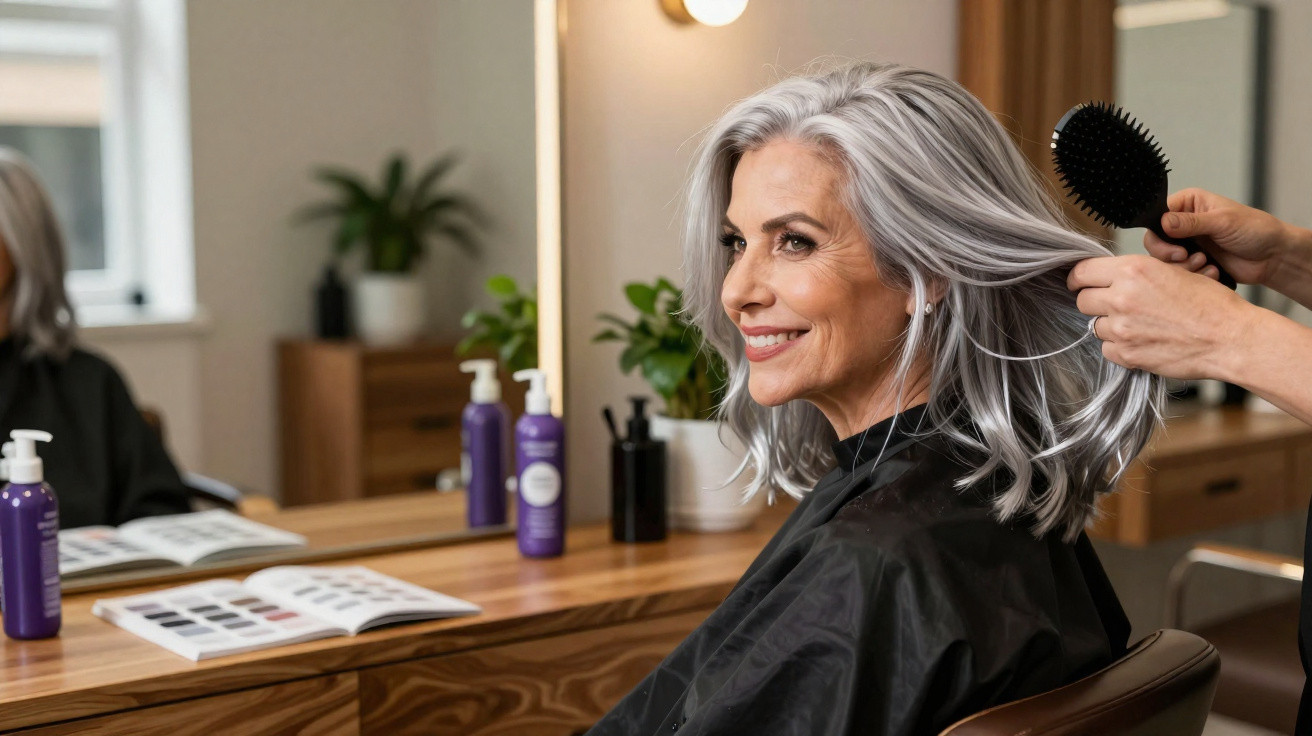
A woman pauses in front of the mirror, hairbrush hovering mid-air. In the bathroom light, her roots catch the glow-silver, not lifeless or weary, but almost lit from within. She edges nearer, intrigued and slightly wary, as though her reflection has acquired a brand-new character overnight.
Her stylist has been mentioning “silver gloss”, describing it as a sheer wash of shine that would turn her scattered greys into an intentional shade-something chosen, not accidental. She’s still undecided. She can picture the box dyes tucked beneath the sink, the panicked Sunday evenings before work, the towels ruined by stains.
Outside the bathroom, her phone flashes with images: grey-haired models, stylish editors, women in their 50s laughing on café terraces with hair like moonlight. Something in her shifts, just a fraction.
Maybe the story isn’t “I’m going grey” anymore.
Maybe the new story is “I’m glowing silver”.
Grey hair after 50: the moment things quietly change
There’s a particular morning when grey hair stops feeling like a few rogue strands and starts reading as an actual shade. You notice it in the lift mirror or a shop window, and suddenly there’s texture, light, contrast. It’s not only ageing; it’s structure.
After 50, the hair shaft changes too. It becomes drier, more porous, and less consistent from root to ends. That’s why the same familiar chestnut or chocolate brown can begin to look flat, even a bit “wig-like”. As the grey pushes through, the constant camouflage starts to feel draining.
At the same time, social media is filling with a new wave: women wearing brilliant “steel” bobs, frosted pixies, and long, pearly waves. They’re calling it “silver gloss”, and it looks unexpectedly current. The old dread of going grey meets a different option-cool, luminous, and deliberate.
Consider Claire, 56, who spent years trying to keep her old brunette colour. Like clockwork, every three weeks she returned to the salon, eyelids heavy, scrolling on her phone under harsh neon while a dense dye coated her scalp. She didn’t dislike the finish, but it never quite matched her. Too dark, too solid, too “not her”.
Her shift happened one summer by the sea, when sunlight hit her roots. The grey wasn’t brassy or bleak; it looked soft, almost icy. Her colourist recommended a gentle transition and a silver gloss toner rather than another full-coverage dye. Two hours later, she didn’t appear “younger” or “older”. She simply looked like Claire-sharper, clearer, in high definition.
And the compliments weren’t, “You don’t look your age”. They were, “Your hair is amazing”. That difference matters more than we usually admit.
The logic behind it is straightforward. As skin changes-often lighter, more translucent, sometimes more lined-very dark, solid colour around the face can make features look harder. Grey, by contrast, throws light back. A touch of silver gloss boosts reflection, reduces yellowish tones, and creates the soft-focus effect our phones try to imitate with filters.
Stylists sometimes call this “tone-on-tone respect”. Instead of battling grey, they bring it into balance. The aim isn’t to wipe away time, but to tune it. That’s why a well-executed silver gloss can feel surprisingly youthful, even as it openly embraces age.
It’s not so much about erasing years as it is about controlling light. And light is ruthless when we fight it, yet generous when we work with it.
What “silver gloss” really is - and how to ask for it
“Silver gloss” may sound like the name of a lipstick, but in salons it usually refers to a semi-permanent or demi-permanent toner made with cool, pearly, or smoky pigments. It sits over your existing grey, adds shine, and subtly adjusts the tone without building a heavy, helmet-like layer of colour.
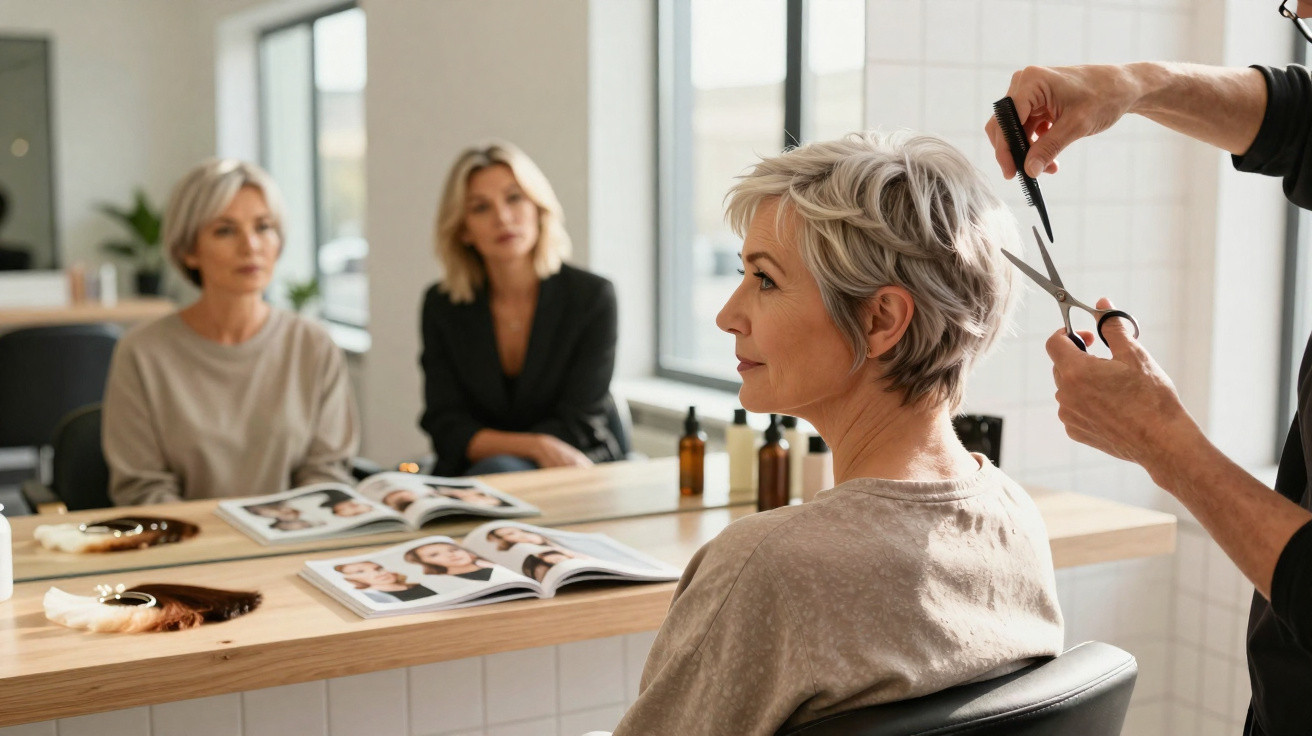
You’ll be at the backwash, hair freshly cleansed, while the colourist smooths a milky or violet-tinged gloss through the lengths. After ten to twenty minutes, yellowish reflections are neutralised, natural white looks clearer, and the darker strands appear more seamlessly blended.
The key is that the hair keeps its transparency. That’s the appeal. It’s your grey-just refined. Your silver-just elevated. One glossy layer, rather than a decade of total coverage.
The most common mistake is walking into a salon and saying, “I want to go grey,” and walking out with a flat, uniform silver that looks more like cosplay than something lived-in.
A stronger way to phrase it is: “I want to keep my grey and enhance it with a cool, luminous gloss that blends everything softly.” Then bring photos-not filtered images, but real textures: visible roots, depth at the nape, brighter contours around the face.
Most of us know that moment: you agree with your reflection in the salon mirror even though the colour isn’t quite right. Next time, reach for words such as “pearl”, “smoky”, “transparent”, “not too opaque”. Your colourist needs your language almost as much as they need your trust.
Let’s be frank: hardly anyone keeps up a perfect routine every single day.
We buy purple shampoos and miracle masks, and then real life gets in the way. So it’s useful to keep the plan simple: one considered colour decision, plus a light maintenance habit.
“Gray hair used to be what we fixed,” says Anaïs, a Paris-based colorist who now specializes in silver transitions. “Now it’s the starting point. The gloss is just there to make it look intentional, polished, and alive.”
- Use a gentle, sulphate-free shampoo once or twice a week to help protect the gloss and prevent the fibre drying out.
- Alternate with a violet- or blue-toned shampoo every 7–10 days to reduce yellow tones without turning the hair lilac.
- Add a weekly nourishing mask, concentrating on mid-lengths and ends, so silver doesn’t look frizzy or fragile.
- Shield hair from heat with a spray or cream before blow-drying or using tools, especially if your gloss involves lightening.
- Schedule a gloss refresh every 6–10 weeks, depending on how quickly your hair loses tone and shine.
Silver gloss as a statement: beyond “looking younger”
There’s a subtle effect when a woman over 50 walks into a room with luminous silver hair. People can’t immediately place her on the timeline. She isn’t in the “still dyeing” group, and she isn’t in the “let’s grow it out and see” group either. She looks like someone who’s curating her age, not denying it.
For many women, silver gloss turns into a quiet act of rebellion against the unspoken rules about “keeping up”. It says: I’m not acting as if I’m 35. I’m putting effort into the version of me that exists today. And that version still sparkles.
Often, that change spreads to other decisions too: stronger glasses, a sharper lipstick, softer clothing chosen for comfort rather than simply being “slimming”. Hair becomes the most visible part of a calm recalibration.
| Key point | Detail | Value for the reader |
|---|---|---|
| Silver gloss respects natural grey | Uses translucent, cool-toned products that enhance rather than cover | Gives a modern, luminous look without harsh regrowth lines |
| Low-pressure maintenance | Refresh every 6–10 weeks, with simple home care (gentle shampoo, occasional purple wash) | Reduces salon fatigue and colour anxiety while keeping hair polished |
| Fits changing skin and features | Softens contrast around the face, reflects light, avoids “block” colour | Makes features look fresher and more defined without chasing youth |
FAQ:
- Does silver gloss damage the hair like regular dye?Most silver gloss products are semi- or demi-permanent, with lower ammonia or none at all. They coat and tone rather than penetrate as deeply as classic permanent dyes, so they’re generally gentler, especially on already fragile gray hair.
- How long does a silver gloss usually last?On average, 4 to 8 weeks, depending on how often you wash your hair, the products you use, and your hair’s porosity. You’ll notice the shine and cool tone slowly fading rather than a harsh line of demarcation.
- Can I do a silver gloss at home?There are at-home toners and glosses, but the risk of ending up too purple or too ashy is real. For a first transition, it’s safer to work with a colorist, then maintain at home with targeted shampoos and masks once the tone is set.
- What if my gray is uneven - some areas white, others still dark?This is where silver gloss shines. Your colorist can apply slightly different formulas to different zones, softly blending contrasts so your natural pattern looks intentional, not patchy.
- Will silver gloss make me look older?Age perception comes more from cut, styling, and overall harmony than from gray itself. A well-cut bob or layered style with a luminous, cool-toned gloss usually looks fresher than a flat, very dark dye that fights your natural growth.

Comments
No comments yet. Be the first to comment!
Leave a Comment