
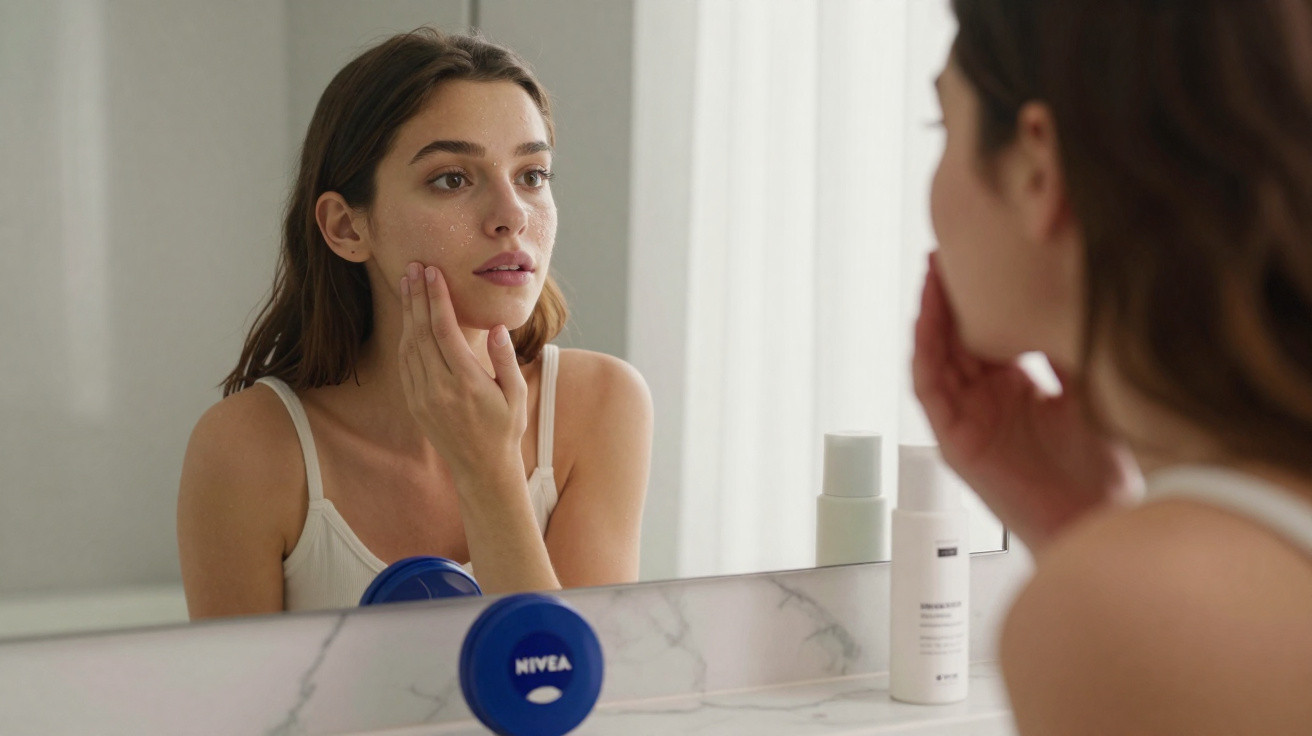
That faintly powdery, slightly soapy smell - the one that instantly takes you back to a grandmother’s bathroom cabinet. Standing at the mirror, I traced an imaginary line straight down the bridge of my nose and committed to a plan that Google would probably label “unhinged but intriguing”: left side only, every night, for seven days.
The right side kept to my normal approach - serums, a lightweight gel moisturiser, and products that speak about hyaluronic acid with near-religious devotion. The left side got one thing and one thing only: a generous, old-fashioned slick of Nivea in the blue tin. No flashy actives. Just the sort of cream that has sat on chemist shelves for decades.
By the third night, the difference was already obvious to my fingertips. On the “blue” side, the skin felt softer and more padded, like it had a little give. The real question, though, was whether it would show - enough for someone else to spot it.
Nivea blue tin vs modern skincare: a face divided in two
On the second day, the left side of my face felt… weightier. Nivea is thick and a bit stubborn: you don’t simply swipe it on, you have to persuade it into place. I warmed a pea-sized dab between my fingers, then pressed it into my cheek, temple and jaw - like icing a tiny cake that happens to be your own face.
Meanwhile, the right side stayed featherlight and almost squeaky-clean in that way gel moisturisers often do. My pillowcase, however, made its preference clear immediately. The Nivea side left a faint oily mark on the cotton, like a smudge I couldn’t quite erase the next morning. My skin didn’t object - my laundry absolutely did.
By day four, I didn’t need to overthink it: the textures had diverged. The Nivea side felt thicker, as if the surface layers were gripping on to water with more determination. The modern-skincare side looked “cleaner”, but under harsh bathroom lighting it also appeared a touch tighter around my mouth when I smiled.
That afternoon on a Zoom call, I found myself leaning in closer than I normally would. Naturally, nobody said a word - but on camera I could see something. The Nivea side had a muted, almost waxy glow. Not shiny, not slick; just smoother, like someone had put a low-strength filter over half my face.
Later, I did the cruellest check of all: a close-up selfie with the phone torch on. At that distance, every pore feels like a confession. The fine lines on the left, particularly under the eye and along the line from nose to mouth, looked just a bit softer - not erased (let’s be realistic), but less carved in. The right side still showed more of that faint crepey texture that laughter and late nights tend to leave behind.
What actually changed in one week of “blue cream” on one side
The most surprising shift wasn’t “glow”. It was toughness. By day five, the heating had been running almost constantly, and that’s usually when my skin starts flaking around the nostrils. The Nivea side coped noticeably better. The dry patch beside my nose? Calmer and less reactive. The right side, in contrast, had that slight pink, tight feeling that creeps in after hours of dry indoor air.
I also developed a strange nightly habit: gently pinching each cheek to compare. The Nivea side sprang back more slowly, but it looked smoother as it did - less crinkle, more cushion. The modern-skincare side snapped back faster, yet it held on to a faint pinch imprint for a moment longer, as if it needed an extra beat to settle.
At the end of the week, I brought in a second opinion. I met a friend for coffee, sat by the window, turned my head and asked, “Left or right - which side looks more rested?” She squinted, laughed, and immediately pointed at the Nivea side. “That one,” she said. “It looks more plump. The other side looks a bit… tired?”
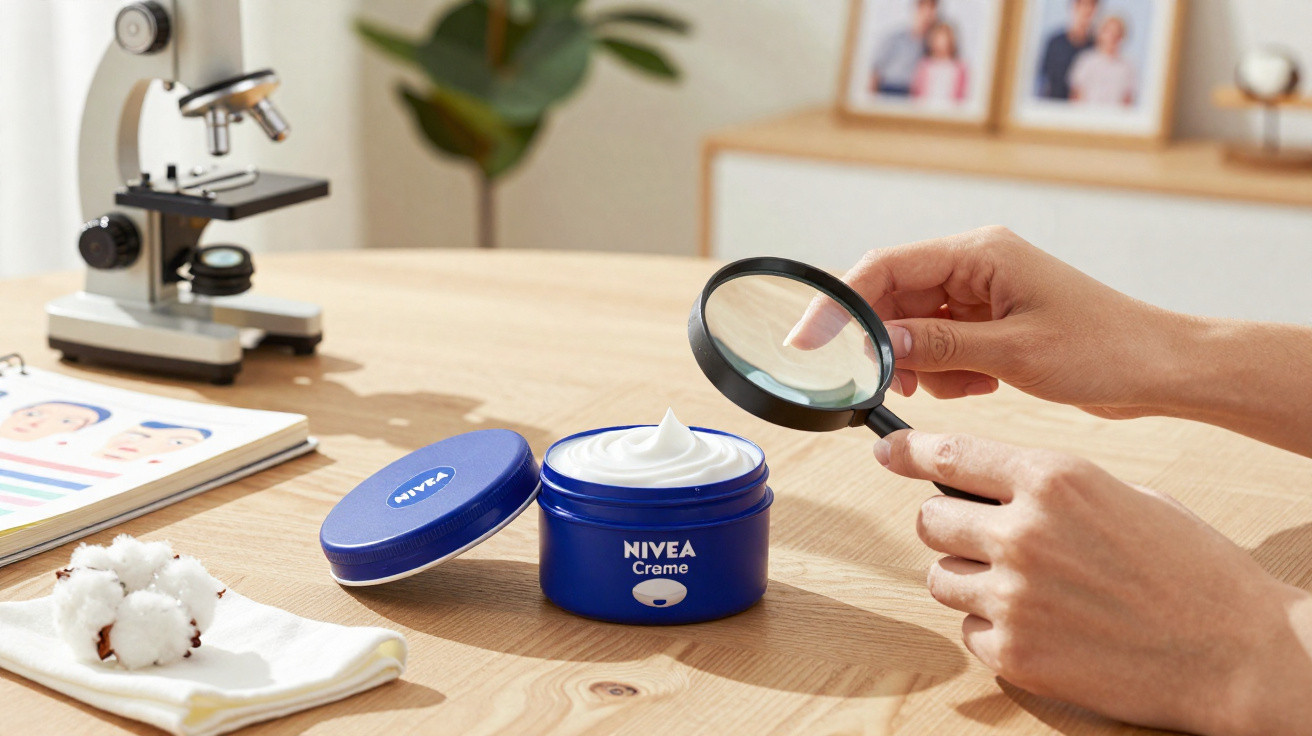
From a skin-science point of view, the outcome wasn’t mysterious. Nivea’s classic blue cream is packed with occlusives and emollients - ingredients that sit on the skin’s surface and help hold water in. Think petrolatum, paraffin, lanolin alcohol. It behaves more like a protective layer than a modern serum full of “actives”. In practical terms, it reduces overnight water loss - like sleeping under a duvet instead of a thin sheet.
My usual product line-up, by comparison, is built around lightweight hydration: hyaluronic acid, glycerin, and a little niacinamide. Excellent for drawing moisture into the skin, but not always as strong at stopping that same moisture slowly evaporating overnight. On cold, heated winter evenings, that difference isn’t theoretical - it shows up in the mirror the next morning.
How I actually applied Nivea to half my face (and what I’d tweak)
I didn’t smear it on like a sleeping mask. What worked best was treating it like butter that needs warming first. I used a pea-sized amount - truly tiny - and rubbed it between my fingertips until it went almost clear. Then I pressed it into the left side of my face, starting where I’m driest: around the nose and up towards the cheekbone.
The more I tried to massage it in, the greasier it appeared, so I swapped to pressing and light tapping and kept away from the immediate eye area. On the third night, I experimented by adding a light hydrating serum underneath the Nivea on the left side only. That combination gave the best finish: the serum supplied the water, and the blue cream sealed it in like a lid.
If you try anything similar, here’s the practical detail people don’t mention: timing changes everything. I needed a solid 20–30 minutes before getting into bed, otherwise my pillow ended up more moisturised than my cheek. Once it had settled, it felt more satin than oily - still not invisible, but less like a coating and more like part of my skin. I finally understood why some people treat it as a winter staple.
This mini test also highlighted every lazy shortcut I take with my “proper” routine. On the right side, I sometimes skipped moisturiser entirely after a long day. I’d cleanse, slap on a weary pump of serum, and call it done. Let’s be honest: nobody maintains the perfect, Instagram-level routine every single night with the discipline they claim.
The left side, because it was the “experiment”, got consistent attention every evening without fail. That alone can change skin. Give any patch of your face seven consecutive nights of care and it often pays you back. It left me wondering how much of the difference came from the product itself - and how much came from simply turning up for my skin and not cutting corners.
There were downsides, too. By day seven, the blackhead-prone area near my left nostril felt slightly more congested. Not a breakout - just that sense of something sitting on top. If you’re oily or very acne-prone, using such a rich cream every night over your entire face could feel like wearing a raincoat in a steam room: helpful in some places, suffocating in others.
“Old-school products like the Nivea blue tin work because they’re simple,” a London-based dermatologist once told me off record. “Not magical, not anti-ageing in the high-tech sense, but they excel at one thing: preventing your skin from losing water. And hydrated skin always looks younger than dry skin - that’s half the trick.”
After this week, I wouldn’t replace my whole routine with Nivea - but I would absolutely borrow the idea. On brutal weather days or after a long-haul flight, I’d gladly use a tiny amount on dry areas only: around the mouth, down the sides of the nose, and perhaps even over my usual night cream on the cheekbones as a sealing layer.
- Use it at night rather than under daytime make-up, unless your skin is very dry.
- Apply a hydrating serum first, then use Nivea as your final step.
- Avoid active spots or very oily T‑zones.
- Start with a pea-sized amount for the whole face - it goes a long way.
- Treat it like a winter coat for your skin, not an all-season uniform.
What this tiny, lopsided experiment really says about our skin
By the end of the week, my face felt like a split-screen. The left side told one story: dense, old-school moisture, a little extra glow, and a hint of heaviness in oilier areas. The right side told another: lighter and “cleaner”, but more vulnerable to dry air and central heating. Neither looked bad. It just looked like two skincare philosophies quietly arguing across my cheekbones.
The oddest part, on a human level, was the psychology. I caught myself angling my face so the Nivea side met the light first - presenting the “better” cheek without even thinking. It was subtle, but real: that pull towards whichever version of your face looks softer, more rested, more forgiving. Everyone knows the feeling of finding the one angle or one lighting set-up you suddenly trust.
This seven-day split-face test isn’t going to end up in a medical journal, and it won’t settle the argument between high-tech serums and thick, traditional creams. What it did show me is that straightforward moisture can do more for visible texture than any slogan. The half of my face that stayed properly hydrated, night after night, simply looked gentler.
Perhaps that’s the point: the name on the jar matters less than whether you consistently use something that shields your skin when life turns dry and unforgiving. For some people, that will be the iconic blue tin. For others, it’ll be a fragrance-free balm or a carefully formulated night cream. The face you see in a week is the one you’ve spent five quiet minutes looking after - even if, in this case, it’s only one side, thanks to a slightly strange experiment you can’t stop thinking about.
| Key point | Detail | Why it matters to you |
|---|---|---|
| Nivea boosted hydration | The blue tin side looked smoother and less lined after a week | Helps you decide whether this cream can visibly improve skin texture |
| Best used as a night occlusive | Works well over a hydrating serum, especially in dry seasons | Offers a practical way to use it without overwhelming your skin |
| Not ideal for every skin type | Can feel heavy or contribute to congestion on very oily or acne-prone areas | Helps set realistic expectations and avoids disappointment |
FAQ:
- Can Nivea blue cream really replace my night cream? For dry or normal skin, it can work as a basic night cream, particularly in winter, but it doesn’t include targeted actives such as retinol or peptides - think of it as a moisture shield rather than a complete routine.
- Will Nivea blue cream clog my pores? If your skin is combination or oily, using it across the whole face every night may feel heavy and could add to congestion in blackhead-prone areas, so using it just on dry patches is the safer approach.
- Is it safe to use Nivea around the eyes? The formula is very rich and lightly fragranced, so many dermatologists prefer a lighter, ophthalmologist-tested eye cream for the eye area, especially if you’re sensitive.
- Can I layer Nivea over retinol or acids? Yes - used as the last step, it can help buffer dryness from actives, but introduce it gradually and pay attention if the pairing feels too intense or irritating.
- How long before I see a difference using Nivea at night? Hydration and texture can look improved within a few days (as in this one-week test), while longer-term changes in fine lines are more about consistent hydration over several weeks.


Comments
No comments yet. Be the first to comment!
Leave a Comment