
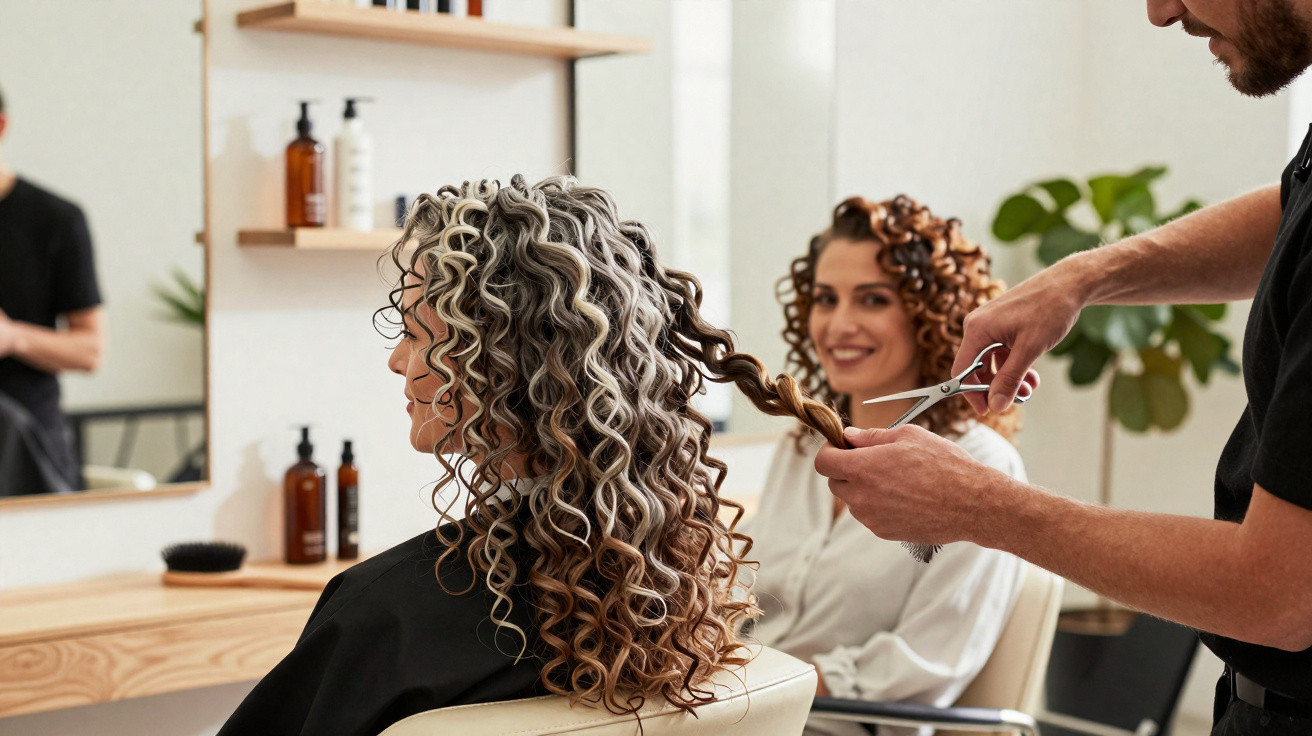
More women and men are happily showing off natural salt and pepper hair, but plenty still choose cuts and finishes that make the face look harsher or leave the hair appearing flat, tired and lacklustre. The gap between a polished silver look and a dated “granny” effect is often just a handful of specific mistakes that are easy to avoid.
Why salt and pepper hair changes the rules
Letting hair go grey isn’t only a colour shift. As pigment fades, the hair’s overall behaviour alters too: strands commonly become drier, coarser and, for many people, more delicate. Natural oils don’t travel through the hair as readily, so shine reduces and frizz becomes more noticeable.
Grey and white strands can also take on yellow tones from everyday pollution, heat styling and even nicotine. Instead of looking bright, the colour can start to appear dulled or stained.
Salt and pepper hair needs a cut that manages texture, volume and shine, not just a flattering length on paper.
When these changes are ignored and you keep the same haircut you had when your hair was fully pigmented, it’s usually the first slip-up. Another common problem is picking a style that fights your natural texture rather than working with it.
The number one cut mistake: long, grey, and very curly
Hairdressers regularly flag the same high-risk combination: very long grey hair paired with a naturally curly texture. It sounds dreamy and bohemian in theory; in practice, it can read as fluffy, dry and undefined.
Curly hair is prone to dryness because the bends in the fibre make it harder for sebum to spread from the scalp down the lengths. When those curls turn grey or white, the dryness is often even more obvious. Over time, the ends can lose spring and clarity, leaving a soft, cloudy shape rather than distinct curls.
Long, grey curls that are never cut back tend to look “moussy” and matte, which can drag the whole face down.
Extra length can also weigh curls down at the roots while collecting bulk at the ends. The result is a triangle silhouette-flat at the top and wide at the bottom. On a mature face, that shape can emphasise drooping features and make the overall look seem more fatigued.
How to adapt curls for a fresher grey look
This doesn’t mean grey hair and curls can’t look fantastic together. It’s mainly a question of the right structure and a more suitable length:
- Choose a mid-length cut that falls between the jaw and the collarbone, keeping movement while reducing heaviness.
- Add long layers to help curls separate and form properly instead of merging into one solid mass.
- Shape around the face with softer, slightly shorter pieces to open up the features and lift the cheekbone area.
- Avoid blunt ends that create a dense, weighty outline-making hair look thicker, but not necessarily healthier.
With a few centimetres taken off, curls often spring back. Light can move through the shape rather than disappearing into a dense block, helping grey tones look cleaner and more refined.
The styling trap: ultra-strict, pulled-back looks
Even with the right cut, styling choices can still spoil the effect. A major styling mistake with salt and pepper hair is going too tight, too sleek and too severe.
Smoothed-back buns, very tight ponytails and rigid plaits can look austere and rarely flatter mature features. With grey or white hair, the effect is heightened because the pale colour can emphasise every line created by tension.
Ultra-pulled styles can sharpen every shadow and wrinkle, making the whole appearance colder and more rigid.
Nothing is entirely forbidden-but it comes down to how tight the style is and how flat the roots are left. Removing all softness at the front and sides can quickly create that dreaded “old-fashioned headmistress” impression.
Making classic styles look modern on grey hair
Buns, ponytails and braids can still look brilliant on salt and pepper hair-provided the finish is adjusted. Small changes can completely shift the result:
| Strict version | Updated grey-friendly version |
|---|---|
| Centre-part bun, hair glued to the head | Low bun with a soft parting and a few loose pieces around the face |
| Ponytail pulled tight at the temples | Ponytail with gentle volume at the crown and a light wave in the lengths |
| Rigid braid with no air between sections | Loosely pulled-out braid with a slightly “undone” finish |
These tweaks keep the style practical and quick, while steering clear of the harshness that can add years to the face.
Lengths that tend to flatter salt and pepper hair
There’s no single length that suits everyone, but certain shapes and proportions tend to complement grey and white tones particularly well:
- Short crop for thick, coarse hair: reduces bulk and highlights natural texture.
- Pixie with longer top for fine hair: builds lift and movement while keeping the outline airy.
- Long bob (lob) at collarbone level: gives you length without the drag of very long hair.
- Layered bob with softened edges: adds structure without a hard, angular finish.
The aim is balance, not hiding. A touch of lift at the crown and movement around the jawline often refreshes the face more than long curtains of hair.
Managing texture and shine so the cut really works
A well-executed cut can still feel disappointing if the hair looks parched or slightly yellow. With salt and pepper shades, two things make the biggest difference: frizz control and colour clarity.
Grey hair looks modern when it is bright and controlled, not when it fights back against every brush stroke.
Lightweight moisturising products can enhance curls and waves without dragging them down. For straight hair, smoothing serums help seal the cuticle and boost sheen, so white strands reflect light rather than looking chalky.
Using a purple or blue-toned shampoo occasionally can counteract yellowing and bring back a clearer silver or icy finish-creating a more intentional, stylish result than “I just stopped colouring and hoped for the best”.
How to talk to your stylist about grey hair
Many people sit down and say, “Do whatever you like, I’m going grey now.” That approach can backfire. A brief chat about your day-to-day routine and what you want from the cut helps a great deal.
Useful points to mention:
- How much time you genuinely spend styling in the morning.
- Whether you wear glasses (it changes how hair sits around the eyes).
- Your natural texture when air-dried, not blow-dried.
- Any spots where grey is more concentrated (temples, crown, front streaks).
These details help your stylist distribute weight and place layers so your grey pattern looks purposeful and flattering rather than uneven.
Two realistic scenarios that show the difference
Scenario 1: long grey curls that feel heavy
Picture someone with waist-length, naturally curly hair that has slowly turned salt and pepper. They keep the length through habit, but they’re unhappy with how frizzy, dry and shapeless it has become.
Once it’s cut to just below the shoulders, given long layers, and softened with a few shorter face-framing pieces, the same person can see bounce return and cheekbones stand out more. A modest shift in length and structure can turn “tired” into “intentional”.
Scenario 2: white hair tied back every day
Now imagine someone with short-to-mid white hair working in a formal office. For ease, they pull it into a tight, slicked-back low ponytail every day. Over time, colleagues start describing them as looking “strict” or “serious”.
They keep the ponytail but relax the front slightly, add a texture spray, and allow a few pieces to fall around the face. The style remains work-appropriate, but the overall expression looks noticeably softer.
Key terms that help you at the salon
A handful of terms can be useful when you’re explaining what you want for salt and pepper hair:
- Texture: how the hair feels and behaves (fine, coarse, curly, frizzy).
- Density: how much hair you have overall; it influences how full a cut appears.
- Layers: shorter internal sections that create movement and shape.
- Blunt cut: a straight, solid line at the ends, without softening or graduation.
Using these words makes it easier to communicate that you’re after softness and movement-rather than a heavy, blocky shape that sits lifelessly on the shoulders.
With thoughtful handling, salt and pepper hair can read as a confident style choice rather than a sign you’ve stopped caring. The right cut, smarter styling, and avoiding harsh, rigid shapes are usually enough to move from dated to quietly striking.





Comments
No comments yet. Be the first to comment!
Leave a Comment