
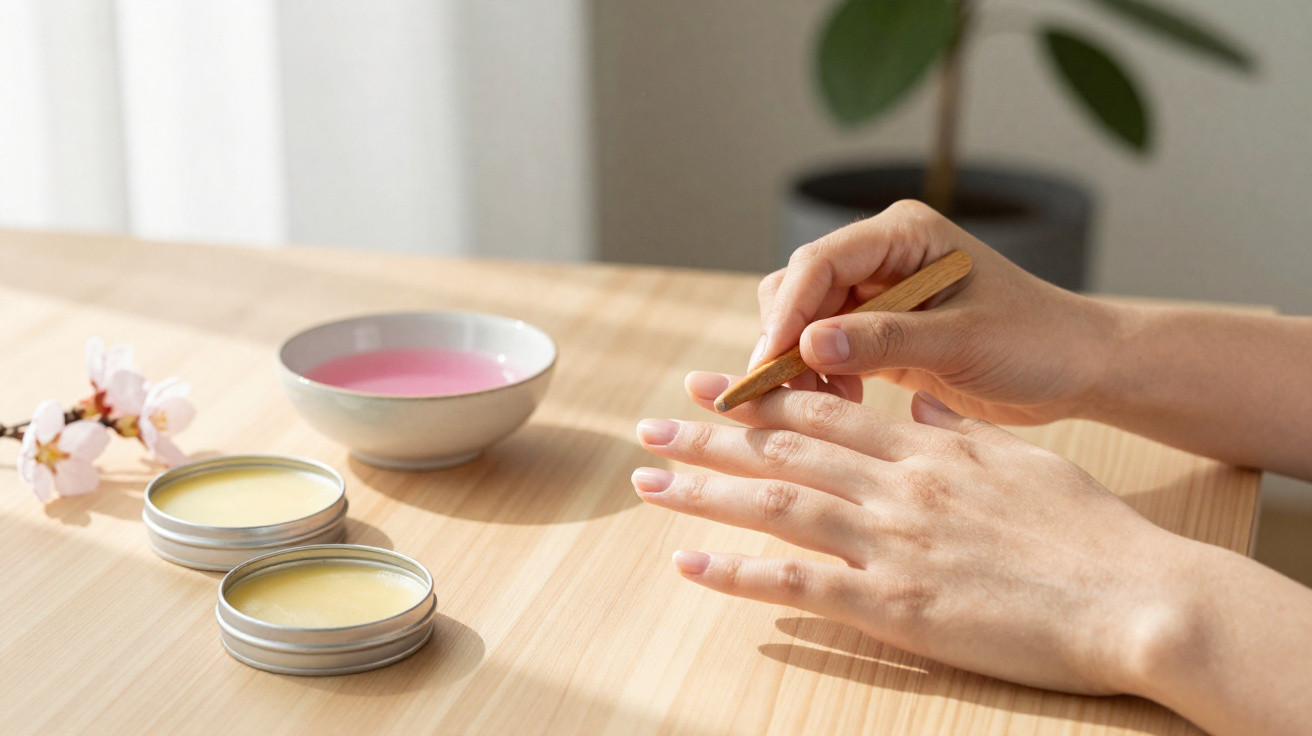
As gel extensions and intricate nail art start to lose their appeal, a quietly effective care ritual from Japan is taking centre stage: the Japanese manicure. Instead of bold colour, the focus is on nails that are healthy, resilient and naturally glossy – exactly what resonates with a generation that has had enough of constant salon appointments and brittle, damaged nails.
What the Japanese manicure really is
A Japanese manicure is not a new polish and not another “miracle coating” – it is a structured nail-care ritual. Everything revolves around the natural nail, with the aim of strengthening and rebuilding rather than covering up. The finish looks like freshly buffed pearls: a soft, rosy sheen that appears to come from within the nail itself.
At the heart of the technique is a rich paste blended with natural ingredients. It typically contains:
- Beeswax for protection and suppleness
- Keratin-rich components to reinforce the nail structure
- Minerals such as silica compounds from marine sources
- Vitamins that help nourish the nail from within
The paste is worked carefully into the nail and then “sealed” with a specialist powder. Buffing produces the signature shine – without a layer of varnish.
“The Japanese manicure relates to gel nails the way skincare relates to make-up: you build first, and the beautiful effect follows on its own.”
Step by step: how a Japanese manicure is done
If you want to try the trend in a salon or recreate it at home, it helps to understand the order of steps. The whole process is intentionally gentle:
- Gentle prep: Nails are trimmed, lightly filed into shape, and the cuticles are only carefully pushed back rather than aggressively cut away.
- Cleansing the nail surface: Instead of harsh files, fine buffing blocks are used to lift residue without damaging the nail plate.
- Massaging in the care paste: The nourishing paste is pressed into each nail with a soft tool or fingertips – like a deep-conditioning mask for hair, but for nails.
- Sealing with powder: A dedicated powder is applied and buffed in. This helps “lock in” the active ingredients and brings the shine to life.
- Finishing touch: A light hand and cuticle balm is usually applied at the end to complete the result.
The change is immediate: nails look rosier and smoother, reflecting light without appearing “painted”. Rather than feeling like an artificial layer, the nail feels firmer while still natural.
Why it fits 2026 so well
By spring 2026, one direction is hard to miss: a healthy body matters more than the loudest look. That shift runs through every corner of beauty routines – from skincare to haircare. The Japanese manicure aligns perfectly with this change.
Many women – and increasingly men – are tired of the same cycle: gel applied, then weeks later a painful removal, followed by weak, peeling nails, and then starting again. The Japanese method breaks that loop. Once you see that the shine comes from a strengthened nail, it is easy to wonder why you spent so long repeatedly applying plastics in the first place.
“The look is like ‘your own nails, only better’ – polished, elegant and understated.”
Comparison with gel, BIAB and classic nail polish
A common question is whether a care ritual can really be enough. Comparing it with the most popular methods makes the appeal clear.
| Method | Material | Durability | Impact on the nail |
|---|---|---|---|
| Gel nails | Synthetic polymers, cured with a UV lamp | 3–4 weeks, requires infills | High stress, frequent filing, nails often become thinner |
| BIAB & strengthening systems | Synthetic resins, partly cured with UV/LED | 2–4 weeks | Can dry the nail out, especially with long-term use |
| Classic nail polish | Solvent-based polishes | 3–7 days | Relatively gentle, removed with remover, can be drying |
| Japanese manicure | Natural waxes, minerals, vitamins | Shine 1–3 weeks, grows out with the nail | Rebuilding, strengthens the nail without an artificial layer |
Instead of worrying about an appointment every three weeks, the Japanese option simply lets the nail grow on. Nothing flakes off, nothing chips – the effect fades gradually over time, while the nail continues to become stronger.
Who is the Japanese manicure for?
This technique suits far more people than many expect. It can be especially helpful if you have:
- brittle, splitting nails after long-term gel or acrylic wear
- thin nails that quickly feel sore with standard filing
- job-related restrictions on bright colours, for example in healthcare
- a sensitive nail bed or a tendency to react to harsh products
Many people also choose a gentler approach during pregnancy and while breastfeeding. The Japanese manicure stands out here because it uses natural, food-grade ingredients. Nails still look neat and groomed, without relying on chemical additives.
“If your job won’t allow bright colours, this technique still gives you impeccably groomed hands.”
How long does the effect really last?
Depending on your nail type and daily wear and tear, the shine remains visible for one to three weeks. Because there is no artificial layer sitting on top, there is no typical “touch-up”. The nails simply keep growing, and the shimmer slowly moves towards the free edge.
If you want the effect consistently, plan a new treatment every two to four weeks. With each repeat session, more nutrients are deposited into the nail. Many users report that after a few months their nails feel noticeably harder, tear less often and grow more evenly.
Designs: only natural, or a hint of glam?
The core idea is natural and understated, but it does not have to be boring. Salons are increasingly pairing the Japanese manicure with minimalist nail design, such as:
- delicate micro-French lines in soft white or pastel shades
- a “glazed” effect using an extra-fine, pearly powder
- subtle highlights on just one accent nail
- transparent, ultra-thin embellishments that do not mask the natural look
The key principle remains the same: the nail can breathe. The base is always the care paste and powder, and any design is added only very lightly.
What to know before switching from gel to a Japanese manicure
If you have worn gel for years, switching can feel a bit like withdrawal. At first, nails may seem thinner, softer and more sensitive. That is not caused by Japanese nail care – it is the after-effect of previous methods.
A little patience helps in the first few weeks. Keeping nails shorter reduces the risk of breakage, and cotton gloves during housework add extra protection. With each session, another layer of nourishing ingredients builds within the nail plate. After two to three months, clear improvements usually show: fewer ridges, less splitting and noticeably better natural strength.
Risks, limits and useful add-ons
This method still has limits. If you are dealing with fungal infections, inflamed nail beds or serious skin conditions, it is best to seek dermatological advice first. Beauty trends are not a replacement for medical treatment.
Useful at-home habits to support a Japanese manicure include:
- massaging nail oil into the cuticles and nail plate daily
- wearing gloves for cleaning tasks and when handling chemicals
- a biotin- and mineral-rich diet to strengthen nails from within
- avoiding harsh removers with a high acetone content
When these basics are paired with regular treatments at home or in a salon, the trend becomes more than a seasonal phase. The Japanese manicure fits a lifestyle where less coating and more real substance matters – right down to your fingertips.
Comments
No comments yet. Be the first to comment!
Leave a Comment