
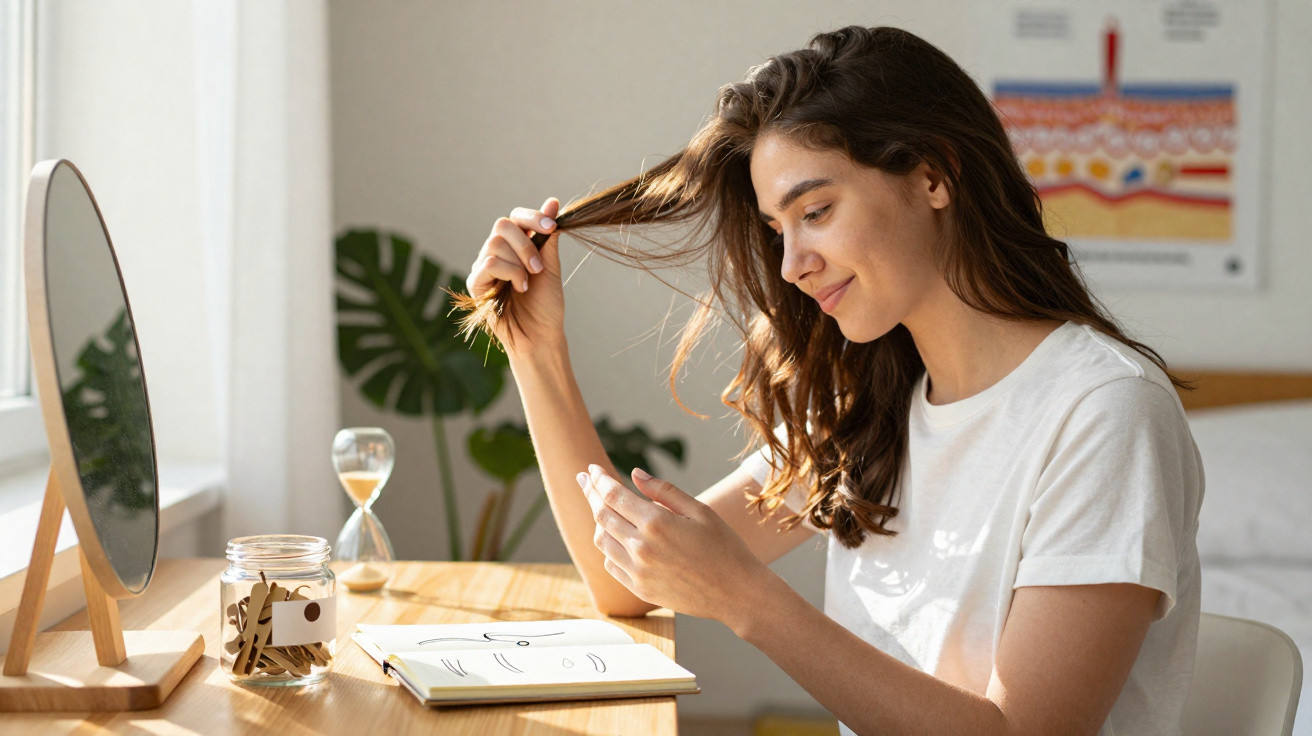
Across recorded history, hair and nails have helped signal identity and social standing. In a way, they are what distinguish the caveman from the businessman.
That is why, during the COVID lockdowns, many of us discovered a fresh appreciation for hairdressers and nail artists. Even Taylor Swift said she trimmed her own hair in lockdown.
But what if the effort of grooming started to feel like too much and we simply stopped? If we gave up haircuts and nail trimming altogether, would hair and nails just continue to grow?
They would. On average, the hair on our heads grows about 1 centimetre per month, and fingernails increase in length by a little over 3 millimetres over the same period.
Left entirely alone, both can reach remarkable lengths. Aliia Nasyrova - often referred to as the Ukrainian Rapunzel - holds the world record for the longest hair on a living woman, with locks measuring 257.33 cm.
For fingernails, the record belongs to Diana Armstrong from the United States, whose nails measure 1,306.58 cm.
Of course, most people have their hair cut and their nails clipped regularly (some more often than others). So why do some people’s hair and nails grow faster than others?
Remind me, what are they made out of?
Hair and nails consist largely of keratin. Both are produced by matrix cells beneath the skin, though they grow via different patterns of cell division.
Fingernails lengthen in a steady, continuous way from matrix cells located under the skin at the nail’s base. As these cells divide, they drive older cells forwards. As the new cells advance, they move over the nail bed - the flat surface beneath the nail that appears pink thanks to its plentiful blood supply.
Hair also originates from matrix cells, which ultimately create the visible part of the hair known as the shaft. The shaft is produced from a root beneath the skin, enclosed within a small sac called the hair follicle.
The follicle contains nerves (which is why plucking a hair can be painful), oil-producing glands that help lubricate the hair, and a tiny muscle responsible for making hair stand on end in the cold.
At the bottom of the follicle sits the hair bulb, which houses the crucial hair papilla that provides blood to the follicle.
Matrix cells close to the papilla divide to form new hair cells. These cells then harden into the hair shaft. As new cells are generated, they push the hair upwards beyond the skin surface, making the hair longer.
The papilla is also central to controlling hair growth cycles. It sends signals that prompt stem cells to move to the follicle’s base and create a hair matrix. The matrix cells then receive signals to divide, triggering a fresh growth phase.
Unlike nails, our hair grows in cycles
Researchers describe hair growth as moving through four phases:
- Anagen (growth phase), lasting between two and eight years
- Catagen (transition phase), when growth slows, lasting around two weeks
- Telogen (resting phase), when growth stops entirely, usually lasting two to three months
- Exogen (shedding phase), when the hair falls out and is replaced by new hair from the same follicle - restarting the cycle
Hair growth cycle. (Iv__design/Getty Images)
Over its lifespan, each follicle repeats this cycle 10–30 times.
If every follicle progressed at the same pace and entered the same phases at the same time, we would periodically all become bald. That is not what happens: at any moment, roughly one in ten hairs is in the resting phase.
Although we shed around 100–150 hairs each day, the typical person has about 100,000 hairs on their head, so this normal loss is barely noticeable.
So what affects the speed of growth?
The strongest influence is genetics. Growth rates differ from person to person, but they are often similar within families.
Genetics also shapes nail growth. Brothers and sisters - particularly identical twins - frequently show comparable nail growth rates.
Still, other factors matter too.
Even in healthy people, age affects both hair and nail growth. Growth tends to be quicker in younger people, because metabolism and cell division slow with ageing.
Hormones can also shift the pace. Pregnancy commonly speeds up hair and nail growth, whereas menopause and elevated levels of the stress hormone cortisol may reduce growth rates.
Diet influences strength and growth as well. While keratin is the main component, hair and nails also contain water, fats and a range of minerals. Because hair and nails continually lengthen, those minerals must be replenished.
For this reason, eating a balanced diet with enough nutrients to support hair and nails is important for keeping them healthy.
If key nutrients are lacking, hair loss and nail breakage may become more likely, either by disrupting the growth cycle or by weakening structure. For instance, iron and zinc deficiencies have both been associated with hair loss and brittle nails.
This helps explain why thick hair and strong, neatly maintained nails have long been linked with perceptions of good health and high status.
However, perception is not always reality.
No, hair and nails don't grow after death
One enduring myth - sometimes tied to vampire legends - claims hair and nails continue to grow after death.
In fact, they do not. Instead, as the body dries out after death, the skin contracts. This shrinkage makes hair and nails look longer.
Morticians know this effect well, and some will inject tissue filler into the fingertips of the deceased to reduce the appearance.
So, whether alive or dead, it seems there is no avoiding the ongoing task of looking after hair and nails.
Michelle Moscova, Adjunct Associate Professor, Anatomy, UNSW Sydney
This article is republished from The Conversation under a Creative Commons licence. Read the original article.


Comments
No comments yet. Be the first to comment!
Leave a Comment