
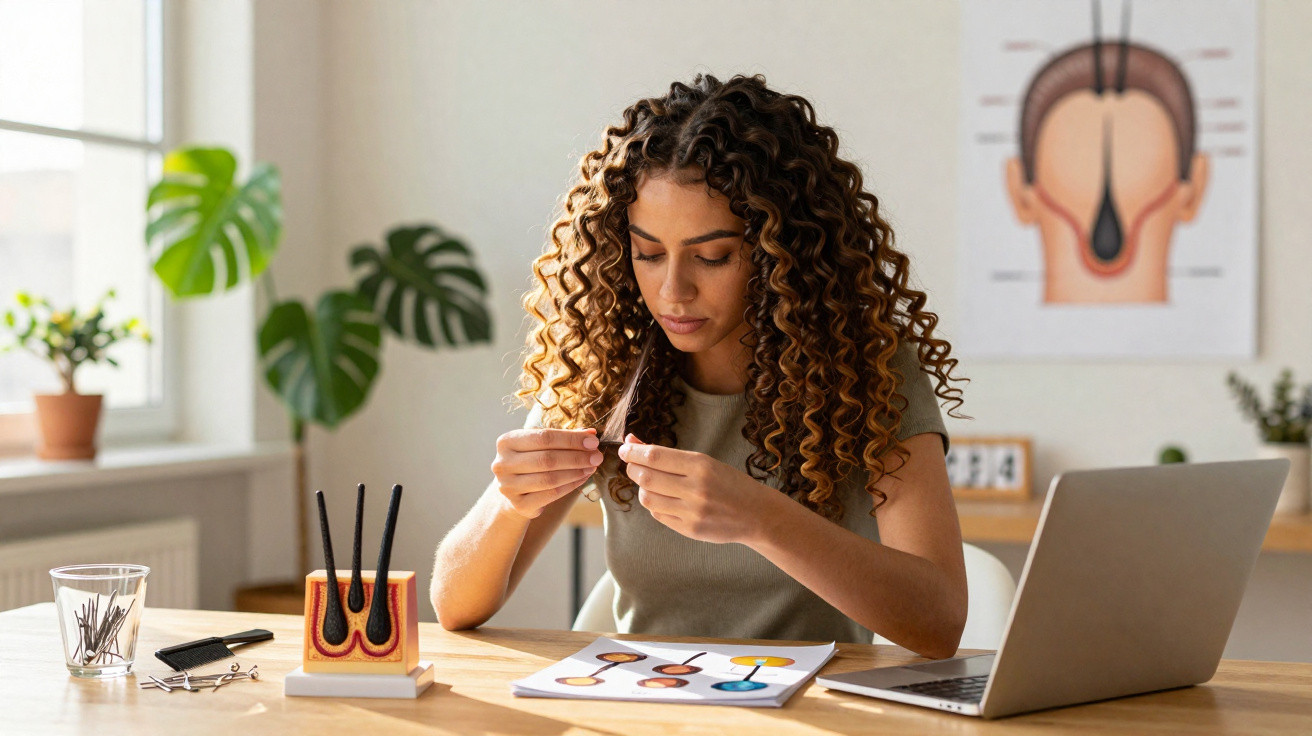
If you are fed up with hair that hangs pin-straight or curls that refuse to behave, the reason is not simply down to how you wash and dry it - or even the heat and humidity around you.
What matters starts beneath the surface of your skin, in the vast number of tiny follicles packed across your scalp.
Where curly hair and straight hair begin: hair follicles in the scalp
Back in 2005, researchers dissected human scalp follicles and discovered that, in people with curly hair, the bend is taking shape before the hair even exits the head and falls over the scalp.
From that work, the team inferred that curliness versus straightness is essentially set by the follicle bulb itself.
Since then, closer studies of hair follicles have added further detail to the science of curly hair.
This is the current picture, based on what evidence suggests so far.
Each scalp hair develops inside a follicle under the skin and, over time, pushes out through a pore.
When a follicle sits upright, the strand that emerges tends to be straight.
If, instead, the follicle curves - rather like the shape of a golf club - the newly forming section of hair is produced with a bend. It is a bit like a 'mold', though the biology is more involved.
More recent findings indicate that cells on one side of that 'mold' may divide and mature differently compared with cells on the other side.
As a result, keratin and other components are not distributed evenly all the way around the strand.
That unevenness creates an asymmetrical fibre that is more prone to kinking and curling in a particular direction.
By comparison, follicles that generate straight hair tend to be built more symmetrically.
Evidence from 2005 and the 2019 review on curl patterns
There is still plenty we do not understand about why hair curls. However, a 2019 review of the research concluded that although the make-up of an individual hair can influence how coarse it is and what it feels like, the deciding factor for whether hair grows out coiled, kinked, or straight is the shape of the follicle.
Once a hair leaves the scalp and flows away from the head, it largely keeps the form set by where it grew.
Because follicle structure is inherited, people often end up with hair types that resemble those of relatives.
Hair follicles are remarkably intricate, containing stem cells, blood vessels, and glands - all contributing to the assembly of the fibrous strands we see as hair.
After those strands emerge from the skin, they are effectively biological ropes: the cells are no longer dividing or maturing. What remains is, for the most part, a dead keratin fibre - but the time it spent inside the follicle has already shaped what it will be.
Hair type, ancestry, and what the science does (and does not) support
Hair is frequently grouped by race, yet the science does not back that kind of classification.
Instead, the 2019 review argues that every population - regardless of ancestry - contains a range of hair shapes, even if certain curl patterns appear more often within some genetic lineages than others.
Why different hair follicles may have evolved: 2023 thermal manikin tests
So why do we have such varied follicles at all? Scientists still cannot give a firm answer, but emerging evidence supports the idea that scalp hair evolved to help keep us cool.
In experiments published in 2023, researchers placed a wig of human hair on a thermal manikin inside a climate-controlled chamber. They found the manikin absorbed less heat with hair than when it was bald.
The team tested several wig types, including straight hair, loose curls, and tight curls.
All of the wigs helped cool the head, but curled hair performed best at shielding the manikin from 'solar' radiation coming from above.
It is a compelling proposal, although working out the evolutionary benefit of particular traits - including hair - can be extremely difficult.
Tracing those origins and sifting the evidence remains a challenge scientists are still working through.
This article was fact-checked by Michael Irving and edited by Rebecca Dyer. While we pride ourselves on our process, we are only human. If you spot a mistake, please let us know.





Comments
No comments yet. Be the first to comment!
Leave a Comment