
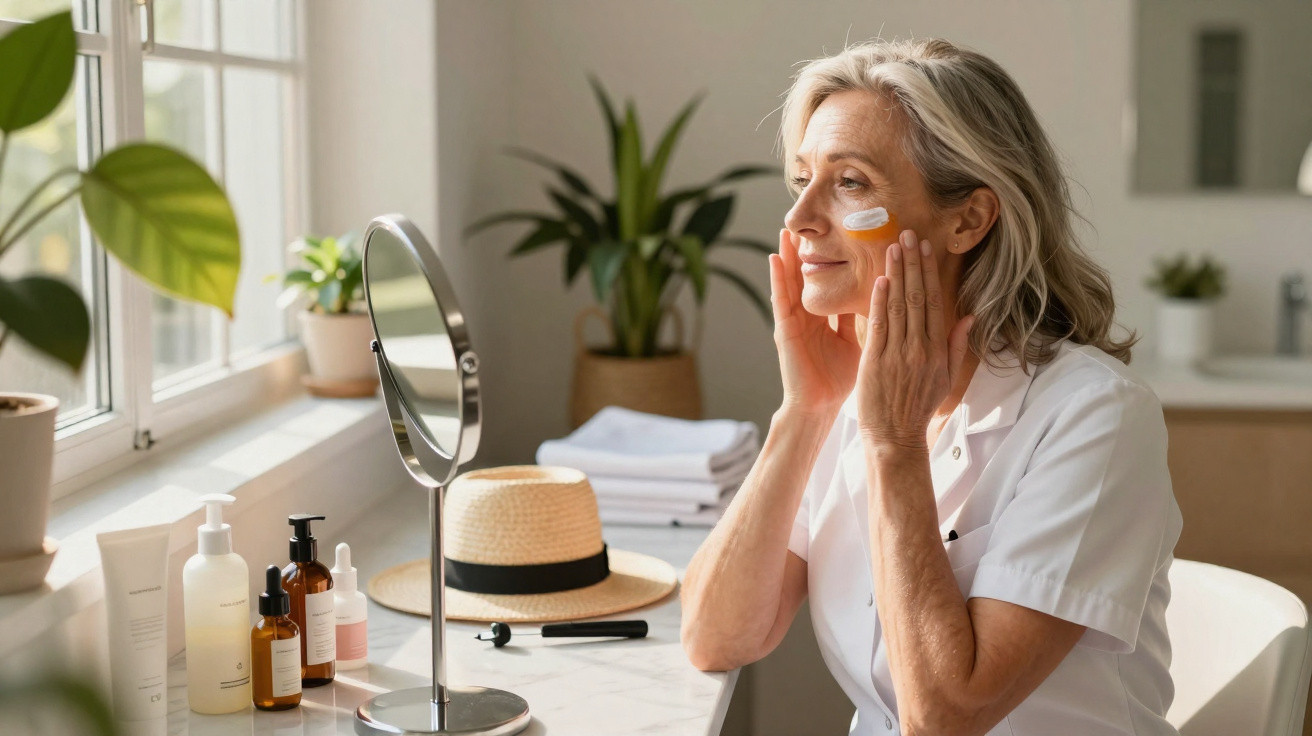
There’s a hushed second in front of the bathroom mirror-somewhere between brushing your teeth and telling the kids to stop yelling through the door-when you catch it: your face looks… changed.
Not “bad”, not “old”, just not quite the same face that sprang back after late nights and budget makeup wipes. Your 40s and 50s will do that. The skin you’ve worn for decades starts to answer you back: a touch drier, a touch softer along the jaw, with lines that don’t fully disappear once you stop smiling. You might poke at your cheeks, narrow your eyes at your forehead, and wonder whether everyone else quietly levelled up their skincare while you were just trying to remember which day the bins go out.
So I asked the people who spend their days looking at faces-who, quite literally, examine collagen for a living: dermatologists in their 40s and 50s. Not for a press release or a product plug, but to put a slightly cheeky question to them: what do you genuinely do to your own skin, day in, day out? Their answers were strikingly straightforward, unexpectedly disciplined, occasionally a bit chaotic-and oddly reassuring.
The morning mirror: what dermatologists really start with
When I asked a London dermatologist in her late 40s what she does first, she laughed and said, “Coffee.” Then she amended it: “Face, then coffee, or I’ll never do it.” Her morning begins in the least glamorous way: a splash of lukewarm water and a mild, non-foaming cleanser-nothing that smells like fruit salad, pudding, or anything engineered for Instagram. A dermatologist in Manchester told me she’s stuck with the same chemist’s own-brand cleanser for 15 years. “It’s boring,” she said with a shrug, “which is exactly why my skin likes it.”
The shared “secret” is that they aren’t scrubbing. No steaming-hot flannels, no harsh spinning brushes racing over cheeks at 7am. The word that comes up repeatedly is “barrier”-an invisible, slightly nerdy concept they treat as though it’s an heirloom. In your 40s and 50s, that barrier can be thinner, drier, and more reactive. Strip it too aggressively in the morning and the rest of your routine turns into damage limitation, not calm upkeep.
The three-step rule most of them quietly follow
Once their skin is clean-but never squeaky-the routine is almost uncannily consistent: antioxidant, moisturiser, sunscreen. That’s it. Brands vary and the prices range from £12 to “don’t ask”, but the structure barely shifts. One dermatologist in her early 50s told me she leaves her vitamin C serum beside her toothbrush, “because if it isn’t staring at me while I brush, I’ll skip it.” And honestly, almost nobody nails this every single morning without fail, experts included.
Vitamin C comes up again and again. They rate it highly, but they’re careful with it. In your 40s and 50s, when pigmentation and dullness start turning up like uninvited guests, that morning brightening step becomes non-negotiable for many. But it’s a few drops, not half a pipette, and they aren’t chasing a sting. A dermatologist in Bristol told me she intentionally chooses mid-strength options, “because I like my face, I don’t want to fight it every day.”
SPF: the one non-negotiable they treat like brushing their teeth
Every dermatologist I spoke to-without a single exception-winced when I asked how often most people use sunscreen. There was a tiny, collective sigh. For them, SPF in your 40s and 50s isn’t a summer-only extra; it’s daily, like underwear. “If I’m walking to the bin, I’m wearing SPF,” said one 51-year-old consultant, only half joking. And they’re not dabbing on a token layer of factor 15: they mean broad-spectrum SPF 30 or 50, whether it’s raining, blazing, at the office, or on the beach.
What surprised me was how hands-on they are with application. They use more than you’d expect-the two-finger rule, or about half a teaspoon for face and neck. One dermatologist described her quick routine in the lift at her clinic: patting sunscreen down to her chest and smoothing it behind her ears. That detail matters; the sheer number of times they all brought up “neck, ears, hands” felt like a gentle scolding. Those are among the first places that reveal age-and the first most of us overlook.
Finding a formula they can actually live with
They also admit-quite openly-to a touch of vanity. They aren’t saints. If a sunscreen pills under make-up or makes them look ghostly in clinic photos, it’s out, no matter how flawless the filter technology looks on paper. So they trial, swap and retry. Many settle on lightweight gel-cream SPFs with a slight glow-something pleasant to apply at 7am while the world still feels half-asleep. One told me, “I’d rather a good SPF 30 every day than a ‘perfect’ SPF 50 I wear twice a month.”
We’ve all had that holiday experience where the SPF you thought was fine turns your face into an oil slick by lunchtime. Dermatologists hate that too. They’re simply quicker to cut their losses; they ditch disappointing products fast. Their midlife lesson is straightforward: sunscreen only protects you if you like it enough to apply plenty of it, every morning, without having to argue with yourself.
Night-time: where the real work gets done
If mornings are about defence, evenings are when dermatologists quietly get more ambitious. This is the slot for retinoids, acids and those big, glossy promises-handled with restraint. A dermatologist in her mid-40s compared her night routine to “laying out clothes for tomorrow, but for my face.” There’s a sense of preparing ahead: undoing the day’s wear, encouraging renewal, and replenishing what skin simply produces less easily now.
Step one is always removing the day properly. No half-hearted face wipes tossed towards the bin. If they’ve worn make-up or sunscreen, many double cleanse: first a balm or oil cleanser to dissolve everything, then a gentle gel or cream cleanser to clean the skin underneath. One said she does it “so my retinoid hugs skin, not old mascara.” It sounds a bit intense-until you remember how often you’ve woken up with yesterday’s eyeliner still sitting along your lower lash line.
Retinoids: the quiet non-negotiable after 40
Here’s where it becomes serious. Retinol or prescription-strength tretinoin forms the backbone of almost every dermatologist’s routine in their 40s and 50s. The rationale is textbook-collagen support, smoother texture, fewer fine lines-but their approach is anything but macho. Nobody is trying to “push through the peel.” They’re cautious, systematic, and surprisingly gentle with their own faces.
Most use a pea-sized amount across the whole face, two to five nights a week depending on how reactive their skin is. Several rely on the “sandwich method”-moisturiser, then retinoid, then a thin layer of moisturiser again-especially when skin feels tight, or when cold weather and central heating ramp up dryness. One dermatologist told me, “I’d rather use a lower strength forever than a high one for three months and give up because I’m miserable.” The unglamorous truth is that consistency beats bravado.
On nights without retinoids, they prioritise recovery: fragrance-free moisturisers, ceramide-rich creams, and sometimes a plain hydrating serum. It’s skincare’s version of pulling on something soft and turning the noise down. They know that in your 40s and 50s, tolerance can swing with hormones, stress, or even a single poor night’s sleep. So they build flexibility into the routine instead of pretending their skin behaves the same way every evening.
Exfoliation, but calmer than your Instagram feed
If social media is to be believed, everyone is acid-peeling three times a week and stepping out with “glass skin”. Dermatologists in their 40s and 50s do exfoliate-but with far less drama. Most use chemical exfoliants (such as lactic or salicylic acid) once or twice weekly at most, and almost never on the same nights as retinoids. The phrase “angry skin” crops up repeatedly. They spend their working lives settling it down; they’re not keen to rile up their own.
One consultant dermatologist told me she moved entirely from glycolic to lactic acid in her late 40s. “My skin suddenly decided it hated being shouted at,” she said. Lactic tends to be gentler and more hydrating, and in midlife that can matter more than a hardcore “burn and peel” effect. They’ll often reach for exfoliation when skin feels rough, foundation starts catching around the nose, or sun spots look more obvious. It’s a targeted nudge rather than a rigid weekly ritual.
They also steer clear of the exfoliation “stack” many of us slip into-toner, serum, mask, pad, all in one night. They choose one, not all four. Several admitted that many “mystery rashes” seen in clinic are self-inflicted: too much exfoliation on already-thinning, perimenopausal or menopausal skin. Their own faces taught them early, which is why they deliberately err on the side of boring.
The small, unglamorous habits that make a big difference
When dermatologists talk about their skin in their 40s and 50s, they don’t only talk products. They talk about sleep-often the shortage of it-and how their cheeks look flatter after too many nights with blue light glowing near the pillow. One told me she can “read her month” in the mirror: the exhausting weeks show up under her eyes before they show up in her inbox. None of them pretend that eight hours and zero stress is realistic, but they do negotiate with real life: less wine on weeknights, water on the desk, and grabbing an extra hour when they can.
There’s also an almost universal commitment to plain, gentle moisturising. A thick hand cream kept in the car. Lip balm within reach of the sofa. Unscented body lotion applied while the bathroom is still steamy. One dermatologist laughed that her 25-year-old self used to ignore body care entirely: “Now my shins itch if I so much as look at a radiator.” The skin below the neck ages too, and they treat it with a kind of resigned softness.
Hormones, honesty and the lines they don’t try to erase
In midlife, hormones enter the conversation and refuse to leave. Dermatologists feel it as well: jawline breakouts, sudden dryness, hot flushes that leave a faint redness on the chest. Many of the women I spoke to mentioned speaking with their GP or a menopause specialist, not just rotating serums. Their point is blunt: there’s only so much a cream can do if your oestrogen has fallen off a cliff.
What stayed with me most was how they speak about lines. None of them is pretending they aren’t ageing. Some have fillers, some have Botox, and some do nothing beyond a chemist’s moisturiser and reliable SPF. One dermatologist in her early 50s said she’d made a deliberate choice to “age like herself” - keep the lines that come from laughter, and soften only the ones that make her look tired when she isn’t. In a world that keeps yelling about “ageless” skin, that honesty feels unexpectedly calming.
The real routine: less perfection, more relationship
Put it all together-gentle cleansing, vitamin C, non-negotiable SPF, and respectful retinoids-and you don’t end up with a 10-step miracle. You end up with something quieter: a rhythm, a relationship with skin that’s been around long enough to have opinions. Dermatologists in their 40s and 50s aren’t chasing flawlessness; they’re aiming for cooperation. They want skin that behaves, recovers, and mirrors how they feel as truthfully as possible.
The main lesson from their routines isn’t a shopping list; it’s an attitude. They speak to their skin like an old friend rather than a DIY project. On difficult nights, they strip it back to cleanser and moisturiser. On better weeks, they add an extra retinoid night or a mild mask and enjoy the glow. There’s room for fluctuation, for hormones, for ordinary life. Nobody’s getting sacked for skipping toner.
And perhaps that’s the quiet comfort in seeing how dermatologists treat their own faces in their 40s and 50s. They don’t have mystical DNA or secret clinic potions. They have science, patience, and a practical kindness towards their own reflection. The precise routine matters less than the fact they stick with it-imperfectly-for years. In the steam of the bathroom mirror and the soft click of a serum bottle, they aren’t trying to rewind time-just to move forward, feeling at home in the skin they’re still learning.





Comments
No comments yet. Be the first to comment!
Leave a Comment