
Her stylist lifted a photo on her phone. Not a Kardashian, not a TikTok name. A grainy black-and-white image from 1966: flicked-out ends, a soft crown, and a fringe with a touch of defiance.
The mood in the salon changed. Two women looked up from their magazines. One murmured, “Oh my god, the flip is back?” The stylist chuckled. “Not just back. 2026 is going to be its year.”
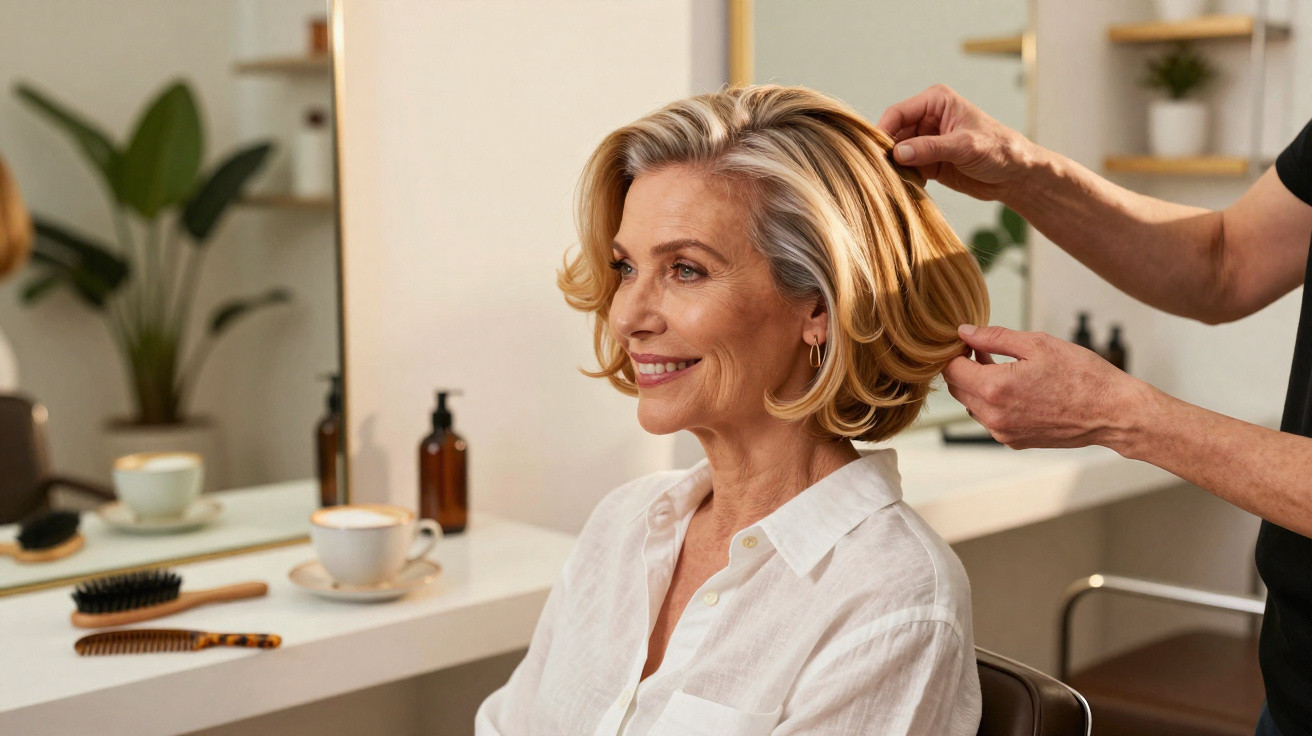
When the scissors got going, the woman in the chair straightened without thinking. Her jaw suddenly read cleaner. Her eyes looked more awake. This wasn’t merely a trim; it felt like stepping through a time tunnel-only with better products and a wiser gaze.
She walked out wearing a modern 1960s flip and a stride that said: I remember who I am.
And that’s where it really begins.
The 1960s flip: why this “old” cut suddenly feels new after 50
Step into any style-led salon right now and it’s there on the boards: the refreshed 1960s flip. Shoulder-skimming layers, ends turned outwards, and a fringe you can part or sweep aside. It’s not the rigid TV “helmet” of decades past-more relaxed, lighter, and full of air.
On women after 50, the effect is quietly bold. It reveals the face rather than covering it. It frames laugh lines instead of acting as though they shouldn’t exist. And it brings back that little swing when you turn your head-like your hair has a point of view again.
Stylists describe it with something close to relief. At last, a cut that isn’t trying to make a 55-year-old resemble a 25-year-old. Instead, it sharpens what’s already there, making her look like the most striking version of her real age. That’s exactly where the trend is heading for 2026.
In a London salon last autumn, a stylist called Jess had three appointments in a single week with women over 60 asking for “something like Jane Fonda in the 60s, but not costume-y.” They weren’t using the term “flip”. They were chasing a feeling: lightness, lift, and a hint of rebellion without raising its voice.
Jess began sharing before-and-after shots on Instagram: shoulder length, gentle volume at the crown, a side-swept fringe, ends grazing the collarbone and flicking out. Her followers in their 20s saved the posts. Her followers in their 50s forwarded them to their hairdressers with “THIS, please” in all caps.
By early 2025, surveys from major salon chains in the US and the UK reported a jump in requests for “mid-length layered cuts with outward flip” among women aged 48–65. No one was calling it a comeback yet. People simply recognised something familiar that still felt oddly current-like finding a song you loved years ago and hearing it again, newly remastered.
Some of the 1960s flip’s pull after 50 is emotional. It draws on a decade linked with change and self-definition. For many women, the 60s were the era when they saw older sisters or their mums try shorter hemlines and bolder hair. Even if you never wore a mini skirt yourself, the memory sits somewhere in the collective body.
There’s also a straightforward visual trick behind it. Flipped ends lead the eye outwards and up, rather than down the neck. That outward sweep lifts the whole facial outline. Beauty brands promise a similar result via elaborate contouring and expensive skincare; a well-cut flip can create it with a round brush and intelligent layering.
With 2026 nearing, trend watchers are emphatic: hair is shifting away from heavy, flat slabs of length. The modern flip is about air, movement, and edges that say: I’ve lived-and I’m still going.
How to wear the 2026 flip after 50 without looking “stuck in the past”
The modern flip’s real engineering comes down to length and layers. Go too short and it reads as strict retro. Leave it too long and the ends lose their bounce and begin to fall. For most women after 50, the most flattering range sits between the base of the neck and the top of the shoulders.
Tell your hairdresser you want soft, graduated layers that lighten towards the tips-never blunt, choppy hacking. The goal is for the hair to naturally want to kick out when it meets your shoulders or collar. A long, slightly textured fringe that you can part or sweep to the side keeps the look current and makes it easy with glasses.
For styling, skip the stiff 1960s rollers. A medium round brush, a light volumising spray at the roots, and a smoothing cream through the ends will do the job. Blow-dry the hair mostly straight, then turn only the final 2–3 centimetres outwards. Two passes, not ten. It should still move when you shake your head.
After 50, it’s tempting to define a “safe” haircut as one you can forget about. In practice, hair that’s completely neglected often ages you more. The new flip asks for a small daily gesture, not a boot-camp routine: a quick blast at the crown for lift, and a gentle re-bend of the ends if they’ve been flattened overnight.
Hairdressers notice a repeat pattern: women sit down and say, “I want low-maintenance.” Underneath, it can mean, “I don’t want to have to ask too much of myself.” Work, life, caring responsibilities-they’re exhausted. Cut properly, the flip can be low-effort, but it still signals: I give myself five minutes in the morning. That counts.
Let’s be honest: nobody truly does it every single day. You’ll have pinned-back days, messy-bun days, hat days-and that’s fine. The shape is forgiving. Even on the lazy days, the layers keep the outline energetic, and when the flip softens into a wave it still looks intentional. Perfection is less compelling than movement.
“Women after 50 don’t want ‘anti-ageing hair’,” says colorist and stylist Maya R. “They want hair that agrees with them. The flip works because it’s nostalgic without freezing you in a time capsule. It says: yes, I remember the 60s… and I’ve moved on.”
To make the flip feel like you, think in small personal codes rather than trying to replicate a celebrity photo.
- Soft, warm highlights around the face if your skin tone needs brightening.
- A slightly choppier fringe if your look leans arty or rock.
- A sleeker, near one-length flip if you dress in a minimalist style.
- Extra lift at the crown if you want that subtle “mini facelift” effect.
The one genuine misstep is making it too rigid: ends that are frozen in place, lacquered volume, or colour so flat it reads like a wig. Hair after 50 tends to look best with softness, micro-tones, and a little motion. The 1960s flip of 2026 isn’t about copying an era-it’s about quietly rewriting it on your own head.
More than a haircut: what the flip says about ageing in 2026
Watch a woman over 50 take in her fresh flip in the mirror and you’ll spot something understated. It’s less “I look younger!” and more “I look like me again.” Different feeling-less fantasy, more homecoming.
At a deeper level, this cut is landing at a particular cultural moment. Generations raised with firm ideas about what “respectable” hair should be after 50 are now challenging the script. Shoulder length with slightly rebellious ends, a fringe that drops towards the eyes-this isn’t the hair of someone quietly exiting the stage. It’s the hair of someone turning a page, not closing the book.
There’s an emotional backdrop to it, too. On a busy Tuesday-between emails, appointments, and family messages-booking a new cut can feel almost indecently self-focused. We’ve all had that moment of catching ourselves in a shop window and wondering: when did I start to fade a little? A flip won’t fix your life, but it can make the person living it more visible to herself.
Stylists also report a shift in what gets discussed in the chair when women ask for the flip. The conversation stops being only about greys and thinning hair. It becomes about starting a business in your 50s, dating again, learning to say no. Hair turns into shorthand for that internal renegotiation.
A cut from the 1960s returning in 2026 is more than fashion cycling back around. It’s a quiet insistence that not everything from the past belongs in the loft. Some ideas mature beautifully: freedom, play, and the right to take up a bit of space in a room-fringed, flicked, and fully present.
So if that 1966 photo keeps appearing in your feed and tugging at you, don’t brush it off as a silly trend. It might be your future self tapping you on the shoulder.
| Key point | Detail | Why it matters to the reader |
|---|---|---|
| Ideal length | Between the base of the neck and the shoulders, with soft layering | Helps you picture a cut that suits a face after 50 |
| Modern “flip” style | Tips turned slightly outwards, supple movement, not stiff | Avoids a dressed-up retro look and keeps it feeling current for 2026 |
| Realistic upkeep | A few minutes with a round brush and light products | Makes the routine doable without feeling overwhelmed |
FAQ:
- Is the 1960s flip flattering for all face shapes after 50? In most cases, yes, because the updated version can be tailored. Rounder faces usually suit a slightly longer length with a side fringe, while square faces look softer with extra layers around the jaw.
- Can I wear the flip if my hair is thinning? Yes. Fine layers plus a touch of root lift can create the appearance of more density, especially when paired with subtle highlights.
- Does the flip work on curly or wavy hair? It can, provided your stylist shapes it on your natural texture rather than on hair that’s been blow-dried straight. The “flip” reads more like a buoyant outward curve.
- How often should I trim a 1960s-style flip? Every 6 to 8 weeks keeps the ends lively and the silhouette intentional without making it feel high-maintenance.
- Will this trend still look current in a few years? The underlying structure is classic, so small adjustments to the layers or fringe can keep it relevant even as headline trends change.



Comments
No comments yet. Be the first to comment!
Leave a Comment