
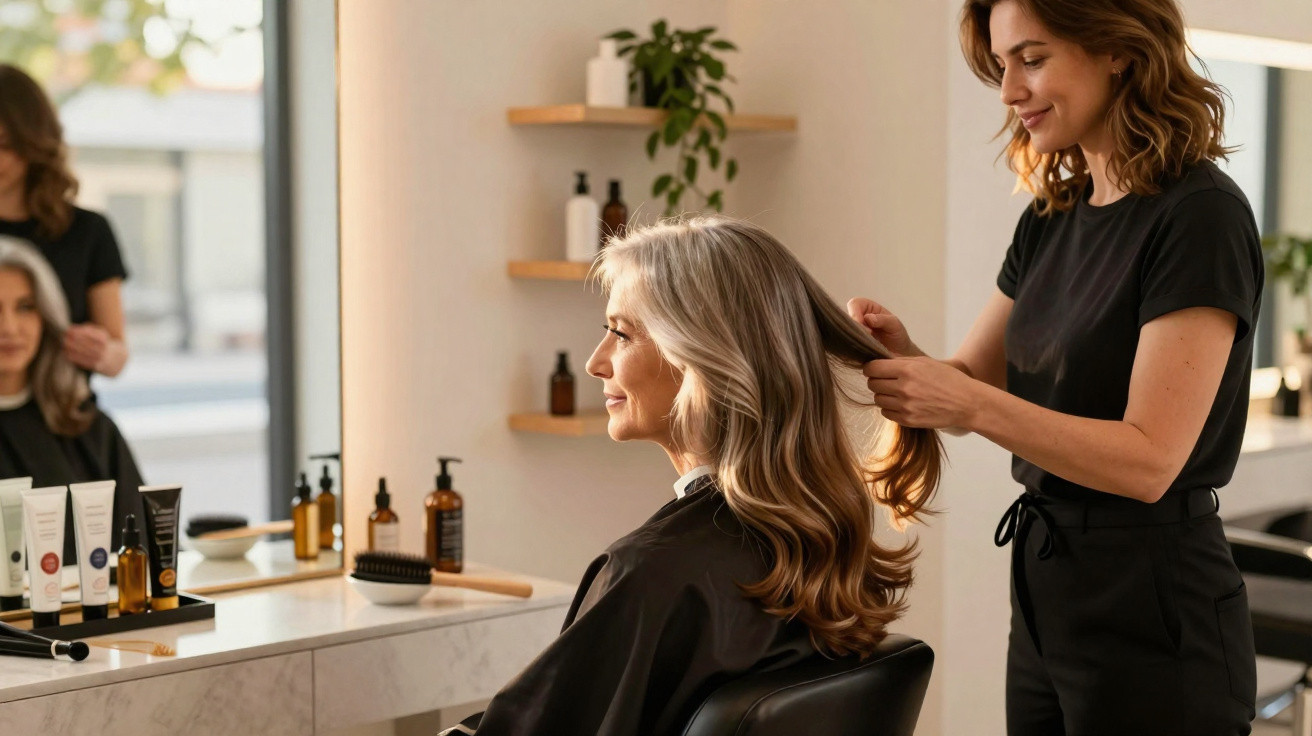
On Tuesday mornings, my salon fills up with women in their 50s. They walk in juggling supermarket bags, laptop sleeves, trainers, and a thousand queries about hair colour. One settles into my chair, slips off her scarf, and murmurs the line I hear week after week: “Be honest… does this color age me?”
For a beat, the mirror feels like it’s holding its breath.
I watch the same pattern play out: stunning women disappearing behind dye that’s too dark, highlights that have gone dry and brittle, or a box colour that promised “chocolate” online and delivered near-black at home.
They’re not trying to look 20. They simply don’t want to look worn out.
That’s what people are really reaching for when they ask about “anti-ageing” colour.
The turning point: when your old hair colour stops working
There’s often a point - usually around 50 - when the shade you’ve worn for years suddenly looks… wrong.
The colour you adored in your 30s can start reading as severe, lifeless, or oddly artificial against your skin.
I notice it most when someone sits down and says, “I don’t know what changed, but my face looks different.”
On paper, their hair might not have shifted dramatically - but everything surrounding it has: skin texture, undertone, how clear the eyes look, even the way light reflects across the face.
The reality is that your 50s aren’t the decade to grip tightly to the exact shade in your wedding photos.
They’re the decade to adjust and refine.
One of my clients, Claire, arrived with almost-black box dye sitting on top of 60% grey.
She’s naturally light brown, but years of “saving time” with supermarket kits had left her hair looking like a dark, solid helmet.
She told me people kept asking whether she was exhausted or cross.
She wasn’t - the colour was simply pulling her whole face downward.
Over a few appointments, we carefully lifted out the heavy darkness, then created a softer medium brown, adding warmer, lighter pieces around her face.
When I turned her back towards the mirror, she didn’t look “younger” in a cliché, before-and-after way.
She just looked like herself again.
What really shifts in your 50s is the level of contrast in your features.
Grey hairs soften the natural depth around the face, brows can look lighter, and skin often loses some of its rosy colour.
So if the hair stays very dark and one-note, it begins to dominate everything else.
At the other extreme, going too pale or too ashy can drain the complexion and make it look dull - even unwell.
At this stage, colour is all about balance.
You’re not “at war” with your grey; you’re learning how to work with it.
The best colour in your 50s doesn’t shout - it quietly lights up your face.
The method I always come back to in the salon chair
When a woman in her 50s asks for guidance on hair colour, I begin with a single principle: soften the line.
In practice, that means reducing harsh contrasts, avoiding thick, solid blocks of dye, and creating smoother transitions.
Rather than one opaque, uniform shade, I look for a base that sits within two tones of your natural level.
Then I add lighter ribbons around the face and through the lengths - particularly in the areas the eye naturally focuses on.
Think “a veil of light”, not “chunky highlights”.
The aim is that people notice your eyes first, not your regrowth.
We also talk - plainly, without fuss - about upkeep.
Chasing full grey coverage every three weeks is a marathon, not a sprint.
So I frequently recommend approaches such as blurred-root techniques, delicate babylights, or lowlights threaded through the grey rather than battling every individual strand.
That way, as the roots come in, the line stays softer, and you’re not counting down to your next appointment like a deadline.
And, honestly, nobody manages perfection every day.
Women always nod when I say it, because feeling pressured to be “flawless” at 53 is draining.
Your hair colour should fit around your life - not the other way round.
“As your hairdresser, my best advice in your 50s is this,” I tell clients. “Don’t chase the exact color you had at 25. Chase the light on your face when you’re well rested and happy - then we color for that.”
I often distil my main guidance for women in their 50s into a short checklist:
- Go one to two tones lighter than your old default shade to soften the look of your features.
- Prioritise dimension over a single flat colour: blended tones read more natural.
- Respect your natural warmth rather than forcing ultra-ashy shades that can look lifeless.
- If you do colour at home, use professional products or professional advice to prevent build-up and breakage.
- Plan your maintenance rhythm realistically so the grow-out looks intentional and graceful.
These small choices add up to a major difference: colour that suits the woman you are now.
Colour as a conversation with who you’re becoming
What stays with me in the salon isn’t the before-and-after collage.
It’s the instant a woman in her 50s catches her reflection and says, “This feels like me again,” with that quiet, surprised smile.
At this age, hair colour isn’t about deleting time.
It’s about changing the story you’ve been repeating to yourself every time you look in the mirror.
For some, that means keeping 30% of their grey and weaving colour through it.
For others, it’s soft caramel lights over natural brown.
And for some, it’s remaining dark - but making it lighter, glossier, and less “helmet-like”.
If you’re colouring your hair in your 50s, the real question isn’t “What’s the trend?”
It’s “What energy do I want to bring into a room?”
You’ve earned the right to go bolder, softer, silver, brunette, copper - anything - as long as it works with your skin, your lifestyle, and your tolerance for upkeep.
We all know that moment when the bathroom light feels like the enemy and you’re convinced your colour betrayed you overnight.
The good news is, it’s almost never beyond saving.
A few smart tweaks, gentler tones, and a less rigid idea of “covering” grey can shift everything.
Your hair stops demanding attention and starts supporting you.
The simplest advice I give - and the same advice I’d give you if you were sitting in my chair - is this.
Look at your reflection as though you’re meeting yourself for the first time.
Let go of the colour you “always” had. Pay attention to your eyes, your skin, and the natural silver coming through.
Then choose a shade that complements that face, that story, that season.
Your 50s aren’t a problem to be fixed at the roots.
They’re a new palette - and your hair, coloured or not, is one of the easiest places to start painting in a new way.
| Key point | Detail | Value for the reader |
|---|---|---|
| Soften your colour | Choose shades one to two tones lighter, with gentle dimension rather than flat, dark coverage | Lifts the face and reduces a harsh or tired effect |
| Work with grey, not against it | Blend, blur, or highlight around natural greys instead of insisting on full coverage | Regrowth is less obvious, appointments can be spaced out, and the result looks more natural |
| Match colour to lifestyle | Set a maintenance plan you can realistically stick to, whether at home or in the salon | Less stress, less damage, and fewer disappointments between visits |
FAQ:
Question 1: Should I go lighter or darker with my hair colour in my 50s?
- Answer 1: Most women look more refreshed with a slightly lighter, softer version of their previous shade - particularly if they’ve been wearing very dark colours. Staying within one to two levels of your natural tone usually keeps the result flattering and believable.
Question 2: How often should I colour my roots if I have a lot of grey?
- Answer 2: For solid grey coverage, plan on every 3–5 weeks. If that feels too demanding, ask your stylist about blurred roots, softer highlights, or a more blended method so the regrowth line is less stark and you can stretch the time between sessions.
Question 3: Are very ashy tones a good idea when I start to go grey?
- Answer 3: A touch of cool tone can help neutralise excess warmth, but very ashy shades often make skin look dull or tired in your 50s. A balanced mix of neutral or slightly warm tones typically gives a healthier, brighter finish.
Question 4: Can I still use box dye at home, or should I stop?
- Answer 4: Home colour can work, but opt for gentler formulas and stay close to your natural level. Avoid repeatedly layering dark dye - that’s what creates heavy, helmet-like hair. Even a one-off consultation with a professional can help you choose the right shade and routine.
Question 5: Is it too late to go grey naturally if I’ve been colouring for years?
- Answer 5: No. The transition can take time, but lowlights, highlights, and partial colouring can soften the demarcation as your natural silver grows in. It doesn’t have to be an overnight, all-or-nothing change.



Comments
No comments yet. Be the first to comment!
Leave a Comment