
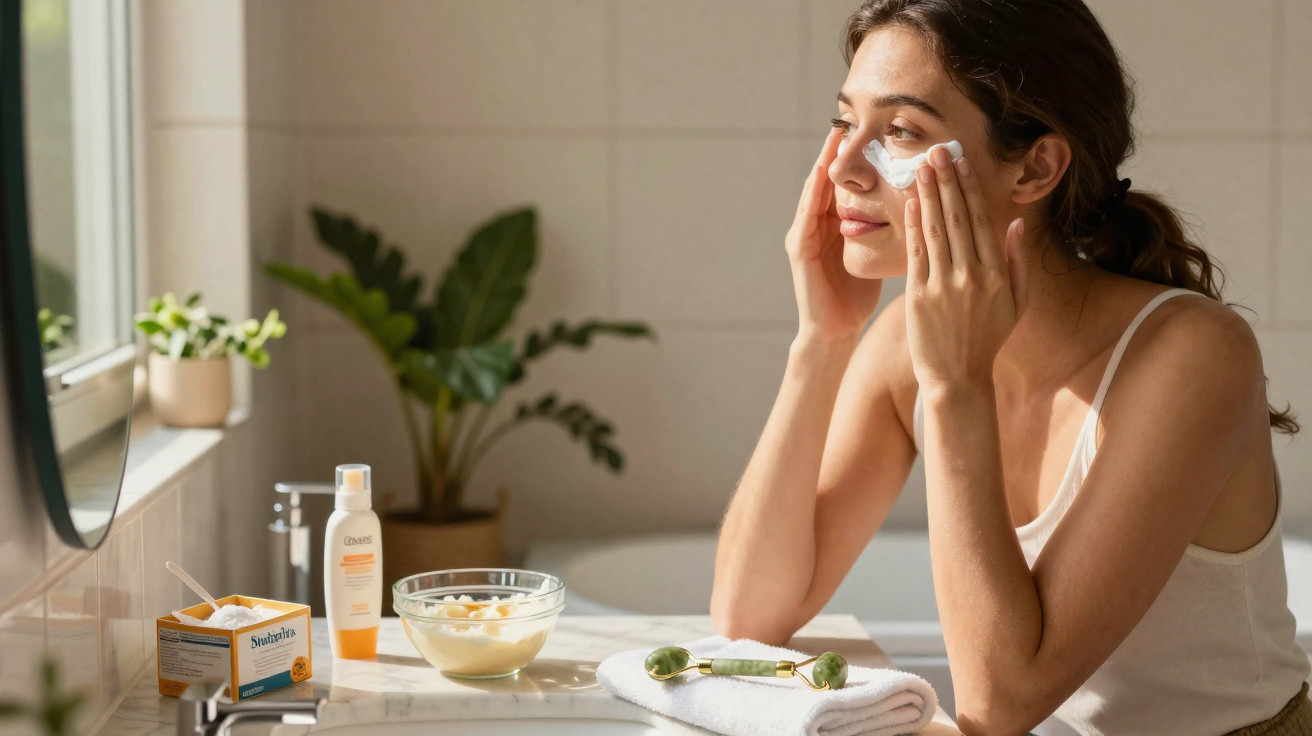
We have all had that moment when the bathroom mirror seems a touch harsher than it was yesterday.
The fine lines at the corners of your eyes that no longer quite fade away. The dark under‑eye shadows that make you look tired, even after a heroic eight hours of sleep. Faced with that, plenty of people dive straight into pricey creams, “miracle” serums, and grand promises sealed inside frosted glass.
Then there are the others. The ones who open a kitchen cupboard, spot a small blue‑and‑white box, and think: “Honestly, bicarbonate of soda for this?” In some dermatology clinics the topic now raises a smile - and also prompts a proper discussion. Skin specialists are increasingly acknowledging that this old household staple is edging its way into beauty routines.
An ordinary ingredient, used carefully, can become a quiet weapon against wrinkles and dark circles. It sounds like a joke. It is not entirely.
Baking soda, from kitchen shelf to bathroom mirror
The first time Emily, 42, dabbed bicarbonate of soda beneath her eyes, she was convinced she was doing something reckless. She had just watched a viral video in which an aesthetician described how to “wake up” the eye contour using this basic powder. A few grains, a splash of water, a beige‑tinged paste - and an almost instant cooling sensation.
The next morning she took a selfie. Then another two days later. “I haven’t knocked ten years off, let’s be honest, but my blue shadows were less noticeable,” she says. Her screenshot ended up in her colleagues’ WhatsApp group between children’s photos and a handful of memes. The king of fridge‑odour fixes had suddenly become the centre of a very serious beauty chat.
In a London dermatology practice, the same scene plays out repeatedly. “People come in with TikTok screenshots, Instagram posts, whole pinboards of baking soda recipes,” says a dermatologist who focuses on gentle cosmetic care. She raises an eyebrow, then unpicks the trend with equal parts amusement and caution. Because yes - bicarbonate of soda does have a genuine exfoliating effect and can give a mild brightening look, but used on skin as delicate as the under‑eye area, the margin for error is tiny.
An internal survey run by a major chain of beauty salons in Europe produced a figure that surprised professionals: nearly one in five clients say they have already tried bicarbonate of soda on their face. Not necessarily under the eyes - sometimes on the T‑zone, sometimes as a brightening mask. Many hesitate to admit it at first, as though it is a slightly embarrassing bathroom secret.
The outcomes are mixed, and this is where reality catches up with the buzz. Some people describe smoother skin, a finer texture, and a “de‑creased” look when they wake up. Others report redness, itching, and tightness beneath the eyes. Salon social accounts receive a steady stream of private messages: “I made the paste too thick, I left it on too long - have I damaged my skin for good?” The line between a clever hack and a painful misstep is thin, and it usually comes down to three things: contact time, frequency, and dilution.
Behind the glossy story of the “€1 miracle remedy”, there is simply sodium bicarbonate - an alkaline powder (basic in the chemical sense). Skin, by contrast, naturally sits at a slightly acidic pH, around 5.5. Put something too alkaline on top and you can disrupt that delicate balance.
That is precisely why, in small amounts, it can gently smooth the skin’s surface by helping lift away dead cells that dull the eye area. The under‑eye can look a little brighter, slightly less puffy, and dehydration lines may appear softer. The risk starts when you treat ultra‑thin skin as if it were the sole of your foot. Used without clear boundaries, bicarbonate of soda can irritate, weaken the skin barrier, and ultimately emphasise exactly what you were trying to hide.
How beauty specialists actually use baking soda (and when they say no)
Among the most cautious aestheticians, the approach looks more like a small weekly ritual than a daily step. A tiny pinch of baking soda is dispersed into a tablespoon of very cold water until you get a faintly cloudy liquid - almost like slightly limescale‑looking water. Some add a drop of a gentle plant oil; others mix in a touch of aloe vera gel for soothing.
This mixture is not meant to be smeared on. It is applied sparingly. A very thin, reusable cotton pad is lightly dampened and then pressed under the eye without rubbing. Thirty to forty‑five seconds, no more, followed by a careful rinse with lukewarm water. The goal is not to whiten the skin; it is to refresh it and smooth the surface just a little. Done once a week - sometimes twice - it can create that “rested eyes” effect clients often describe as oddly addictive.
Professionals who use it insist on one point: it is not a standalone treatment. Immediately afterwards they follow with a deeply hydrating eye product, often featuring ceramides or hyaluronic acid, to restore comfort in the area straight away. Skip that step and tightness can arrive quickly. The strictest practitioners prefer to trial the protocol elsewhere on the face before going anywhere near the eye contour.
This is where the classic mistakes begin. After a first “wow” moment, people try to speed things up. They thicken the paste. They extend the time. A gentle nudge turns into a frontal assault on the hydrolipid film - and skin does not forget.
Reports of goggle‑shaped redness around the eyes are common in clinics. Some react on the very first attempt, especially if their skin is already dry, atopic, or sensitised by retinoids. Others manage for a few weeks before noticing fine lines becoming more pronounced, as though the area has thinned or become fragile.
Professionals tend to describe it as a good idea carried out badly. “Let’s be honest: nobody really does this every single day,” a Paris facialist says with a smile. Online, many claim these recipes are part of a strict routine; in real life it is usually more uneven - a one‑off Sunday‑night test, then forgotten, then tried again, then tweaked. Behind the filters, the stories are rarely straightforward.
Some natural‑beauty experts still defend a cautious fondness for bicarbonate of soda. To them it is a tool, not a universal fix - and a tool that deserves respect, particularly anywhere near the eyes.
“Baking soda is not your enemy, but it’s not your best friend either,” summarises British dermatologist Dr. Helen Moore. “Used once in a while, properly diluted and followed by hydration, it can brighten the under-eye area. Used like a daily scrub, it becomes harsh, especially for mature or sensitive skin.”
For established wrinkles, specialists emphasise that baking soda does not replace proven actives such as retinoids, peptides, or stabilised vitamin C. Its effect is more of a light “surface result” - a pleasant, slightly illusory eraser that can make the eye area look a bit clearer in the moment.
- Use it as a short course, once a week, rather than as a daily ritual.
- Avoid it entirely if the skin is already stinging, flaking, or showing eczema.
- Patch‑test on a small area of cheek before going anywhere near the under‑eye.
Rethinking dark circles, wrinkles… and what really shows on our face
At heart, the bicarbonate‑under‑the‑eyes story says something about the times we live in. We want results that are fast, affordable, almost magical - using whatever is already at home. We would like short nights, accumulated stress, and passing years to dissolve into a little white powder that costs about €2 a kilo.
Specialists keep repeating that dark circles and wrinkles are rarely just a “surface issue”. There are the familiar factors: sleep, hydration, smoking, late‑night screens. And there are others mentioned less often: genetics, chronic micro‑inflammation, and facial muscle tension. One aesthetician says she sometimes sees puffiness drop after twenty minutes of gentle neck massage, without any product at all.
In that sense, baking soda becomes almost symbolic - a reminder that skin responds to small, repeated gestures, but also to the bigger story of how we live. Some readers may open their kitchen cupboard tonight and look at that blue‑and‑white box differently. Others will reach for a classic eye cream, a mask, or a cold‑water compress instead. What matters most is understanding what you are doing to your skin, not only what you put on it.
One day, these viral hacks will be replaced by new ones. Mashed avocado, cornflour, coffee scrubs, yoghurt masks - the cycle never stops. Between the pull of “all‑natural DIY” and blind faith in luxury bottles, there is a middle ground: informed curiosity and slow experimentation, where you listen to your mirror and to your skin in equal measure.
| Key point | Detail | Why it matters for readers |
|---|---|---|
| Baking soda works on the surface | A mild exfoliating and brightening look when very diluted and used infrequently | Helps you understand the effect on wrinkles and dark circles is largely visual and temporary |
| The under‑eye area is extremely delicate | Skin pH is easily disrupted; redness and tightness are possible | Explains why a “home” method can do more harm than good |
| Lifestyle matters as much as product | Sleep, stress, genetics, massage, and hydration play central roles | Helps you take control of your routine without betting everything on one ingredient |
FAQ:
- Can baking soda really reduce dark circles? It can sometimes brighten the skin’s surface by lightly lifting dead cells and adding a “fresh” look. For vascular or genetic dark circles, the impact remains very limited.
- Is it safe to put baking soda directly under the eyes? Not directly and not neat. The skin there is too thin. Specialists who use it dilute it heavily, keep contact time short, and do not treat it as a daily habit.
- How often can I use a baking soda under-eye soak? Professionals generally suggest once a week at most, on non‑irritated skin, with a very watery mix, followed by a targeted hydrating product.
- Does baking soda help with fine lines and wrinkles? It can slightly smooth the surface by removing tiny rough patches, creating the illusion of less visible lines. For meaningful wrinkle care, other actives are more effective.
- Who should absolutely avoid this trick? Anyone with sensitive or dry skin, rosacea, eczema, or those already using strong dermatological treatments should avoid it and discuss appropriate options with a professional.





Comments
No comments yet. Be the first to comment!
Leave a Comment