
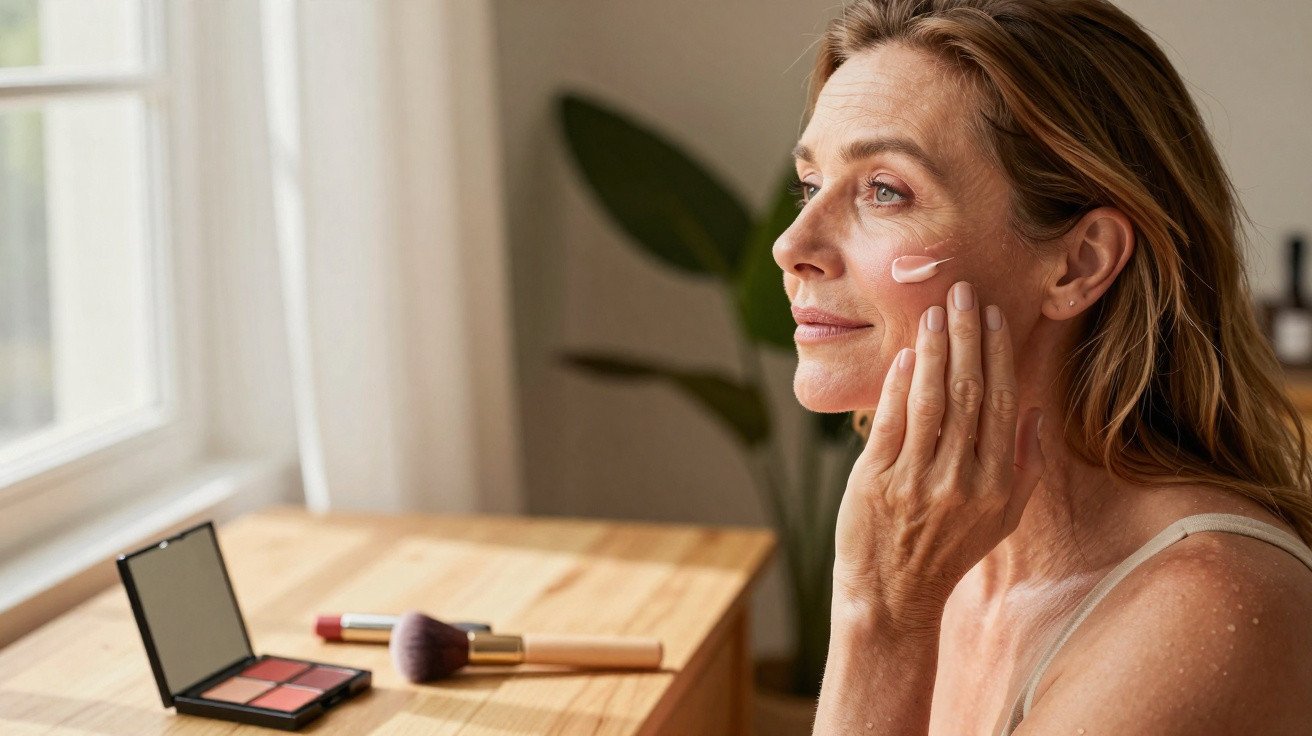
Creating make-up for drooping cheeks in mature skin works best with lightweight prep, subtle contouring, blush placed on an upward angle, and a softly luminous finish without overdoing powder. The goal is to visually lift the cheek area, soften the loss of facial definition, and keep the make-up looking seamless with the skin’s natural texture.
Why does mature skin suit a lighter make-up approach?
Mature skin often shows more visible texture, produces less oil, and has lines where product can settle if make-up is layered too thickly. Because of that, heavy foundations, too much powder, and very dark contour can draw attention to exactly what you’re trying to blur.
A better starting point is to prep with moisturiser, sunscreen (SPF), and then either a sheer foundation or a tinted moisturiser. When mature skin is treated with creamy products that are blended thoroughly, both blush and contour apply more smoothly and are less likely to catch in fine lines.
Where should you place contour to lift drooping cheeks?
For drooping cheeks in mature skin, contour needs to sit slightly higher than the classic placement. Rather than carving a deep line under the apple of the cheek, place the product just beneath the cheekbone and blend it diagonally upwards towards the temples.
A few simple choices help keep the finish believable and prevent harsh striping:
- Opt for a cream contour or stick formula with a neutral undertone, not overly orange.
- Start with a small amount and build the depth gradually.
- Blend upwards every time-avoid dragging the brush down.
- Don’t extend contour too close to the mouth, as it can make the expression look heavier.
Which blush gives a lifted effect?
Blusher is one of the most important steps when doing make-up for drooping cheeks in mature skin. Peach, soft pink, light mauve, and muted coral shades tend to add a healthy look without creating a stark contrast, while creamy textures help keep the finish fresh and slightly radiant.
Begin applying on the higher part of the cheeks, avoiding a heavy concentration in the centre. Then diffuse the colour out towards the side of the face and up to the temple, creating an upward visual line that supports the contour placement.
How do you follow a step-by-step without the make-up looking heavy?
The difference is usually the product order and how little you use at each stage. On mature skin, the most flattering result is when make-up looks fused with the complexion rather than sitting on top of it.
- Moisturise thoroughly and give it time to settle before applying base.
- Apply a thin layer of foundation only to even out the skin tone.
- Use concealer only where needed, such as under-eye darkness or small, localised pigmentation.
- Add contour on a diagonal under the cheekbone, blending upwards throughout.
- Place blusher high on the cheek and pull it up towards the temples.
- Tap on a subtle highlighter along the top of the cheekbone, steering clear of very pronounced lines.
- Finish with a light touch of powder only where shine appears most, such as the forehead, nose, and chin.
How can you keep drooping cheeks looking natural?
A natural-looking finish relies more on blending than on the amount of make-up. With drooping cheeks in mature skin, contour that is too dark can look like an artificial shadow, blusher placed too low can drag the face downward, and highlighter with large glitter particles can emphasise texture.
When the contour sits higher, the blusher follows the temple diagonal, and highlighter is kept to true high points, mature skin gains definition without losing softness and movement. The make-up stays noticeable enough to subtly reshape the face, yet light enough to avoid making the expression look rigid.




Comments
No comments yet. Be the first to comment!
Leave a Comment