
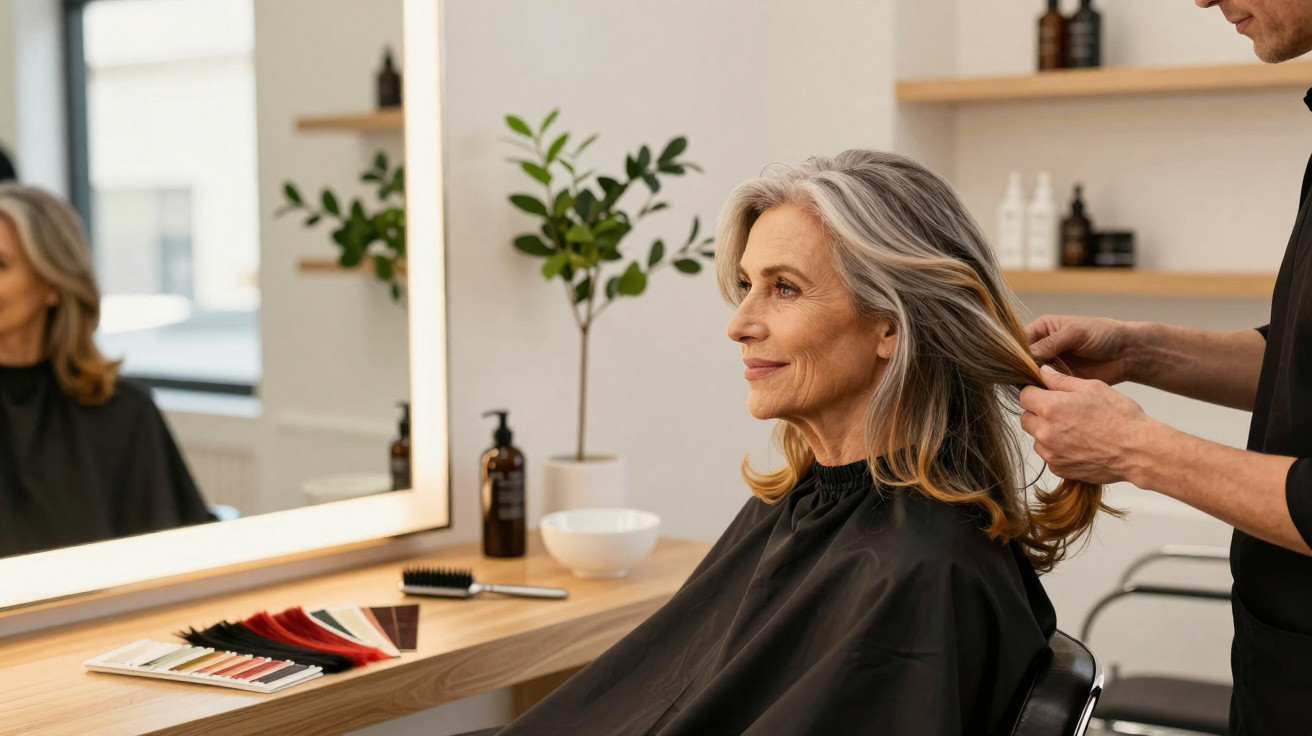
“I want to look younger,” she says - half apologetic, half defiant. The hairdresser smiles, checks the grey regrowth, then the too-dark lengths she coloured at home a few months ago. Under the salon’s strip lighting, the hair looks harsh, almost helmet-like. In daylight by the door, it’s worse.
Most of us know this moment - from the waiting area, or from our own bathroom mirror. Inside, you feel alert, curious, full of life, yet your hair colour tells a completely different story. And, if we’re honest, nobody sits down every month and works through every shade chart. Still, some tones have a nasty side effect: they make lines look deeper, skin look sallow and tired. Those are the shades hairdressers quietly warn each other about - for good reason.
Why some hair colours suddenly make us look “older”
Hairdressers don’t always say it outright, but they can see it in seconds: certain colours place an invisible filter over the face. It’s especially noticeable for women over 50, when skin, eyes and natural hair subtly shift. A shade that felt bold at 35 can look harsh, severe or “mask-like” at 55. That isn’t “because of age” as such - it’s because the pigments no longer sit in harmony. The wrong tone deepens shadows, underlines fine lines and pulls redness forward. Suddenly the eyes look tired, even when you don’t feel that way.
That’s when the doubts creep in: “Why do I look less fresh after colouring - and somehow heavier?” That question is usually the first warning sign.
A colourist in Hamburg said she can spot “problem colours” the moment a client walks in: very dark black-brown on delicate skin, cool ash blonde on a warm complexion, bright red on fine, dry hair. She watches facial features change visually. Clients then report colleagues asking if they’re tired or unwell - or whether they’ve “had something done”, because their face suddenly looks stricter. Some figures from the cosmetics industry suggest that women over 50 colour their hair more often, yet are also more dissatisfied with the result. The issue is frequently not the product quality, but the shade choice.
The nuance is rarely just a nuance - it becomes a story written across the face.
The logic is surprisingly simple: as we get older, skin and hair hold less pigment. Strong contrasts that once looked exciting can start to look busy. Very cool tones can turn the complexion grey; very warm ones can overwhelm it. If grey regrowth comes through sharply, the eye jumps straight to the hairline - and with it to forehead lines or crow’s feet. Colours without depth or reflective dimension make the surface look flat; light doesn’t break and move, it sits like a single block. To the eye, that reads as rigid, static - older. And there are five shades and approaches that make almost every professional wince.
These 5 hair colours make women over 50 look older - and what hairdressers advise instead
Top of many warning lists is inky black or very dark espresso brown, especially on fair or pink-toned skin. The contrast against the face is so hard that every fine line becomes more visible. The contours around the mouth and eyes look sharper; features can read as stern. Many people choose black to “hide grey completely”. In reality, grey roots against pitch-black lengths create a clear line after a fortnight - and it’s the first thing you notice. Hairdressers usually steer clients towards a deep chocolate brown, softer reflections and subtle highlights. The overall effect stays calmer, and attention returns to the eyes rather than the hairline.
Second: extremely cool platinum or ash blonde on women with warm-toned skin, or with naturally mid-brown hair. On Instagram these shades look edgy; in real life they can drain every hint of warmth from the face. Skin can read bluish, dark circles stand out, and redness appears stronger. One client said her granddaughter asked whether she had “dyed granny hair”. That stung. Softer, neutral or gently warm blondes tend to suit better: honey, beige, sand - ideally as fine highlights rather than a single all-over tone. That way, grey blends in almost elegantly, and the regrowth doesn’t shout “Touch-up!” after four weeks.
Third trap: vivid, artificial red - tomato red, copper-orange, intense mahogany shades, anything that screams from the box. On young, even skin, these colours can look striking. With age, they tend to amplify facial redness, broken capillaries and dryness. Red pigments also fade unevenly, so hair can quickly look dull and patchy, which subconsciously reads as “tired” rather than “lively”. If you love red, hairdressers often suggest muted versions: strawberry blonde, rose gold, soft copper with brown lowlights. These tones sit with the face instead of fighting it.
Fourth: a single, uniform block colour. Even when the shade itself is “right”, an all-over, one-note result can make hair look like a flat sheet - particularly if the texture has become finer. Professionals prefer to break up the surface with highlights, balayage or a gloss/toner that adds sheen and movement, so the light plays through the hair.
Fifth: an overly stark jump between dyed lengths and natural grey. When the difference is too strong, the root line becomes a constant focal point. Many colourists now recommend integrating grey rather than aggressively covering it - for example with soft shading, gentle blending and strategically placed lighter pieces.
How hairdressers choose hair colours that look younger - without chasing youth
The first professional trick isn’t about trends; it’s about observation. Skilled hairdressers don’t begin with the shade book - they begin with your eyebrows, eye colour and skin. Nature gives clues about what you can carry. Are your brows more ashy or more golden? Does your skin read peachy or olive? Are your eyes a clear blue, a warm brown, or green with golden flecks? The most flattering hair colour echoes those undertones and lifts them slightly.
Rather than “battling” grey, many colourists build it into the plan: soft balayage, babylights or glossing treatments that shimmer instead of covering everything solidly.
A lot of women over 50 stick with the shade they wore in their thirties simply out of habit - and then feel shocked when their face no longer seems to “match”. An honest hairdresser won’t just apply “the usual” without checking in. They’ll explain that a softer base with fine reflections often looks fresher than a fully saturated wall of colour. They may also suggest a slightly lighter area around the face - face-framing in a shade or so brighter - which can visually lift features like a mini facelift without a scalpel.
Let’s be realistic: few people turn up every four weeks with a flawless maintenance plan. That’s exactly why it matters to choose a colour that still looks good with a bit of regrowth.
A seasoned stylist in Munich put it dryly:
“The best anti-ageing hair colour is the one you barely notice as a hair colour at all - just: ‘Wow, you look well-rested.’”
To get that effect, professionals pay special attention to five “no-go” zones and flip them into something more flattering:
- Very dark black-brown → shift to a soft chocolate brown with warm reflections
- Ice-cold platinum blonde → translate into beige, honey or sand tones, with depth at the roots
- Vivid reds → move into muted copper, strawberry blonde or auburn with lowlights
- A single all-over colour → break it up with highlights, balayage or glossing so the light can move
- Too much contrast against grey → integrate the grey instead of brutally covering it, for example with soft shading
In the end, nobody should be admiring your hair colour - they should be noticing your face.
Grey confidence, softer shades - and the freedom to reinvent yourself
That small moment outside the salon - catching yourself in a shop window and giving a quick smile - can bring a quiet kind of surprise: so this is how I can look, too. Not “younger at any cost”, but clearer, brighter, more like myself. After 50, hair colour is less camouflage and more translation: a way of expressing what’s going on inside.
Maybe you’re tired of endlessly trying to hide grey. Maybe you still love colour, just not the way you did before. It gets interesting when you stop trying to be 20 and start being your own version of 55, 63 or 71 - with a tone that tells that story.
Hairdressers see every day how strongly hair colour can shift someone’s mood. A client who spent months battling overly black, dull hair can look instantly calmer with a lightly caramel brown. The laugh lines are still there, but now they sit naturally in the overall picture. Another client who gave up platinum blonde for a soft silver-grey with cool highlights says she finally feels “not dressed up” anymore. None of this is magic; it’s craft, combined with honesty - and, yes, the courage to let go of old colour recipes.
Perhaps that’s the real point: hair colour isn’t a youthful filter, it’s a tool for framing the face that holds your life. Once you recognise the five problematic directions, you can choose more deliberately. Maybe that means a gentle transition into your natural grey. Maybe it’s a warm blonde that captures the feel of summer evenings. Maybe it’s a bronze brown that makes your eyes light up. Not every choice has to be perfect; some are simply a chapter - and nothing stops you opening a new one with a colour that says: “Here I am. Now.”
| Key point | Detail | Benefit for the reader |
|---|---|---|
| Extremely dark black-brown makes facial features look harder | Strong contrast against the skin; grey regrowth shows immediately | Helps readers understand why they can look sterner, and encourages a switch to softer browns |
| Cool platinum and ash blondes can make the complexion look washed out | They remove warmth from the face and emphasise dark circles and redness | Encourages beige, honey or sand tones that tend to look fresher |
| Bright red tones amplify redness and can quickly look dull | Red pigments fade unevenly, leaving hair patchy and tired-looking | Offers alternatives such as muted copper or auburn that frame the face more softly |
FAQ:
Which hair colour generally makes women over 50 look younger?
Medium tones with soft reflections tend to work best: chocolate brown, caramel, honey, beige or sand blonde. Ideally, the colour should be no more than two shades away from your natural hair and should pick up undertones from your skin and eyes.Should I cover grey hair completely, or is it better to blend it in?
Many hairdressers now recommend blending grey in gradually - with highlights, balayage or gloss/toner treatments. It looks more modern, the regrowth line is less obvious, and the transition phase feels easier.Do red hair colours always make you look older?
No, but very vivid artificial reds can look hard. Softer options such as strawberry blonde, copper blonde or auburn with lowlights can make the face and eyes look brighter.How often should I go for colouring after 50?
It depends on regrowth and the contrast with your natural colour. Softer techniques like balayage or glossing/toner appointments usually allow longer gaps of six to twelve weeks without the look seeming unkempt.Can I colour my hair at home, or should I always go to a hairdresser?
Root blending or gentle toners often work well at home. For bigger colour changes, lots of grey, or a more youth-enhancing effect, it’s worth seeing a professional who factors in face shape, skin tone and hair texture.

Comments
No comments yet. Be the first to comment!
Leave a Comment