
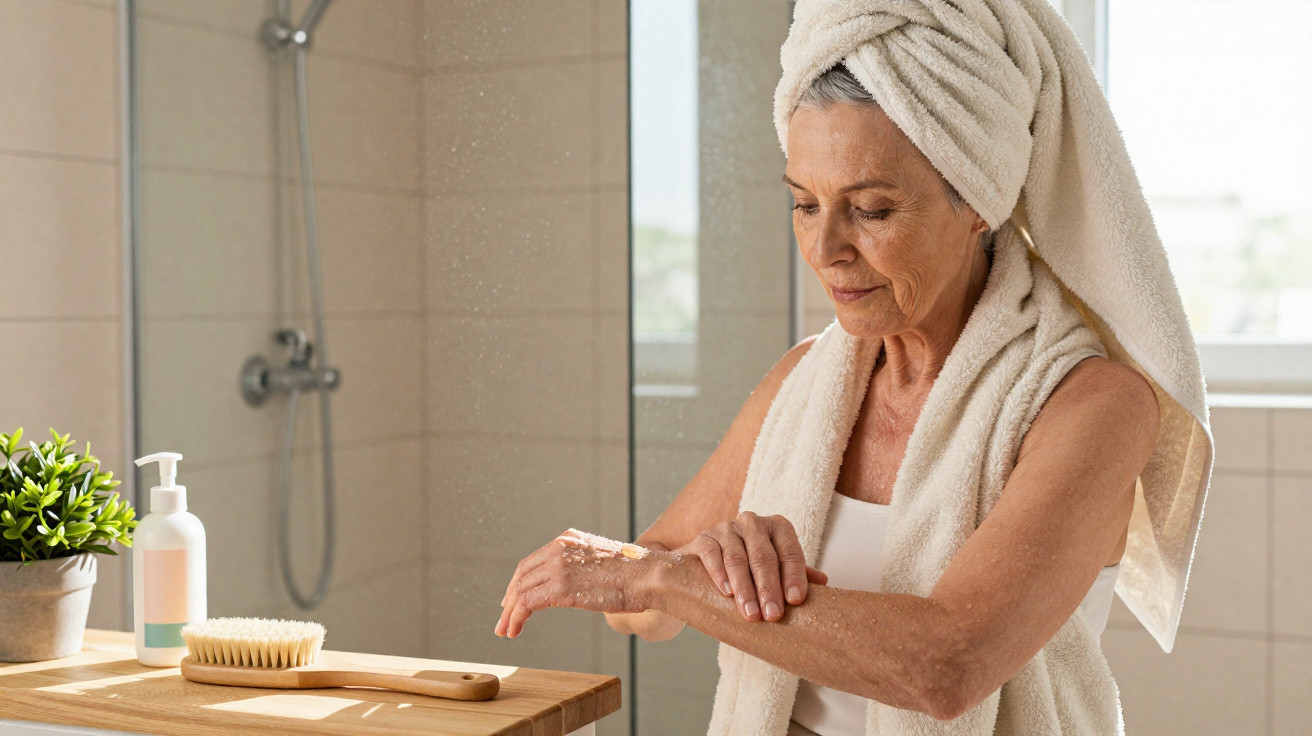
She reaches for the same orange shower gel she has relied on for 20 years - the one with that faint grapefruit scent that brings back memories of holiday hotels. She moves more slowly now and watches her footing on the tiles, yet the routine hasn’t changed: hot water, plenty of foam, and a thorough scrub that “makes her feel really clean”.
Later, she tells her daughter her skin “itches for no reason”, and that her legs shed dry flakes under her tights. She puts it down to ageing, the central heating, “winter skin”. Her dermatologist sees it differently: the shower habits that suited her at 40 are quietly working against her at 70.
That’s the part almost no one over 65 expects.
Why your 30-year shower routine stops working after 65
Most of us treat showering as a neutral, everyday act: water, soap, rinse, done. In your mid-20s, that’s close to true - skin recovers quickly, oil glands are busy, and the barrier can mend itself overnight. Past 65, the very same routine can start to feel like slow-motion sandpaper.
Dermatologists are straightforward about it: after 65, skin is thinner, drier and easier to damage - more like tissue paper that’s been folded one too many times. Hot water removes protective lipids more rapidly. Strong, foaming gels latch onto what little natural oil remains. So that “nice long scrub” doesn’t just lift away grime; it gradually wears down the shield that keeps bacteria, irritants and inflammation on the outside.
At that point, showering becomes less about feeling squeaky clean and more about safeguarding what the body can’t rebuild as effortlessly as it once did.
A London dermatologist describes a familiar winter pattern. A new patient in their late 60s or 70s arrives with red, cracked shins, itchy arms, and sleep broken by scratching. They’re sure it’s an allergy or “some weird rash”. They’ve swapped laundry products, moved to cotton pyjamas, even slept with the window open.
When she asks about bathing habits, the account is strikingly similar: daily showers, very hot water, foaming gel all over, and firm scrubbing with a flannel, sponge or washcloth. Many have two showers a day because it “wakes them up”. Some feel ashamed about missing a wash, as if cleanliness were a moral standard they’re failing.
On her advice, they move to showering every other day, turn down the temperature, and moisturise within minutes of drying. Two weeks later, the “mystery rash” is easing. No miracle ointment - just a different approach to stepping under the water.
The biology behind the change is simple, but it can be unsettling. With age, the skin’s outer layer (the stratum corneum) thins and retains less water. Oil production slows, so the natural “moisturising film” becomes uneven. Collagen and elastin fall, leaving skin less able to tolerate friction and heat.
Against that backdrop, long, hot, soapy showers act like small daily assaults. Surfactants in shower gels dissolve oils that older skin can’t replace quickly. Higher temperatures speed that up and increase transepidermal water loss. Over time, constant dryness can lead to eczema, infections, and even tiny painful cracks that sting with every step.
Dermatologists aren’t saying, “Don’t shower.” They’re saying: handle 70-year-old skin the way you’d handle your favourite silk shirt - gently, briefly, and with care.
New rules of the shower after 65: what dermatologists actually recommend
The advice that shocks many people in an “always fresh” culture is this: plenty of adults over 65 don’t need a full-body shower every day. A targeted wash is often better. That can mean a quick daily clean of the “hot zones” (armpits, groin, feet, skin folds), with a full shower every second day - or even every third day if your skin is very dry.
When you do shower, aim for brief and warm rather than lengthy and scalding. Five to ten minutes in comfortably warm water is kinder than twenty minutes in a steamy self-made sauna. Replace foaming gels with fragrance-free, pH-balanced cleansers, and use them only where you truly sweat or are visibly dirty. Arms and legs often only need water.
Then comes the quiet game-changer: smooth on a rich, unscented moisturiser within three minutes of getting out. That short window helps lock in the water your skin has just taken up.
In practical terms, a routine might run like this. You step into water that feels pleasant but not so hot your skin turns bright red. If you need to wash your hair, focus shampoo on the scalp rather than the full length. Put a small amount of cleanser into your hands - not onto an abrasive sponge - and wash underarms, groin, under the breasts, between the buttocks, and feet. And stop there.
Rinse thoroughly, then pat dry with a soft towel instead of rubbing. Sit down for a minute. Use a pump of cream for each leg, each arm, then torso - and back if you can reach, or with help. It feels slow the first week, then it turns into a quiet ritual, like making tea.
Many older adults are embarrassed to admit that long showers exhaust them or that they worry about slipping. So they carry on in silence. A lighter, adapted routine isn’t “giving in”. It’s a sensible plan.
Dermatologists often speak about these habits with unexpected tenderness. They understand they’re dealing not only with skin, but with memories of youth, work, attraction and dignity. One senior dermatologist told me:
“When I ask an 80-year-old to change how they bathe, I’m not giving a beauty tip. I’m asking them to rewrite a piece of their identity. So I go slowly, and I explain why every step matters.”
The biggest missteps she sees include: assuming more soap equals more cleanliness; dismissing tightness and itching after bathing; choosing strong fragrances “because they smell clean”; and skipping moisturiser because “I never used that before and I was fine”. Let’s be honest: almost nobody manages to do all of this perfectly every day from the start. Most people need a few weeks before the new movements feel normal.
- Use lukewarm water, not hot, and keep showers under 10 minutes.
- Choose fragrance-free, gentle cleansers, not harsh antibacterial soaps.
- Moisturise from neck to toes within three minutes of drying off.
- Focus daily washing on folds and high-sweat areas; full body less often.
- Install a non-slip mat and grab bar to make shorter showers feel safer, not rushed.
Rethinking “clean” after 65: less friction, more kindness
“Clean” is a loaded word. It holds childhood instructions, hospital corridors, school-day mornings and factory shifts. For many people who grew up with shared bathrooms or limited hot water, skipping a daily full wash can trigger guilt - as if they’re slipping backwards. That belief can linger in the body long after the skin itself has changed.
So when dermatologists advise showering less, some patients hear “be less respectable” or “look after yourself less”. In truth, it’s the reverse. Updating shower habits after 65 is about paying closer attention to what your skin is trying to tell you. Red patches, night-time itching, and the feeling that your legs are suddenly too tight for your body are signals - not personal failings.
We don’t often acknowledge how isolating these private problems can be. Dry, sore skin can make people avoid swimming pools, summer clothing, and sometimes even intimacy. Talking about such small details with a GP, dermatologist, partner or friend may feel awkward at first - yet that’s frequently how kinder routines begin to spread through families and friendship groups.
There’s also a health angle that extends far beyond comfort. Fragile skin tears more easily during a fall. Small cracks near the ankles or between the toes can become entry points for bacteria. For people with diabetes or circulation problems, even a tiny wound can become a serious issue. A gentler shower routine lowers those risks quietly, day after day.
For carers, adult children and partners, these “minor” details matter as well. Helping an older relative isn’t only about prescriptions and appointments. Sometimes it’s as simple as swapping a harsh shower gel for a milder one, turning the temperature down, or suggesting a shower stool while framing it as “saving energy” rather than “getting old”.
On a deeper level, changing bathing habits after 65 means accepting that the body now plays by different rules - not worse ones. Just different. In the same way we update glasses prescriptions, adjust exercise, or reconsider night driving, we can renegotiate our relationship with water, soap and time under the spray.
You don’t need to overhaul everything overnight. Perhaps tomorrow you simply lower the heat slightly. Next week you try moisturising while your skin is still a little damp. In a month, you may notice the redness has eased and you’re sleeping better. Most meaningful change begins like that: quietly, in a bathroom, with no audience.
| Key point | Detail | Why it matters for you |
|---|---|---|
| Adjust shower frequency | Move to a full shower every 2–3 days, with daily targeted washing | Reduces dryness, itching and the effort fatigue that comes with personal care |
| Soften the water, time and products | Lukewarm water, under 10 minutes, gentle fragrance-free cleansers | Protects the skin barrier that becomes more fragile after 65 |
| Moisturise straight away | Apply a rich cream within 3 minutes of showering | Helps keep water in the skin and limits cracking and irritation |
FAQ:
- How often should someone over 65 actually shower? Many dermatologists recommend a full-body shower 2–3 times a week, alongside daily washing of armpits, groin, feet and skin folds. If you’re very active you might need more, but the aim is always to balance hygiene with protecting the skin.
- Is it unhygienic to use less soap on arms and legs? No. If your skin isn’t visibly dirty and you haven’t been sweating heavily, water plus a gentle cleanser on the “hot zones” is usually sufficient. Using lots of soap on limbs mostly strips natural oils rather than removing extra germs.
- What kind of shower gel is best after 65? Choose fragrance-free, soap-free, pH-balanced cleansers marketed for dry or sensitive skin. Cream or oil-based formulas are often preferable to very foamy gels.
- Are baths better than showers for older skin? A long, hot bath can be just as drying - sometimes more so. A short, warm bath with added bath oil may suit some people, but good safety measures are essential because getting in and out carries more risk.
- When should an older person see a dermatologist about dry skin? If itching is keeping you awake, if you have cracks that hurt when you walk, a sudden rash, or any wound that hasn’t healed within a couple of weeks, speak to a professional.





Comments
No comments yet. Be the first to comment!
Leave a Comment