
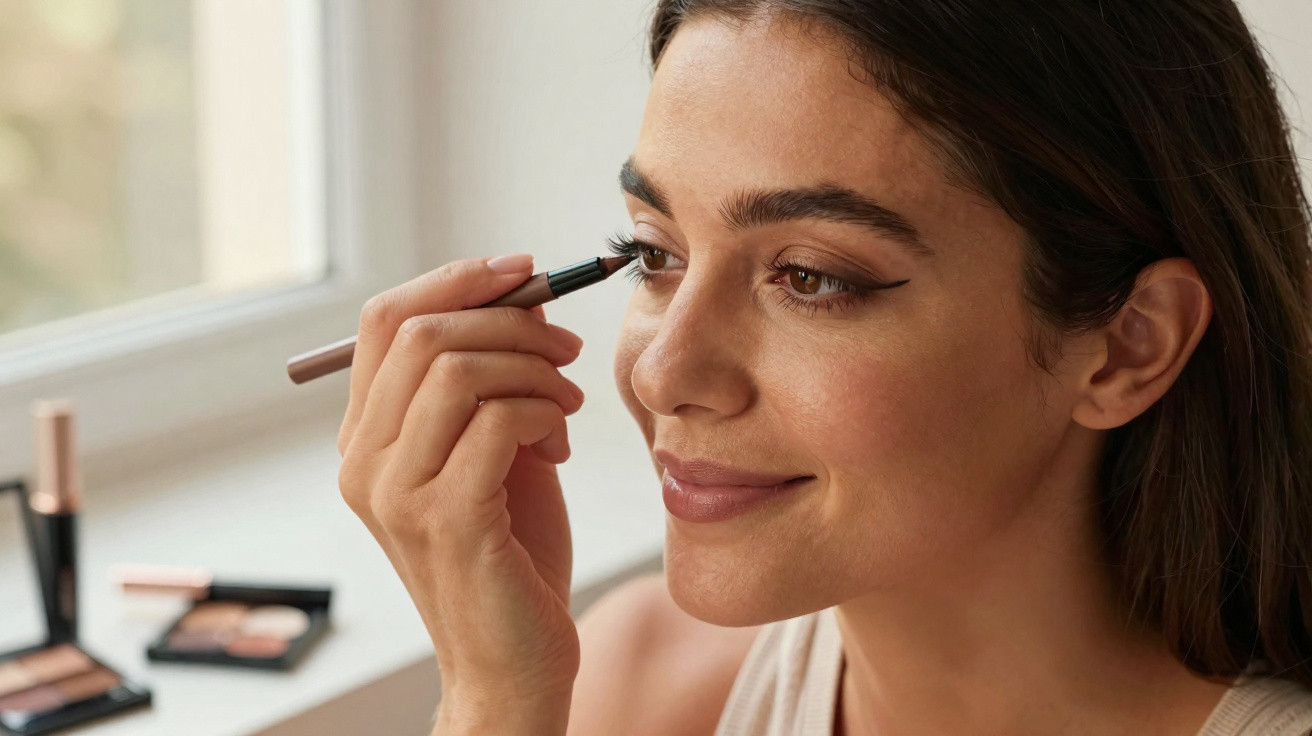
Many women notice from around 50 that their go-to black kohl suddenly stops flattering them: the eye looks smaller, the gaze seems to droop, and make-up settles into fine lines. That is why professionals often suggest changing tactics. Instead of thick lines all the way around the eye, the focus shifts to fine, precisely placed eyeliner techniques that visually lift hooded eyelids without weighing the eye down.
Why classic kohl often makes hooded eyelids look worse
As the years pass, the eye’s shape changes. The skin on the upper lid becomes softer, drops slightly, and starts to fold over the mobile crease. What once looked great as a rich kohl line along the upper and lower lash lines can suddenly look harsh and heavy.
"A thick, dark line steals visible lid space - making the eyes look smaller and the gaze more tired."
Three issues in particular turn traditional black kohl into a problem:
- Too much product on the lower lid: A fully smudged kohl in the lower waterline visually shrinks the eye.
- Wide lines on the upper lid: If the line sits too low, it disappears beneath the fold or visually drags down.
- A hard black shade: Pure black can look severe quickly and highlights any shadowing under the eye.
For hooded eyelids, make-up artists therefore tend to choose long-wearing eyeliner in brown, taupe, or dark grey. These shades read softer, more forgiving, and more modern than the heavily applied kohl pencil look many people used to wear.
The “reverse” eyeliner technique: how to create a lifting effect
A make-up artist frequently referenced in the beauty world uses an unusual twist on the classic winged liner designed specifically for hooded eyelids. Rather than pulling the wing up from the lower lash line, she deliberately starts the other way round.
Step by step to a lifted outer corner
The key idea is simple: the wing should not follow the natural angle of the lower lid - because with drooping lids that angle often slopes downwards. Instead, it takes its direction from the upper lash line.
- Look into the mirror with your eye open. That way you see how the lid actually sits day to day - not just while you are applying make-up.
- Draw a fine line along the upper lash line. Start right at the roots; keep the inner third whisper-thin.
- Sketch the wing “from top to bottom”. Begin at the outer third of the upper lash line and pull the line slightly downwards towards the temple - it feels odd at first.
- Choose the end point. Place a tiny dot where you want the outer corner to appear lifted.
- Connect the dot back to the lash line. This creates a small triangular area, which you then fill in neatly.
When you look down, this wing can appear almost wrong - a little kinked or uneven. But once the eye is open in a normal, relaxed way, the line aligns with the hooded lid shape and reads like a mini lift at the outer corner.
"What matters isn’t how the wing looks with your eyes closed, but how it sits in real life with your eyes open."
Tightlining: the invisible trick for fuller-looking lashes
A second technique that makes a big difference on hooded eyelids is called tightlining. The aim is not a visible line on the skin, but colour placed directly between the lashes.
In practice, it works like this:
- Use a well-sharpened waterproof eyeliner pencil or a gel liner, applied from underneath at the upper lash line.
- Press the pigment gently into the tiny gaps between the lashes.
- Keep your gaze as straight ahead as possible; if your eyes are sensitive, lift the lid slightly and carefully.
The result: the lash line looks denser and the eye gains definition, without sacrificing precious space on an already small lid area. This is especially useful with very droopy lids because there is less to smudge or settle into fine lines.
Inverted eyeliner – when the upper fold hides almost everything
With very pronounced hooded eyelids, even an ultra-thin line on the upper lid can be difficult because the mobile lid disappears completely under the overhang. In these situations, professionals often rely on an inverted version of eyeliner.
A subtle line below, a lifting effect above
With inverted eyeliner, attention shifts to the lower lash line - but in a very restrained way:
- Draw a fine line only along the outer third of the lower lashes.
- Extend it slightly outwards and on a gentle diagonal upwards.
- Soften the line a little so there is no harsh edge.
Paired with an extremely thin, gradual line on the upper lid that becomes slightly thicker only at the outer edge, this creates an upward visual direction. It is a modern replacement for the old habit of fully lining the eye all the way around.
| Old habit | New alternative for hooded eyelids |
|---|---|
| Thick black kohl all the way along the lower area | A fine, softer line only in the outer third |
| Wide liner across the entire upper lid | A progressive line: ultra-thin inside, slightly stronger outside |
| Pure black in the waterline | Soft brown or taupe close to the lashes, plus tightlining |
Which textures and shades work particularly well
These techniques suit products that allow precision and last all day without smudging. Many make-up artists prefer:
- Gel eyeliner in a pot with a fine brush - ideal for tightlining.
- Liquid eyeliner with a felt tip for crisp wings.
- Waterproof pencils that blend easily at first and then set.
For colour, it is worth moving away from standard black. Deep brown, espresso, cool taupe, or a rich dark plum look softer, make the whites of the eyes appear brighter, and tend to suit mature skin better, which often reacts more noticeably to strong contrast.
How hooded eyelids develop – and what that means for make-up
Hooded eyelids can be genetic or develop with age. Over time, skin loses elasticity, the distribution of fat under the skin changes, and muscles weaken. As a result, the upper lid sits a little lower.
That has two consequences for make-up:
- The mobile lid area becomes smaller, leaving less room for bold eyeshadow looks.
- Lines that used to sit perfectly can now crease, kink, or vanish into the fold.
This is why it pays to revisit old habits and choose techniques that work with the new anatomy rather than against it. Fine, well-judged eyeliner tricks can transform more than adding a fifth coat of mascara.
Practical add-ons: eyeshadow, mascara, and small no-gos
A flattering eyeliner look for hooded eyelids rarely stands alone. A few supporting tweaks can make it noticeably stronger:
- Matte rather than very shiny: Matte, lightly tinted eyeshadows reduce shine on lid skin that can otherwise look puffy.
- A lighter shade at the inner corner: Champagne or ivory tones help the eyes look fresher.
- Emphasis on the outer lashes: Applying more mascara to the outer third reinforces the lifted effect of the liner.
Less helpful are heavy glitter textures placed directly on the overhanging fold, as they tend to highlight unevenness. Extremely hard, sharp-edged lines can also make the face look stricter, especially on mature skin.
If you are trying an inverted wing or tightlining for the first time, take your time and start with very little product. The methods look more complicated than they are. After a few attempts, the movement usually becomes second nature - and the eyes look more awake, without needing to look like you have “painted yourself ten years younger”.



Comments
No comments yet. Be the first to comment!
Leave a Comment