
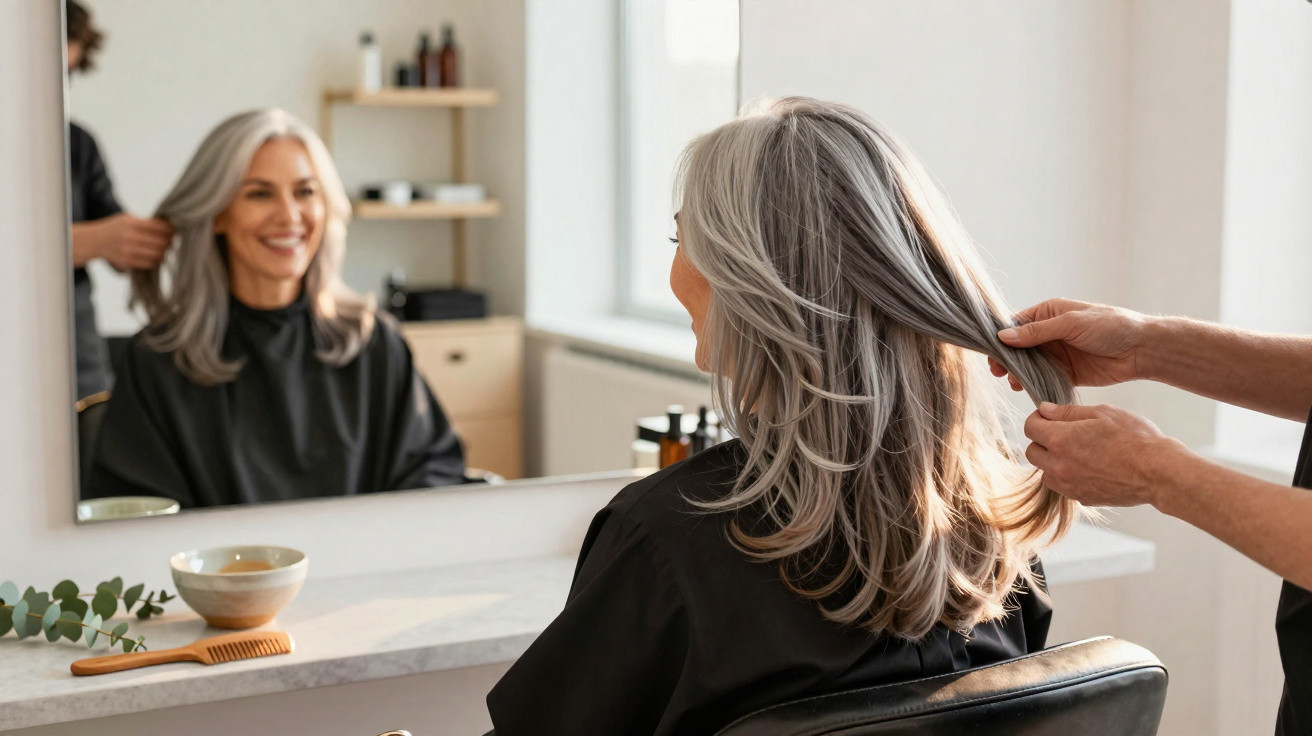
Her stylist proposes “just a little warm brown” to mask the silver catching the light at her temples. She studies her reflection, unsure, fingertips brushing the new white strands that seemed to arrive overnight. On the chair beside her is an Instagram screenshot: a woman her age with hair threaded through with gentle grey ribbons, oddly radiant - and not remotely “old”.
Elsewhere in the salon, another client is having something altogether different: a careful method that softens, blends and reframes her grey rather than smothering it beneath a flat, opaque colour. The finish is understated. Brighter. Less like hiding, more like growing into something. The stylist steps back, pleased. The client smiles too - slightly shocked by how good it looks.
The real question has shifted. It’s no longer “How do I erase my greys?”
From hiding to harmonising: why grey hair is being reimagined
Grey hair once felt like a point of no return. You’d spot the silver and it seemed you had two options: colour it, or “let yourself go”. That storyline is unravelling. In salons from New York to Berlin, colourists say more and more people are asking for something gentler, more intelligent and more liveable than total, full-coverage dye.
What they don’t want is that solid, helmet-like colour that demands a retouch every three weeks. What they do want is hair that has movement, light and dimension - hair that still looks like them, just… less drained. The aim isn’t to impersonate 25. It’s to look refreshed, crisp and current at 45, 55, 65. The grey can remain; it simply gets refined.
On a wet Thursday in London, colourist Mia tells me that around half of her new clients arrive with screenshots filed under “anti-grey but not fake”. A banker in her 40s pulls up a Pinterest board packed with women whose grey is woven into soft highlights. “I’m not hiding my age,” she says, “I just don’t want my roots screaming about it in Zoom meetings.”
Mia suggests “grey blending”: whisper-thin highlights and lowlights placed around the face and along the parting. The greys aren’t removed - the contrast is reduced. When it’s finished, the hair reads like expensive summer light rather than a reluctant deal with time. She walks out without a harsh regrowth line; instead, she has a cooler, softer version of herself.
The data points in the same direction. In 2023, Google searches for “grey blending” and “transition to natural grey” surged across English-speaking countries, while “permanent hair dye every 3 weeks” levelled off. Over on TikTok, the hashtag #grombre - grey + ombre - has become a kind of group endeavour, with women sharing the awkward months between dye and natural hair and trading tips for staying polished in the in-between.
What’s behind the change? Some of it is sheer exhaustion: the cost, the smell, and appointments that dictate your diary. Some of it is health-led: fewer people want ammonia-heavy colour sitting on their scalp year-round. But there’s a wider cultural pull too. The generation that turned its back on crash diets is now giving side-eye to constant root touch-ups. The definition of “well-groomed” is widening. Grey hair isn’t automatically a maintenance failure; it’s a material you can work with. And that reframing changes everything.
How to conceal grey and look fresher – without committing to full dye
This isn’t a call to go fully silver overnight. It’s about deliberate, selective camouflage. Treat grey hair as areas of light and shade, not as defects. The key is to soften what people notice first: your hairline, your parting and the front sections. That’s where targeted blending can transform the whole look.
Ask your colourist for ultra-fine “baby lights” in a tone just a touch lighter than your natural base. These tiny threads blur the boundary between brown and grey, turning sharp contrast into something closer to a soft-focus filter. Then add a handful of lowlights - slightly deeper pieces - to keep the colour grounded so it doesn’t drift into a washed-out haze.
You also don’t have to become trapped in a rigid salon routine. Between visits, a root touch-up powder or spray can quietly mute the most obvious sparkles along the parting - especially ahead of big meetings, dates or family occasions. This approach is about autonomy, not dependence. The grey isn’t erased; it’s simply turned down.
At home, it’s tempting to reach for a box dye and “sort it all out” on a Sunday evening. That’s often where problems begin. Full-coverage colour creates one dense block that looks fine for a fortnight, then suddenly reveals a harsh step-change between bright roots and darker lengths. That scalp line is what tends to age people, not the grey itself.
A kinder option is to use semi-permanent glosses in cool or neutral tones. They won’t completely cover grey; they veil it. A good gloss boosts shine, tones down yellow or brassy notes, and makes your natural colour look purposeful rather than faded. You can also bring in a purple or blue shampoo once a week to keep grey sections clear and bright, instead of drifting into dull or nicotine-yellow. Let’s be honest: no one really keeps up with that every single day.
Texture matters, too - and it’s something we don’t discuss enough. Grey strands can be drier, coarser and more wiry. When they stick out, people register “untidy” long before they register “silver goddess”. A leave-in conditioner or a light smoothing cream can settle that halo, making any colour choice look more intentional. Once the texture behaves, your eye stops zooming in on every single white strand.
“People come in asking me to erase their grey and leave saying they want to show it off,” laughs Paris-based colourist Diane, as she holds up a streak of hair that shifts from pearl to ash to smoke under the light.
“The trick isn’t to fight grey,” she says. “It’s to give it context so it looks like a designer shade, not a random accident.”
That “designer shade” outcome isn’t one dramatic step - it’s lots of small, practical choices that build. Here’s a quick cheat sheet to screenshot before your next appointment:
- Ask for “grey blending”, not “covering” - it signals you want dimension and softness, not a flat mask.
- Start with the hairline and parting - those small areas account for most of what people actually notice.
- Go for cooler, smoky tones rather than warm, red-based ones - they sit more naturally with silver and avoid the “old dye job” look.
Beyond colour: styling tricks that make grey hair look like a choice, not a defeat
Colour is only part of the equation. The cut and the styling can either broadcast “I’ve given up” or quietly communicate “I’m on top of this”. The same amount of grey can look completely different depending on the haircut’s shape, how it moves, and how it frames your face.
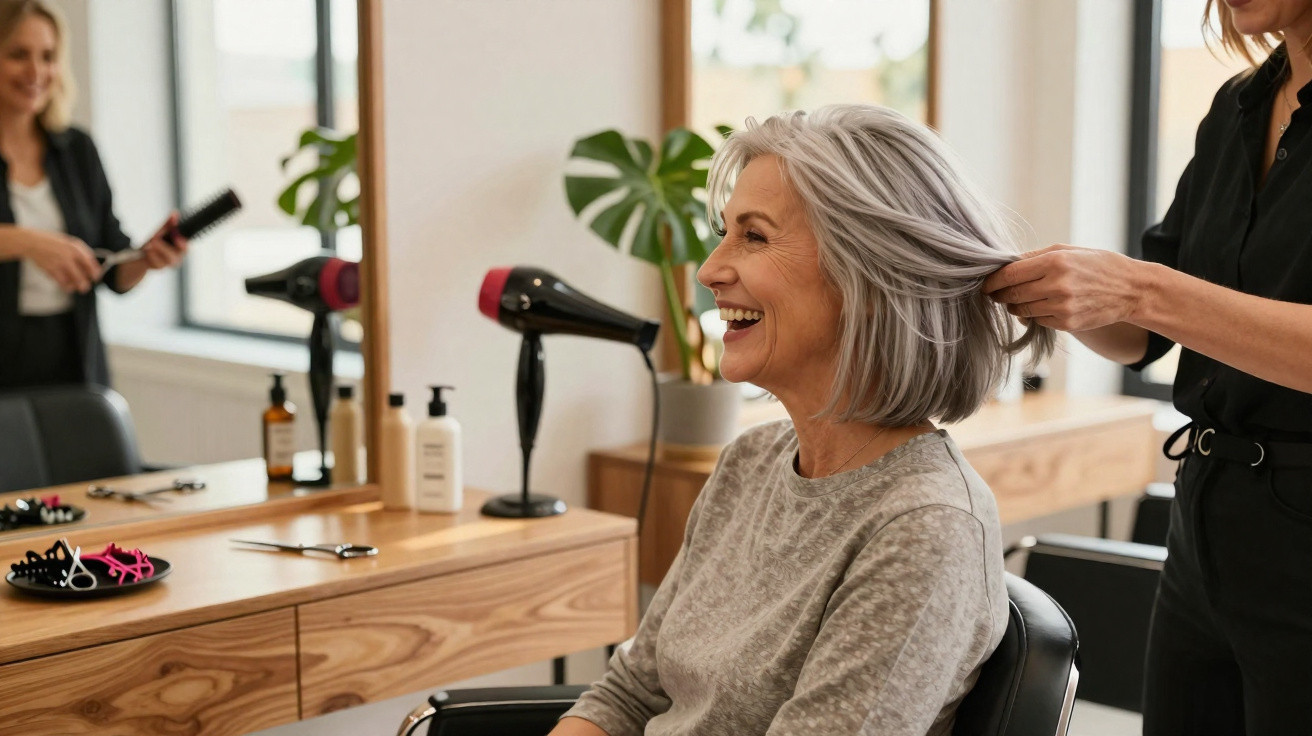
Short, structured styles can make grey feel strong and graphic, particularly through the temples. Longer cuts with layers turn it into softer bands of light. A fringe might conceal a streaky hairline - or it could spotlight a striking grey front panel. That’s why five minutes with a hairdresser who genuinely listens can be more valuable than the most viral dye job on Instagram.
Think of grey as the highlight you didn’t have to pay for. A subtle face-framing layer can bring brighter strands forward so they work like natural contouring. And a bit of lift at the crown - from a round brush or a quick blast with the hairdryer - stops hair falling flat and looking “tired”, which is one of the most common unspoken fears around going grey. Volume reads as energy; flatness reads as fatigue.
Most of us know that bathroom-mirror moment under brutal lighting, when every white strand looks ten times brighter and the urge to panic-dye feels urgent. The current shift is, in part, a pushback against that panic. On social media, people post before-and-after photos where nothing extreme happened - just a better cut, a cooler tone and a light-reflecting styling cream - yet the person suddenly looks cleaner, sharper, more defined, more themselves.
Psychologists who research body image often talk about “cognitive load”: the mental bandwidth you burn worrying about something you’ve labelled a flaw. Chasing roots is expensive in headspace. When grey becomes something you manage rather than conceal, that mental bill drops. You stop checking your scalp in every lift mirror. You get on with your life.
Handled thoughtfully, grey hair can even become part of your personal brand. Some executives who once worried it would undermine authority now find it adds gravitas - provided the cut is crisp and the styling is intentional. Artists and creatives lean into streaks and patterns, letting silver stripes flicker through curls or waves. There’s a quiet confidence in saying through your appearance: “Yes, I age. I also edit.”
Ultimately, moving away from strict dye routines isn’t really about pigment. It’s about freedom. Freedom to visit a salon because you want to refresh your look, not because you’re mortified by your roots. Freedom to take a selfie on an off day without angling the camera to hide your hairline. Freedom to get older in public without apologising for it from a bottle.
The next time a flash of grey catches you in the mirror, you might still wince - habits take time to fade. But instead of grabbing the darkest shade on the shelf, you may pause and think: how could this silver be arranged so it works for me? You might start noticing people whose hair tells a more layered story - not young, not old, simply present in the life they’re living.
At its best, hair isn’t camouflage. It’s a dialogue between who you were, who you are and who you’re becoming. Grey is just another colour in that language. What you choose to do with it is entirely yours.
| Key point | Detail | Why it matters to you |
|---|---|---|
| Grey blending instead of full coverage | Uses fine highlights and lowlights to soften contrast with grey | Creates a fresher look with less harsh regrowth and fewer salon visits |
| Texture and cut matter as much as colour | Structured cuts, layers and smoothing products tame wiry greys | Makes grey look intentional and stylish rather than neglected |
| Partial, strategic camouflage | Focus on hairline, parting and face-framing sections | Maximum impact with minimal effort, keeping the look natural and modern |
FAQ:
- How can I start transitioning away from full hair dye without a drastic change? Start by asking your colourist for subtle grey blending at the hairline and parting, then swap permanent box dye for semi-permanent glosses that fade gradually.
- Will grey blending make my hair look patchy or uneven? When it’s done properly, it prevents that: it breaks up strong lines and creates a more seamless, sun-kissed variation rather than patchiness.
- Can I still look “professional” if I let some grey show? Yes - “professional” usually comes from a clean cut, healthy-looking texture and deliberate styling, not from being completely grey-free.
- How often do I need to go to the salon with this approach? Many people can stretch appointments to every 8–12 weeks, using root powders or sprays only for key events or when they want extra polish.
- What if I try this and hate seeing my greys? You can always return to more coverage; beginning with blending is a low-risk way to test what feels right before you commit in either direction.




Comments
No comments yet. Be the first to comment!
Leave a Comment