

The stylist had barely turned the chair to face the mirror when the irritation began. That tiny moment of “this looks amazing” that slowly turns into “…and in a fortnight it’ll be a disaster again”? That was the woman beside me last Tuesday, combing her fingers through a flawless bob while already fretting about how quickly her hair grows.
Her hair looked glossy, crisp and carefully shaped - and yet she was mentally booking the next appointment before she’d even stood up.
The hairdresser just smiled and said, almost offhand: “You need a shape that survives your growth, not fights it.”
For a beat, the whole salon fell quiet.
Because that line landed right on the sore spot.
The cut that grows with you, not against you
Some haircuts look brilliant for six days and fall apart on the seventh. Others - rarer - seem to wear better as the weeks go by. The difference isn’t only in the snip; it’s in the structure.
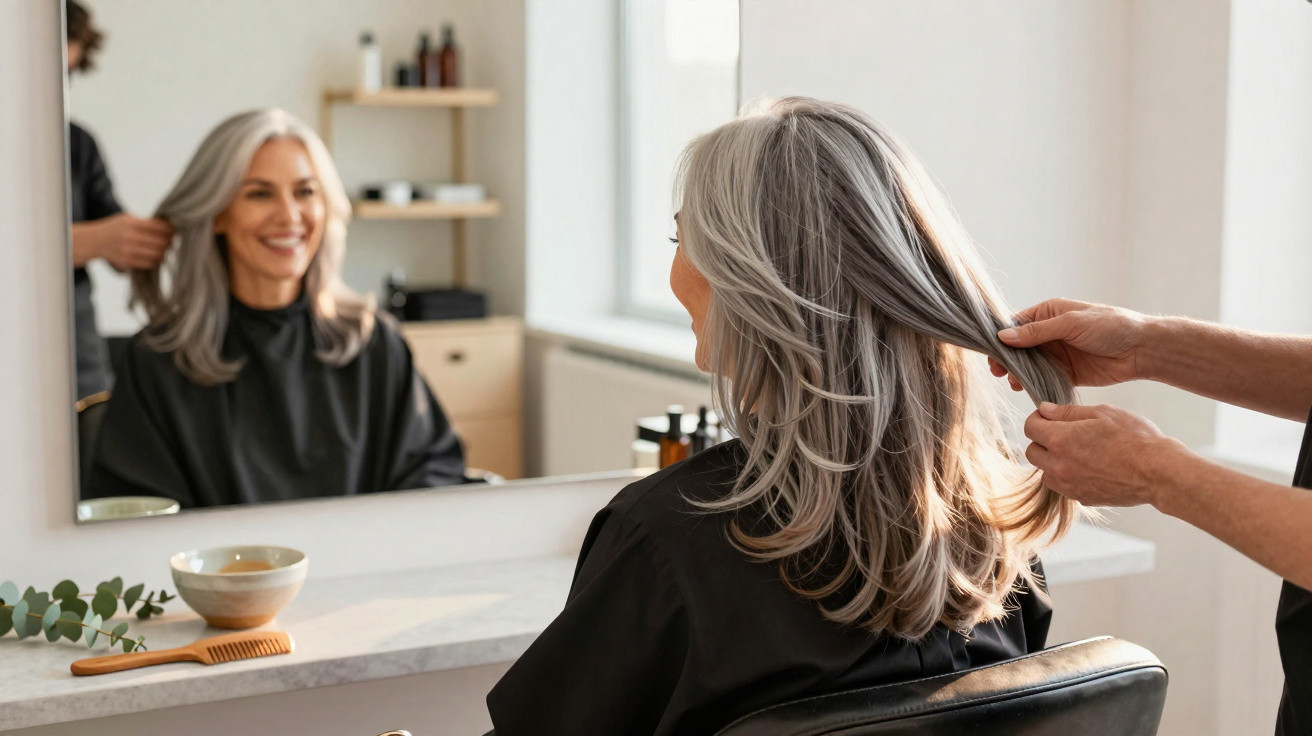
A style that holds together on fast-growing hair is usually designed around clear lines paired with gentle graduation. Think a long layered bob, a French bob, or a shaggy long cut that naturally drops into place.
What matters is where the weight sits. When a stylist works with your natural growth pattern, the cut settles rather than caves in - and that changes everything.
Take Léa, 29, whose hair grows at lightning speed. Every four weeks her fringe would creep into her eyes, her ends would kick out in odd directions, and she’d end up tying it back. It felt like she was paying for great hair… but only getting to enjoy it for about ten days.
Then her stylist proposed a long, layered bob that finished just above her collarbones, with slightly longer pieces at the front. No heavy fringe, and no razor-straight baseline that exposes every extra millimetre.
Six weeks on, she sent a selfie that could have passed as an “after” shot. The bob had eased, the layers had shifted slightly, but the proportions still worked. It didn’t shout “just left the salon” - it simply looked “intentional”.
That isn’t chance. It’s geometry. With fast-growing hair, any cut behaves like a sculpture in motion.
Very straight, ultra-blunt edges magnify each millimetre of regrowth. Leave it an extra week and the shape can suddenly read as uneven, heavy or flat. By contrast, light layering, softly rounded outlines and gentle texture disguise the growth.
Hair grows at roughly a centimetre a month. On a rigid cut, that centimetre can feel like an emergency. On a cut built with clever graduation, it simply nudges the volume and length without wrecking the silhouette. That’s why a growth-friendly cut doesn’t try to keep your hair frozen in time - it’s designed with the next stage in mind.
How to ask for a cut that still looks good in week six
It starts during the consultation, not with the scissors. Sit down and say plainly: “My hair grows fast, I need a shape that still looks good in six weeks.”
That one line shifts the approach. A good stylist will steer clear of overly precise lines at the nape if your hair tends to flick there once it gets longer. They may guide you towards a slightly layered, face-framing shape rather than a dense, blunt block.
Ask what will happen to the volume as your hair grows out. If they can demonstrate it with their hands or a comb, you’re in safe territory. If they can’t, treat it as a prompt to dig a little deeper.
A common mistake is bringing in an Instagram photo that was heavily styled - and cut for someone whose hair grows differently. You arrive with that picture of a micro-bob or baby bangs, and three weeks later everything feels wrong.
If that’s happened to you, you’re not alone. Hair grows, life gets busy, and appointments slip. Let’s be honest: nobody really does this every single day.
Instead, show reference pictures and then add the missing context: “This is the vibe I like, but I don’t want to cut it every three weeks.” That prompts your stylist to adapt the idea rather than copy it, and you’ll feel the benefit on rushed mornings.
“Good hair isn’t the day you leave the salon,” my stylist once told me. “Good hair is the day you wake up six weeks later, throw it into place with your hands, and it still looks like a decision.”
- Opt for soft edges: Slightly rounded bobs, airy shags, or long layers soften regrowth lines.
- Think “movement”, not “perfection”: A touch of texture keeps the cut flattering as it loosens.
- Avoid ultra-short, rigid fringes if your hair grows quickly and straight down.
- Choose lengths that still look intentional when they drop 1–2 cm.
- Book cuts for every 8–10 weeks instead of 4 if the shape is designed to evolve gracefully.
Living with a cut that actually forgives you
There’s a particular kind of relief in not monitoring your hair every 20 days. When a cut is meant to evolve, it gives you back headspace you didn’t realise you were spending.
You stop dividing time into “before haircut” and “after haircut”. You wear it down on days you’d normally hide it. You brush it once, scrunch a bit of cream through the ends, and you’re done.
Your hair still grows fast, obviously. The difference is that it grows within a plan rather than pushing against one - and you can see that in how you meet your own reflection before you head out.
| Key point | Detail | Value for the reader |
|---|---|---|
| Choose “evolving” shapes | Soft layers, rounded bobs, shags that blur regrowth lines | Longer-lasting cut that stays flattering as hair grows |
| Talk about growth at the consultation | Tell your stylist you want a six-week-friendly silhouette | Customised cut that anticipates how your hair will move |
| Accept a bit of texture | Light movement and graduation instead of rigid, blunt edges | Less maintenance, more “lived-in” style day after day |
FAQ:
- Question 1 What type of haircut is best if my hair grows very fast?
- Answer 1 Softly layered bobs, long shags, or mid-length cuts with movement tend to age best. They disguise regrowth far better than ultra-blunt or perfectly geometric styles.
- Question 2 How often should I cut my hair if I want to keep the shape?
- Answer 2 With a growth-friendly cut, many people can stretch to 8–10 weeks between appointments rather than 4–6, depending on hair type and personal standards.
- Question 3 Can I keep a fringe if my hair grows quickly?
- Answer 3 Yes - but go for a longer, curtain or wispy fringe that still looks intentional as it drops a little, rather than a very short, sharp bang.
- Question 4 Does layering always help with fast-growing hair?
- Answer 4 Light, well-placed layers help most people. Heavy, choppy layers can do the reverse and look messy sooner, so technique and distribution are key.
- Question 5 What should I tell my stylist to avoid high-maintenance cuts?
- Answer 5 Say clearly: “My hair grows fast, I don’t want to be here every month. I need a cut that still looks good after six to eight weeks, with minimal styling.” That gives them a practical brief to work with.





Comments
No comments yet. Be the first to comment!
Leave a Comment