

It nearly always begins in the same place: right in front of the mirror. The lighting feels a touch too unforgiving, the bathroom is oddly silent, and there they are - those silvery roots that have returned quicker than your last online delivery. You tip your head, tug at a strand, narrow your eyes. The lengths are still chestnut, or copper, or “chocolate 5.3” from the box. Yet at the scalp there’s a sharp line: two shades that refuse to blend.
You could cover it up again. You could squeeze in another last-minute “roots emergency” appointment. And then that small, stubborn question appears: what if I just… stopped? Grey hair looks gorgeous on other people, doesn’t it?
That’s precisely the moment reverse colouring shows up - softly, almost under the radar.
Why reverse colouring is changing the game after 50
From roughly 50 onwards, hair becomes brutally honest. Pigment starts to fade, the texture shifts, and the notorious “root regrowth effect” takes centre stage. Classic all-over colour, which looked seamless at 35, begins to demand near-military upkeep. Within three weeks, that bright line returns - like a reminder you never set.
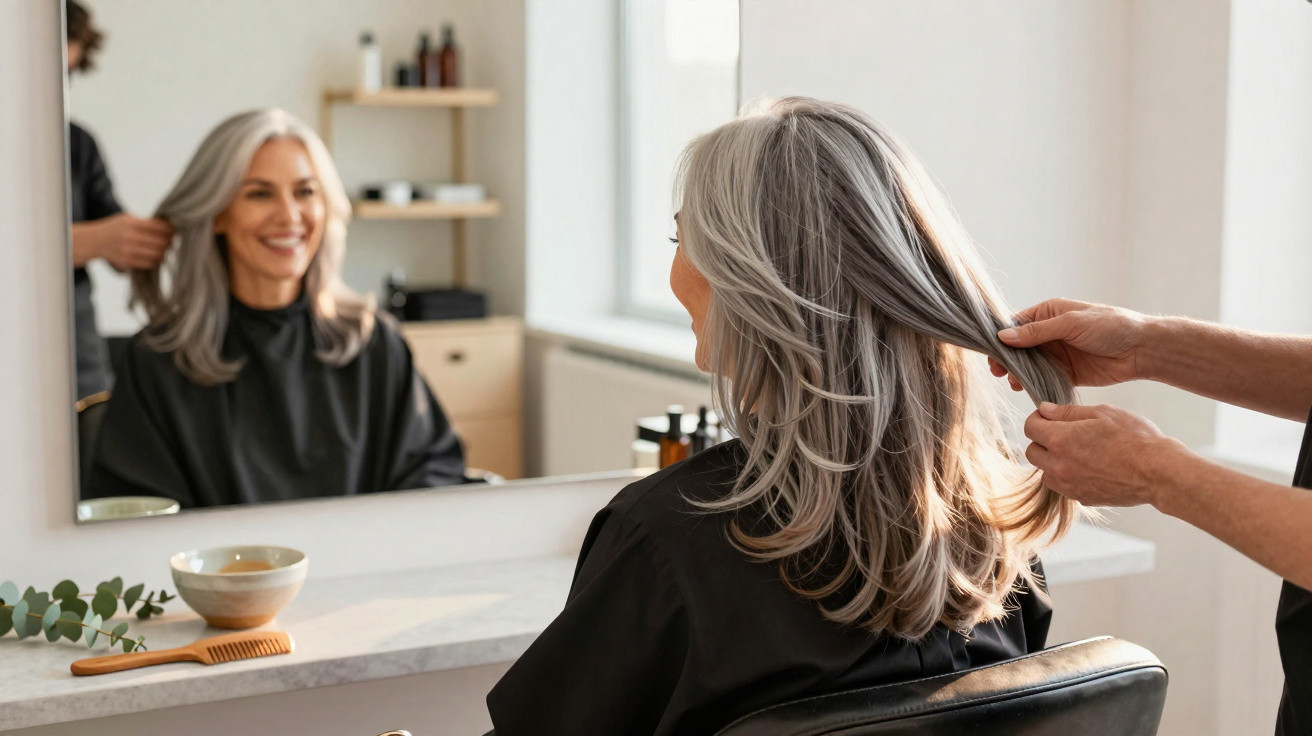
Reverse colouring is built on a straightforward switch in thinking. Rather than battling your grey or white base, you keep it - and you colour the lengths instead. Not the scalp. That one adjustment alters the whole look.
Consider Marie, 57. For a decade she chased her roots: salon visits, home kits, panicked touch-ups before dinners. Her hairline was always a fraction deeper than the rest - slightly too solid, like a painted band. Then her hairdresser proposed the reverse: stop masking the roots. Start from her natural white and add gentle, cool highlights and lowlights only through the mid-lengths and ends.
The change happened gradually, across six months. People began to comment, “You look rested,” and “Have you changed your skincare?” Nobody singled out her hair. Regrowth simply stopped being part of the conversation. The eye no longer picked up a dividing line - just light.
It’s almost maths. With reverse colouring, the lightest area sits at the roots, exactly where new hair appears. From there, the colour is subtly deepened down the hair shaft using translucent tones that are just a shade darker than your grey. Your brain reads it as believable.
That hard “helmet” line disappears because you’re no longer trying to make the scalp darker than everything else. Your base becomes a partner: a bright, luminous canvas. Rather than hiding maturity, reverse colouring arranges it beautifully.
How to do reverse colouring without wrecking your hair
The first rule is always the same: stop colouring the roots. Give it at least two to three months. Let a proper band of grey or white come through - even if it irritates you when your hair is tied back. A colourist needs that real starting point. After that, instead of laying down one flat colour, they work shades only through the lengths.
The colours used are typically semi-permanent, sheer, or glossy formulas. Picture light veils of beige, pearl, sand or very soft taupe, depending on your natural base. The aim is to soften the contrast, not wipe it out. The roots remain untouched - bright, natural, and alive.
The biggest mistake is trying to rush it. Requesting to “go grey” in a single appointment, or insisting every trace of old dye be removed in one aggressive stripping session. That’s when snapping, straw-like texture and instant regret appear. A skilled professional will talk you through a staged plan across multiple visits - not a miracle fix.
Another common reflex is packing too much pigment into the lengths, especially if you’re anxious about “looking old”. That can make features look harsher. A kinder result comes from restraint: transparent tones, fine ribbons of colour, and a slightly cooler note around the face to lift the complexion. Most of us know that moment when fear of ageing nudges us into choices that end up ageing us more.
“Reverse coloring is like dialling down the volume of color instead of turning it off,” explains Ana, a colorist who sees more and more women over 50 asking for it. “We respect the gray at the root, we play with light on the rest. It looks less ‘done’, more expensive, more free.”
- Begin with a consultation that looks closely at your true base colour and your skin tone.
- Schedule a transition over 3–6 months rather than one drastic, all-at-once change.
- Request translucent, glossy colour - not dense, opaque dye through the lengths.
- Keep the roots natural and luminous; focus work on the mid-lengths and ends only.
- Refresh the tones every 8–12 weeks, leaving the scalp alone.
Living with your new hair: more freedom, less drama
Once reverse colouring is established, day-to-day life shifts in small, practical ways. Your bathroom shelf clears out: no more emergency root kits tucked beside the cotton pads. Appointments become less frequent - stretching from every 3–4 weeks to every 8–10. And the mirror stops shouting “regrowth!”; instead, it shows hair that changes gradually, on its own schedule.
It can soften your relationship with ageing, too. You’re not performing a sudden, Instagram-ready “embrace the grey” moment. You’re making a compromise with it: reducing the contrast, keeping nuance - light and shade together. Honestly, nobody feels serene about it every day, but you may catch yourself touching your hair more, noticing how the white picks up sunlight rather than trying to hide it.
For some people, that extra breathing space triggers other tweaks: a lighter cut, a fringe grazing the brows, glasses with a bolder frame, lipstick half a shade brighter. Hair stops feeling like a battleground and becomes enjoyable again.
| Key point | Detail | Value for the reader |
|---|---|---|
| Flip the usual colouring logic | Natural grey/white at the roots, with soft shades applied only through the lengths | Removes the “root regrowth effect” without committing to fully grey hair |
| Move through the change in stages | A 3–6 month plan using glosses, highlights and small cut changes | A smoother transition, less damage and fewer regrets |
| Choose softer, translucent tones | Beige, pearl, sand or taupe veils rather than heavy, opaque dyes | Looks more youthful, brightens the complexion and keeps the hair feeling supple |
FAQ:
- Does reverse colouring work if I’m only 30% grey? Yes - provided there’s a visible grey band at the roots. Your colourist will keep the work on the lengths finer and lighter so it doesn’t look uneven.
- Can I do reverse colouring at home? You can maintain it with glosses or colour-depositing conditioners, but it’s best to have the initial plan set up in a salon. Placement and tone selection need precision.
- Will my hair be damaged by the process? If it’s done properly, reverse colouring is gentler than years of all-over root coverage. You’re colouring less hair, less often, using sheerer formulas.
- How often will I need touch-ups? Many women settle into a rhythm of every 8–12 weeks (sometimes longer), depending on growth speed and how much contrast you prefer.
- What if I decide later to go fully grey? Reverse colouring can make that transition easier. Because the lengths are already lighter and blended, you can simply extend the time between glosses and gradually go shorter with the cut.





Comments
No comments yet. Be the first to comment!
Leave a Comment