
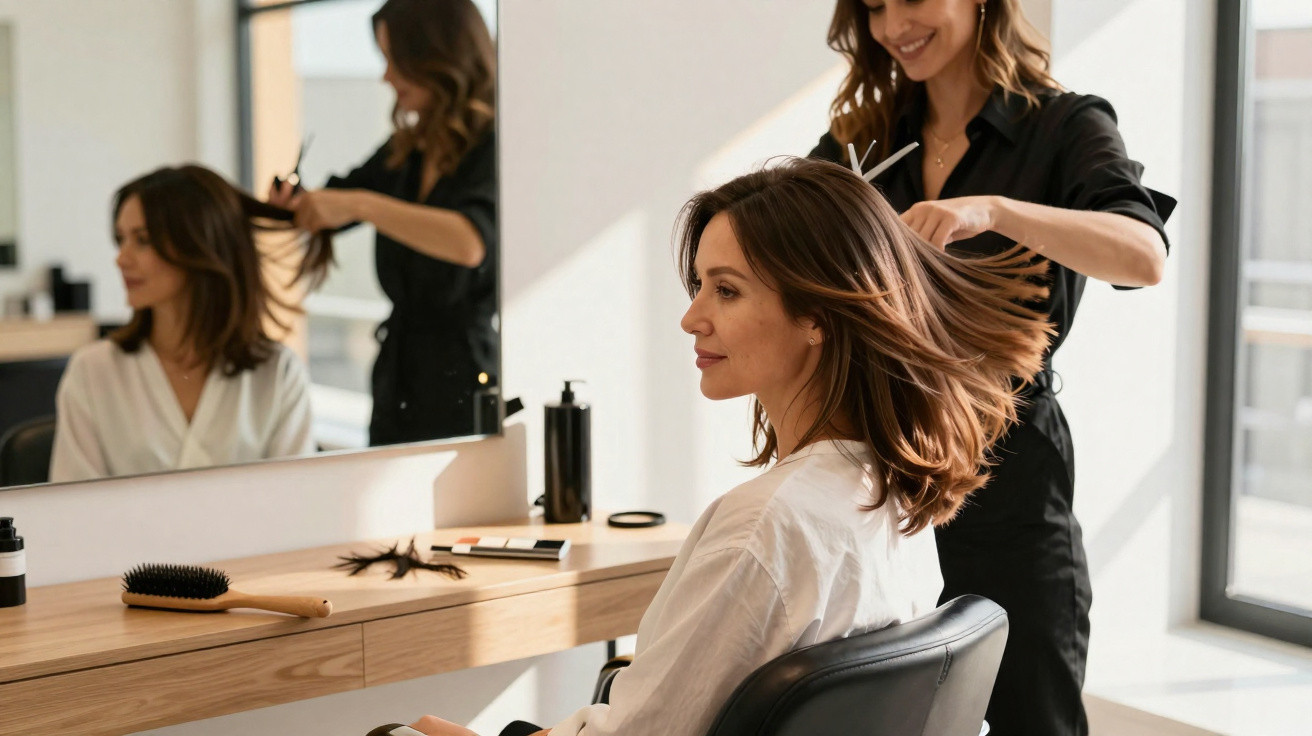
The salon was already buzzing when she came through the door: quick stride, chin up, and the unmistakable expression that says, “Do whatever you have to, just take it all off.” Her hair sat at shoulder length, softly brushing her collarbone, with a few silver strands catching the overhead light. Within ten minutes, the consultation had slid into something more personal: “Everyone keeps saying short hair is ‘fresh’ after 50. Maybe that will make me look younger?” The stylist-someone who’s been cutting hair longer than most influencers have been alive-set his comb down and gave the sort of smile that means, “We need to talk.”
What he said next contradicted the advice she’d been hearing for years.
“Short hair after 50 will age you, not refresh you”
The seasoned hairdresser I spoke to didn’t pause for breath: “I spend half my week correcting ‘anti‑age’ cuts that age women by ten years.” The line lands heavily because it clashes with the old magazine mantra that ran through the 1990s and 2000s: hit 50 and cut it all off. In his chair, it plays out constantly-women arrive with tidy, sensible short cuts that somehow look… lifeless, severe, and drained.
Short hair can absolutely be stylish. The issue is that, on mature features, it can quickly sharpen what you’d rather soften-hardening lines and making the face look smaller rather than lifted. It’s not about age; it’s about geometry.
He told me about Claire, 57, who came in wearing a textbook pixie: tight at the sides, a touch longer on top. It was well executed and technically immaculate. Yet when she looked at herself, all she could see was her neck, her jaw, and the slight looseness under her chin suddenly highlighted like a spotlight. “I feel naked,” she confessed. “And not in a good way.”
Instead of starting over, they eased the shape back over time-allowing length to return around the ears, letting hair skim the nape, and building movement near the cheekbones. Two months later, in that in-between stage with a cut grazing the jaw, she looked noticeably less stern. Same face. Same age. A completely different frame.
That’s his point: at 50, hair stops being a simple style decision and becomes a frame, a filter, sometimes even a shield. When short hair is cut too tight or too controlled, it pulls attention straight to changes in skin texture, to asymmetry, and to every sign that you’ve lived. Keeping a little length around the face helps soften shadows and interrupt harsh lines. The trick is not to erase age, but to stop the haircut from underlining every single year of it.
The real youthful effect is movement, not length
With new clients over 50, he now follows a small routine. Before discussing how many centimetres to take off, he asks them to turn their head from side to side, then watches the hair’s response. Does it follow the motion? Does it spring? Or does it sit rigidly, helmet-like? “What makes a face look fresh isn’t short hair,” he says, “it’s hair that moves.”
So his focus shifts to layering, lightness, and direction-rather than simply cutting everything shorter. Even a jaw-length bob can read younger than a pixie if it swings as you walk and doesn’t cling to the scalp.
He described a woman who arrived with a celebrity pixie saved on her phone. She was 63, quite petite, with fine hair and glasses. On the actress, the cut looked lively and bold. On her, he explained carefully, it could easily tip into a “school headmistress” feel. Instead, he proposed a slightly longer shape: shorter at the back, the front brushing the cheekbones, with some lift at the crown.
She hesitated, then agreed. A fortnight later she returned carrying photos from her grandson’s birthday. Same jeans, same jumper, same face-yet she looked brighter, almost playful. It wasn’t short-short, but it moved; it danced. No one asked whether she’d cut it “because of her age.” They simply told her she looked well.
His reasoning is straightforward. After 50, the face naturally loses some fullness and elasticity. If the hair is cropped too close, it echoes that loss. Head shape-and any little irregularities-becomes more noticeable. Add a touch of elevation at the crown, keep a few pieces skimming the cheekbones, and create a bit of “air” between scalp and hair, and the effect can be transformative. It mimics the volume the skin no longer provides.
He calls it “borrowing youth from your haircut.” Not trying to pass for 30-just refusing to let a rigid, ultra-short style strip away the remaining softness. And, realistically, almost nobody is doing a daily blow-dry with three brushes and a round-brush curler. The cut needs to behave on low-effort days too, with natural movement built into the shape.
How to ask for a cut that doesn’t age you overnight
His first practical tip is almost a change of language: stop asking only for “shorter” or “more practical”. Turn up using words like “lighter,” “softer around the face,” “movement,” “air.” Those prompts steer the scissors in a different way. Rather than taking everything up to ear level, a skilled hairdresser will leave purposeful length at the temples, along the neck, and near the jaw.
He also recommends identifying where your features feel softest-cheekbones, eyes, lips-and letting the cut guide attention there. If the jawline or neck are your least favourite areas, you don’t want the shape pointing straight at them. A small fringe or a side curtain sitting around eyebrow height can create a subtle lift through the top half of the face.
What trips many women up, he says, is chasing “easy” above everything else. They come in tired after years of juggling children, work, ageing parents, and ask for something that dries in five minutes and “doesn’t move.” Then they’re shocked when it looks rigid and slightly severe. Most people recognise that moment: you choose pure practicality and suddenly feel you’ve misplaced a part of yourself when you catch your reflection.
He mentions common missteps kindly-taking the neckline too high, over-thinning at the crown, or straightening a fringe across a forehead that has become more expressive. Often, a softer, slightly undone structure photographs far better than the perfectly flattened style we’re told looks “polished.”
“Past 50, I don’t cut short to make women look younger,” he tells me. “I cut to make them look alive. That’s not the same job.”
- Keep some length around the face
Even a few centimetres that touch the jawline or the nape can soften angles and prevent the ageing “helmet” effect. - Ask for volume at the crown, not at the sides
Height at the back of the head creates lift, while too much width around ear level can make features seem heavier. - Avoid ultra-straight, razor-sharp lines
Gentle layers, broken edges and a touch of texture blur wrinkles rather than spotlighting them. - Think colour and cut together
A harsh, single-tone colour on an ultra-short cut can harden the overall look. Slightly lighter pieces around the face act like built‑in lighting. - Test before you chop
Pin your hair up to roughly the length you’re considering and live with it for a day at home. If every mirror makes you feel older, the haircut probably will too.
Short, long, or in‑between: the real question behind the scissors
Ultimately, the argument about short hair after 50 often masks a deeper one: how do you want to be seen-and how do you want to see yourself? This veteran hairdresser doesn’t offer a one-size-fits-all formula. He offers questions instead. What do you actually like about your face? When was the last time you genuinely liked your hair? Which version of you feels most like “you”: the woman with a low ponytail, the one with big curls, the one with a sweeping fringe?
He’s clear that some short cuts look incredible-but they’re rarely the ultra-condensed, hyper-strict styles marketed as “age appropriate.” The best versions are softer, less uniform, a little irregular, with a hint of rebellion that says, “I’ve lived, and I’m not shrinking to fit anyone’s idea of my age.”
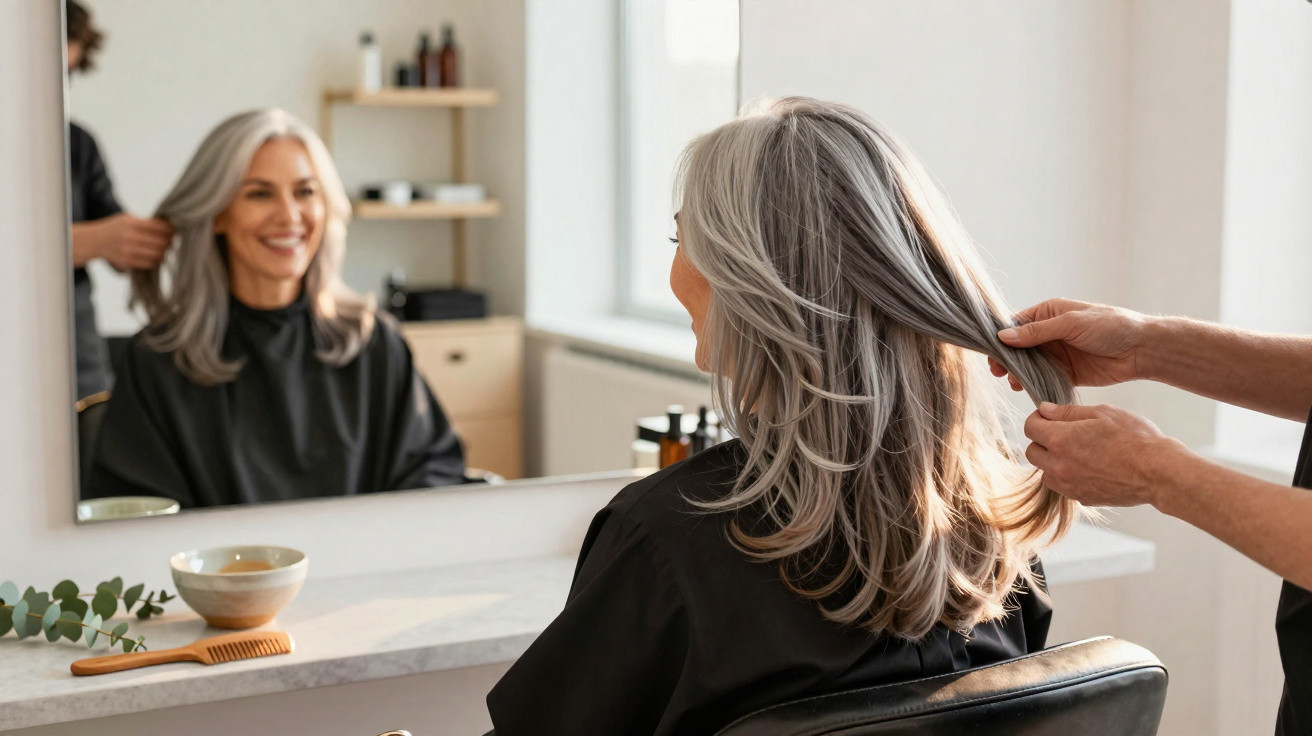
The bigger shift may be this: stopping the habit of cutting hair as though you’re entering a smaller, narrower category, and instead letting it reflect the story you want to tell now. For some, that means keeping a shoulder-length curtain of hair, with silver streaks and waves that tangle in the wind. For others, it’s a short, airy crop that shows off a strong neck and bright eyes-without freezing anything into place.
Somewhere between worrying about looking “too old” and being nervous about change, the scissors pause in mid-air. Perhaps the bravest step is sitting in the chair and saying, “I don’t want to look younger. I want to look like myself, but lighter.” The length becomes the outcome, not the rule.
| Key point | Detail | Value for the reader |
|---|---|---|
| Short hair can harden features | Ultra-short, tight cuts expose neck, jawline and skin texture, emphasizing signs of aging | Helps you avoid cuts that unintentionally age the face |
| Movement beats length | Soft layers, lift at the crown and hair that “dances” create a fresher overall impression | Gives clear direction to discuss with your hairdresser for a more flattering result |
| Keep softness around the face | Some length at the temples, nape and jawline frames the face and diffuses harsh lines | Offers a simple, practical guideline for any future haircut |
FAQ:
- Should women over 50 avoid short hair completely? No. The issue isn’t “short” but “too tight and too rigid.” A soft, textured, slightly longer short cut can be very flattering, while an ultra-short, sharp style may age the face.
- What is the most flattering length after 50? Most hairdressers mention between the jaw and just below the shoulders as the most forgiving zone. It allows movement, framing, and volume at the crown without overwhelming the face.
- Does letting hair grow long always make you look younger? Not necessarily. Very long, heavy hair that hangs flat can drag the features down. The key is lightness and shape, not absolute length.
- How often should I adjust my cut after 50? Every 6 to 8 weeks for shorter or layered styles, and every 8 to 12 weeks for mid-length cuts. Tiny, regular adjustments preserve the shape that flatters you most.
- What should I tell my hairdresser if I’m afraid of looking older? Say clearly: “I want softness around my face, movement, and a shape that doesn’t harden my features.” Then show photos where you like the overall vibe, even if the length isn’t exact.




Comments
No comments yet. Be the first to comment!
Leave a Comment