
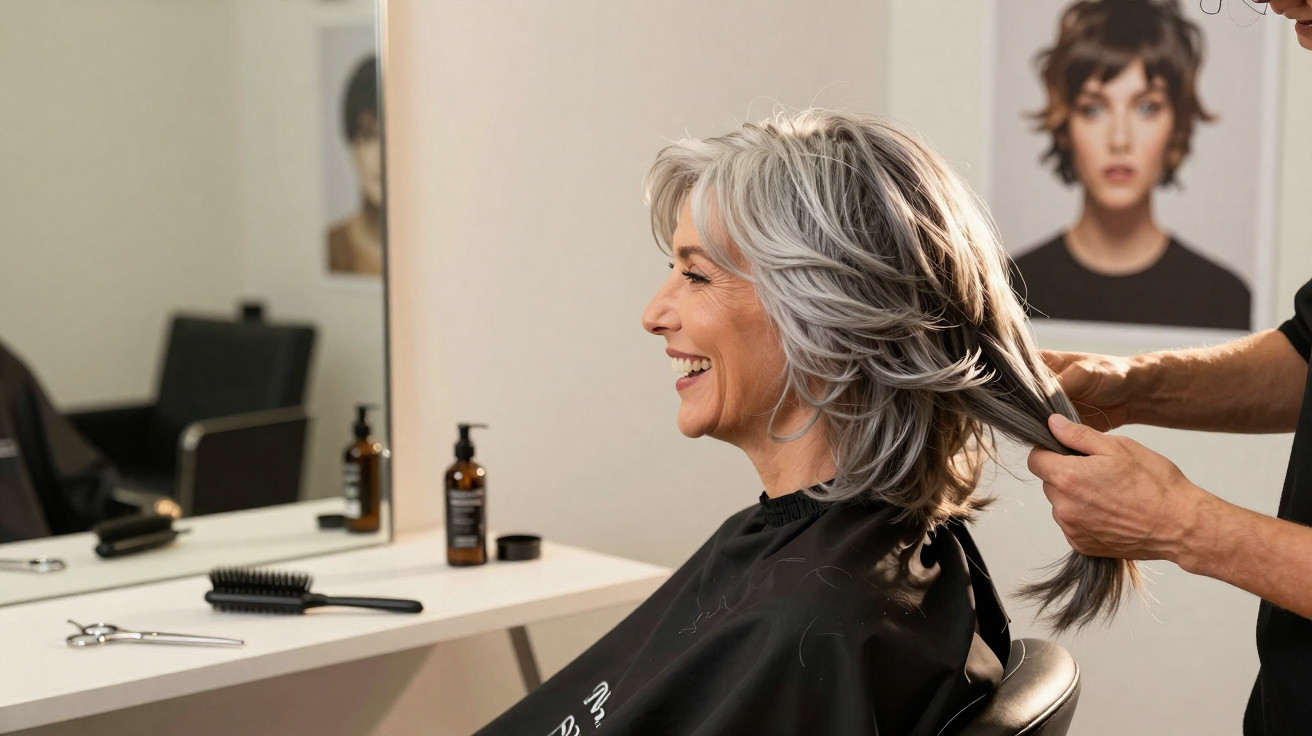
The first time you properly notice your salt and pepper hair, it’s almost never under kind lighting. It tends to happen late at night, leaning into the bathroom mirror a bit too closely, when you realise the “few white strands” have quietly become a whole terrain. You angle your head, pull up a section, and the idea lands: “Maybe I just need a fresh cut. Something younger. Sharper.”
You reach for your phone and flick through photos of polished silver bobs and striking grey pixies. On everyone else, it looks effortless-cool, self-assured. Then you lock the screen, meet your own reflection again, and the uncertainty rushes in.
What if the wrong cut makes me look older instead of refreshed?
The first big mistake: choosing a “young” cut that fights your salt and pepper hair
Speak to any hairdresser who regularly works with grey and white hair and they’ll tell you: it’s the same story on repeat. A client in her 40s, 50s, sometimes 60s arrives clutching a screenshot of a 25-year-old influencer wearing icy highlights and a razor-clean bob. She wants that exact look. “I need something that makes me look ten years younger,” she says.
The motivation is completely understandable. The problem is unforgiving. When a cut is copied without adjusting for the texture and light-reflection of salt and pepper hair, it can set the face in a harsher way, emphasise fatigue, and draw attention to every bit of dryness through the lengths.
Take Sophie, 53, who let her roots come through gradually during lockdown. Her natural blend of white, silver and darker strands looked incredible… on the days she styled it. The rest of the time, she felt “washed out” and slightly drawn.
She booked in with a photo: a blunt, chin-length bob on a much younger woman-same length, the same straight perimeter, the same centre parting. In the chair, it read as modern. A fortnight later, she admitted to her stylist that she felt more rigid and severe, and people kept asking whether she was “more tired than usual”.
That response isn’t a coincidence. Salt and pepper hair catches light differently from dyed hair. Roots can look brighter, ends can read more matte; it may be drier, or frizzier, or both. On that kind of fibre, an ultra-blunt, highly structured shape can create a hard outline around the face.
Your eye gets pulled to the contrast: sharp edges plus metallic highlights. It’s not especially forgiving of fine lines, dark circles or a softening jawline. A supposedly “young” cut that’s stunning on glossy, even-toned brunette hair can turn into a magnifying glass for every little sign of time when grey and white strands are in the mix.
The second big mistake: ignoring volume, movement, and the neckline
With salt and pepper hair, the genuinely refreshing ingredient isn’t a specific length-it’s movement. Once you’ve decided to embrace your silver, one of the biggest pitfalls is choosing a shape that sits dead flat around the face and neck.
A limp bob, a medium length that’s left too long with no layers, or a formless pixie that grows out like a helmet can all pull the features down. When hair clings to the jaw and neckline without air or texture, the face can appear heavier, expressions seem less animated, and the natural brightness of grey and white gets swallowed.
Consider Marcela, 61, with beautiful wavy silver hair down to the middle of her back. Over the drying time, she asked for “something practical, short enough, not too complicated.” The stylist took it to a straight bob just below her jaw, kept it one-length, and thinned the ends to “lighten” it.
For the first few days-fresh from a salon blow-dry-it felt soft and wearable. Then she washed it at home and everything fell away. The weight sat at the bottom, there was no support at the roots, and the thinning had flattened her natural wave. The hair hung against her face and neck like a curtain. She felt as if she’d aged five years in one month.
There’s a straightforward explanation. Grey and white hair often loses density exactly where we want it: at the roots and through the crown. If the cut removes even more substance there, while leaving heavier sections underneath, it flips the visual “youth triangle” the wrong way.
A lifted look reads upwards: volume near the cheekbones, movement at the temples, and a neckline that can breathe. A weighted shape does the opposite-it presses everything down and draws attention to the neck and jawline, where skin is often less firm. One plain truth: a cut that ages you is almost always a cut that suffocates your silhouette.
How to really rejuvenate a salt and pepper haircut (without lying to yourself)
A truly rejuvenating cut for grey and white hair begins with a simple intention: lift the face. That doesn’t automatically mean going very short. It means building support and softness where your features benefit most.
Ask your hairdresser for gentle layers that start around the cheekbones, a curtain fringe or tapered fringe if that suits you, and a neckline that doesn’t drag the eye down to the heaviest part of your hair. Even at medium length, a cut can look strikingly fresh when the face-framing is shaped with small, subtle pieces that shift as you talk or smile.
Many people come in with a single request: “I don’t want something complicated.” Underneath that is usually the worry that they’ll need to blow-dry and style every day. In reality, hardly anyone does.
The aim is a cut that settles back into shape on its own. That means collaborating with your natural texture rather than battling it. If your grey hair has a wave, make that wave your ally with layered lengths and a drying routine that enhances it. If it’s straight, go for something cleaner and more graphic-but keep the edges softened. A good test: if you have to style it excessively to like it, the cut isn’t really tailored to you.
“With salt and pepper hair, it’s not about erasing the years,” says Claire, a Paris-based stylist who specializes in gray transformations. “It’s about drawing the eye to what’s alive in your face: your eyes, your smile, your posture. The haircut should be the frame, not the main character.”
- Request soft layers that move towards the face, rather than arbitrary thinning through the ends.
- Keep noticeable fullness at the crown so the features look visually lifted.
- Slightly open up the neckline so hair doesn’t stick to the neck.
- Experiment with a side parting or a flexible fringe to soften severe lines.
- Always check the cut from the side and the back, not just the front mirror.
Living with your salt and pepper cut: more attitude than age
After the cut, what makes the biggest difference is how you wear your salt and pepper hair day to day. A softly layered bob paired with good posture, a touch of texture spray and a bit of lip colour gives a completely different impression from the very same cut tied into an old elastic at the nape for weeks on end.
The two mistakes that age most people aren’t caused by grey hair itself, but by fighting the wrong battle: chasing a “young” cut copied from someone with entirely different hair, and forgetting how much volume and movement matter as hair changes over time. Avoid those traps and the salt and pepper blend becomes a strength. It catches the light, gives depth to simple shapes, and tells a story rather than trying to conceal one.
There’s a quiet power in walking into a room with a well-cut head of grey, silver and white hair-and not apologising for it. Not rigidly set, not desperately straightened, just alive. Most of us know that crossroads: another round of colouring, or the courage to accept what the mirror is already showing.
Maybe real rejuvenation isn’t about stripping away ten visual years. Maybe it’s about easier mornings, freer movement, a cleaner neckline, and a cut that keeps up with you instead of holding you back-the kind that prompts: “You changed something… you look rested.”
| Key point | Detail | Value for the reader |
|---|---|---|
| Adapt the cut to salt and pepper texture | Soften lines, respect natural wave, avoid overly blunt shapes | Reduces the risk of a hard, ageing effect |
| Prioritise volume at the right places | Support at the crown and around cheekbones, lighter near the neck | Lifts features and brightens the face |
| Focus on movement, not length | Contours that move when you talk and smile, airy neckline | Creates a fresher, more dynamic silhouette |
FAQ:
- Is salt and pepper hair always ageing? Not at all. The ageing effect mainly comes from a cut that isn’t adapted properly or from neglected texture, not from the grey and white tones themselves.
- Which length is most rejuvenating with grey hair? There’s no magic length. What usually works best is a length that keeps movement around the face and doesn’t weigh down the neck.
- Do I need layers if I have fine salt and pepper hair? Yes, but they need to be very controlled. Light, strategic layers add lift and body, while aggressive thinning can make hair look even finer.
- Is a fringe a good idea with white or grey hair? Soft, tapered fringes or curtain fringes can be extremely flattering and rejuvenating, especially for bringing attention to the eyes.
- How often should I trim a salt and pepper cut? Every 6 to 10 weeks for most people, depending on the style. Regular micro-trims keep the shape looking fresh and stop the ends from appearing frayed or dull.





Comments
No comments yet. Be the first to comment!
Leave a Comment