
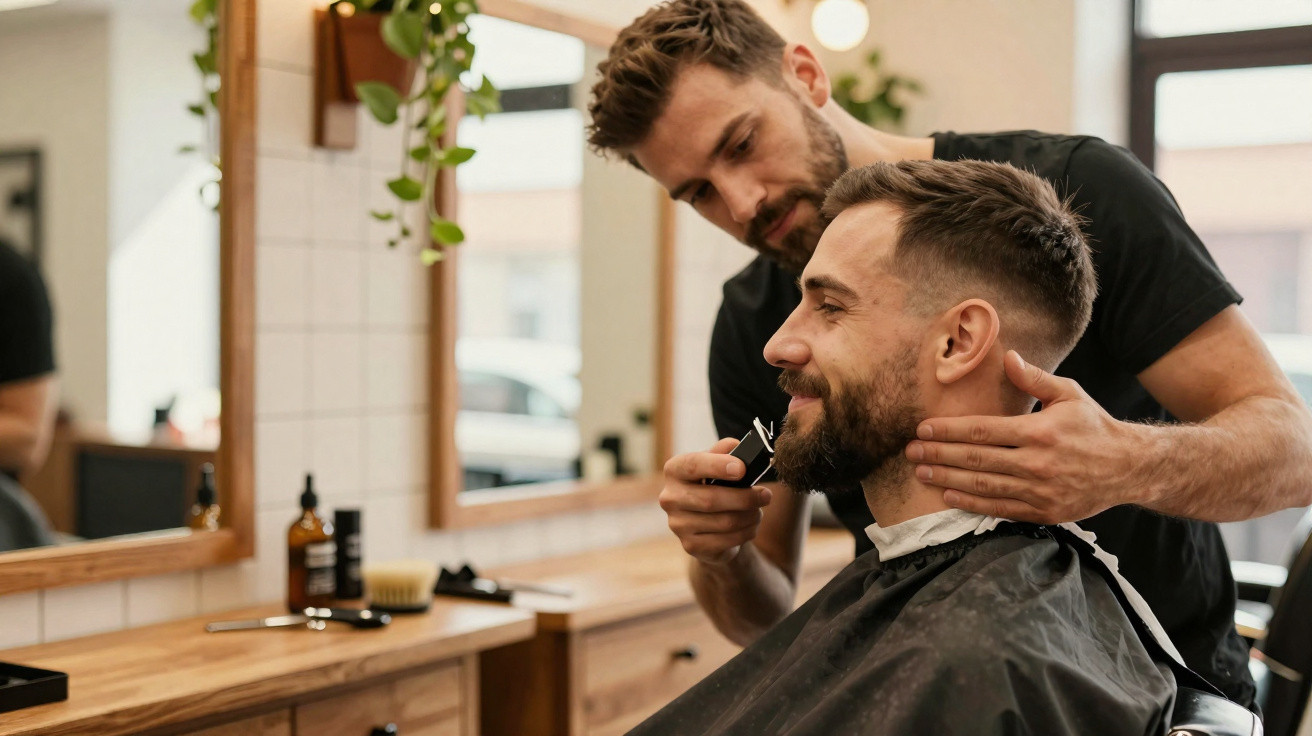
The bloke in the barber’s chair looked properly beaten. Mid-30s, decent hair, a crisp shirt… and a beard that was thin and uncertain-more “three stressful weeks of growth” than “effortless masculinity”. The barber didn’t even blink. He reclined the chair, narrowed his eyes, then gave the kind of grin a mechanic wears when the engine’s clearly salvageable. “You’re trying to grow a Viking beard,” he said, “with a teenager’s growth pattern.” The guy laughed-half awkward, half grateful.
The barber picked up his trimmer and set about building shape: a sharp line along the jaw, gentler work through the cheeks, and more heft left on the chin. Ten minutes on, it was the same face-but now it looked cleaner, more deliberate, more grown-up. Same hair. Same rate of growth. Completely different presence.
Some beard styles argue with your genetics.
This one makes them work for you.
The beard style barbers quietly push for slow growers
If you ask three barbers what to do with slow, patchy growth, most of them will look at your chin first-not your cheeks. They’ve seen the pattern: when growth is sparse, the winning move is a short, close style that puts the visual “weight” on the chin and jaw while keeping the cheeks light, faded, or nearly bare. Think short boxed beard with a goatee-leaning focus, not a full-on lumberjack.
The point isn’t to manufacture extra hair. It’s to use what you have in smarter places. When the outline is clean and the length is kept under control, even a modest beard reads as an intentional choice-rather than an unsuccessful attempt at something thicker.
A barber I spoke to in Paris described a regular, Sami, who’d been chasing a full beard for years. He’d grow it for a month at a time, convinced it would eventually “fill in”. It never did: the cheeks stayed see-through, the neck fluff took over, and colleagues kept asking if he was “between shaves”. He got so fed up he nearly ditched it entirely and went back to being clean-shaven.
His barber steered him in a different direction: fade the cheeks down, cut a crisp line from sideburn to moustache, and let the chin carry about 80% of the volume. Two weeks later, nobody was commenting on the beard at all. Instead, they were asking whether he’d lost weight.
That’s the understated magic of the short boxed / goatee-focused approach barbers keep recommending. Thin cheeks stop being a flaw and start acting like negative space that sharpens your face. A low, tidy cheek line removes the worst patchiness altogether. A slightly fuller chin then “anchors” the lower face and adds shape to your profile.
It’s basically geometry: darker areas read as contour. So a stronger line along the jaw and around the mouth can visually sculpt features that your genetics didn’t fully sketch in. You’re not trying to pretend you’ve got a huge beard-you’re refining your face the way a good crop fixes a photo.
How to wear the “slow-growth” beard like a pro
The framework is simple. Keep the cheeks very short or close to clean, blending down softly from the sideburns until there’s almost nothing. If your growth allows, let the moustache connect into the chin, and keep that section 2–3 mm longer than the rest. Under the jaw, keep a clear neckline that sits just above your Adam’s apple and follows the natural curve of the jaw.
Most barbers will label it either a short boxed beard or a defined goatee with connected sides. The plan doesn’t change: lighter sides, purposeful density around the mouth and chin.
Where most lads come unstuck is trying to “out-wait” their patchiness into a full beard before the base is ready. They stop trimming for a month and hope length will disguise the weak areas. Usually it does the opposite: thin spots look thinner beside stronger growth, and the overall effect turns scruffy rather than solid. We’ve all had that moment catching ourselves in a shop window and thinking, “Oh. That’s not rugged. That’s just tired.”
Realistically, nobody maintains perfect lines every day. But setting the shape once or twice a week is enough to transform how it looks.
Barber Luis, who runs a busy shop in Madrid, told me: “Men with slow growth always think they need more length. Most of the time, they need less. Clean edges, smart lines, and a style that doesn’t pretend they’re someone else’s genetics.”
- Keep cheeks light – Go for a low, clean cheek line, or fade into stubble that stops before the patchiest zone.
- Anchor the chin – Leave the hair just under the lip and on the chin slightly longer to strengthen the jaw.
- Guard length matters – Around 3–6 mm suits most men with slow growth.
- Neckline discipline – Set the line just above the Adam’s apple, tracking your jaw-not your natural neck fuzz.
- Slow, not lazy – Sparse growth can still look strong when the shape is clearly intentional.
Living with a slow-growth beard without hating your face
The moment you accept that your beard comes in slowly and unevenly, the tension eases. You stop fighting your reflection and start working with it. That’s exactly where this barber-approved style earns its keep: it doesn’t demand six months of patience. It gives you a version of yourself that looks “done” in about ten days. Grow to a comfortable short length, set the outline, then maintain it.
Some men even end up liking the limitation-less trial and error, more polish.
| Key point | Detail | Value for the reader |
|---|---|---|
| Strategic style | Short boxed / goatee-focused beard that uses density on chin and jaw | Turns slow growth into a defined, flattering look |
| Clear edges | Low cheek line and clean neckline above Adam’s apple | Prevents the “messy and unfinished” effect |
| Realistic routine | Weekly shaping, not daily perfection | Sustainable grooming for busy, non-obsessive men |
FAQ:
- Question 1: What if my cheeks are almost completely bare-can I still wear this style?
- Answer 1: Yes. In that situation, commit to a goatee-leaning version: moustache and chin, plus a tight jawline connection if it grows there. Keep the sides ultra-short or clean-shaven so the contrast looks deliberate rather than patchy.
- Question 2: How long should I grow it before the first proper shape-up?
- Answer 2: For slow growers, 10–14 days is usually plenty. You need enough length to reveal your growth pattern, then your barber can build a shape around it instead of waiting indefinitely for “more”.
- Question 3: What trimmer setting suits this short look best?
- Answer 3: Most barbers recommend 3–6 mm for the main beard, then one step shorter on the cheeks if you’re fading them. Keep the chin on the longer setting to add visual depth.
- Question 4: Will oils or supplements genuinely make my beard grow faster?
- Answer 4: They can improve the quality of the hair you already grow-especially if your skin is dry-so hairs break less and look healthier. But they won’t magically turn you into a full-beard bloke. Shape and placement do far more visible work than any product.
- Question 5: Should I take a reference photo to the barber?
- Answer 5: Definitely. Bring a picture of a short boxed beard or a tidy goatee you like, then let your barber tailor it to how your beard actually grows. A good barber will tell you what’s realistic for your face.





Comments
No comments yet. Be the first to comment!
Leave a Comment