
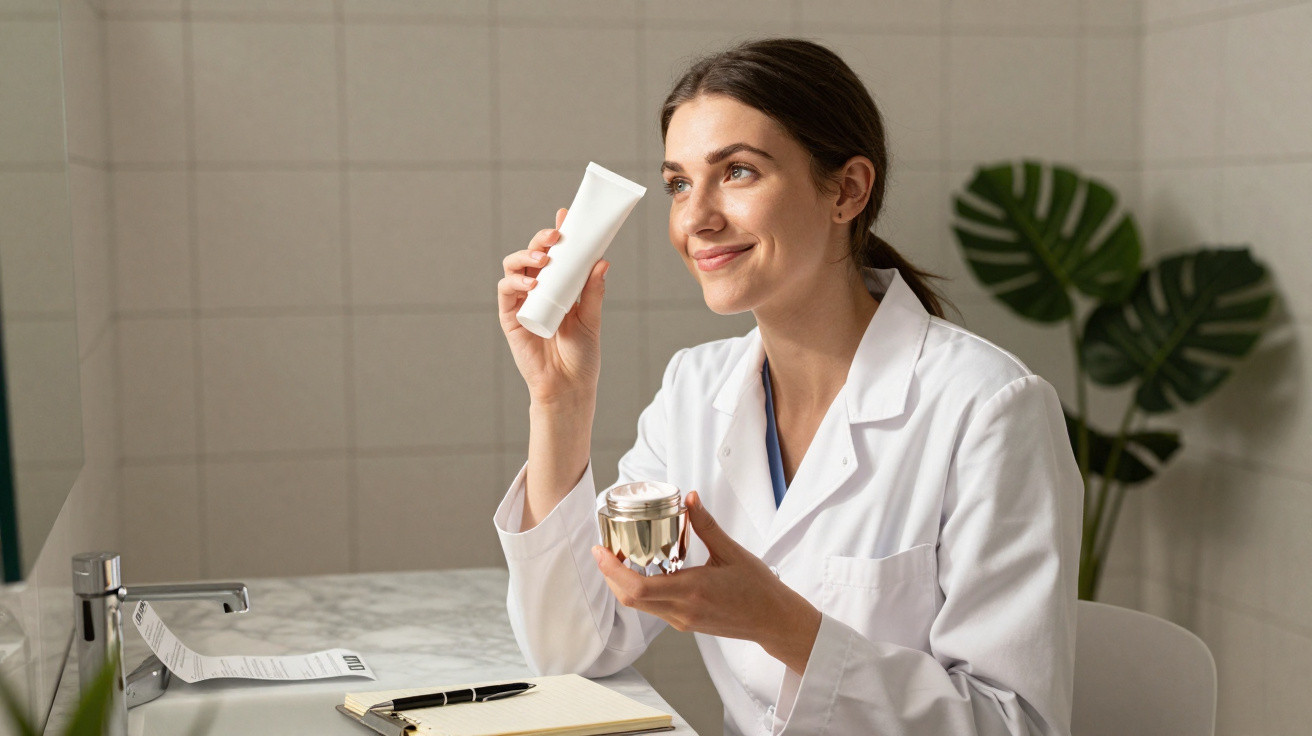
At 8:27 a.m., under harsh strip lighting in a chemist’s aisle, a woman in a trench coat stands perfectly still between two shelves. In her left hand sits a glass pot of $120 “luminosity” cream. In her right, a squat plastic tub that costs less than what she spends on lunch during the working week.
With the sound muted, she scrolls TikTok using her thumb, her expression tightening clip by clip. Dermatologists appear one after another, each lifting the cheap tub as if it were a sacred artefact. The subtitles all say some version of the same line: “This beats your luxury moisturiser.”
In the convex security mirror, her face looks weary-and faintly duped. She can almost see the years of tiny Sephora bags, the towers of emptied jars, the silk-smooth finishes and perfume-heavy promises.
So which pot ends up back on the shelf first?
Why dermatologists are suddenly obsessed with “ugly” cheap creams
Speak to a dermatologist privately and you’ll often hear a blunt confession: a good chunk of what’s in your #shelfie is there for the branding, not because your skin benefits.
The budget creams-those anonymous white tubs on the bottom shelf-aren’t designed to look good in photos. There are no rose quartz spatulas, no marble-effect lids. What they do have are ingredient lists that are almost defiantly plain: petrolatum, glycerin, ceramides.
And yet those very formulas are what’s driving the latest social-media uproar. Doctors are posting side-by-side tests, arguing that a $7 no-frills cream can outperform a $200 “miracle” moisturiser on the only things that matter: restoring the skin barrier and keeping water in.
The moment that lit the fuse was a handful of viral videos that dermatologists likely assumed would vanish within 24 hours. In one, a New York-based derm walks straight past the glossy, spotlighted counters in a department store, rides down the escalator, pops into the chemist next door, and plucks a plain blue tub from the lowest shelf.
“Best moisturiser in this entire mall,” the caption read.
The replies went into overdrive. Some people shared photos of bathroom cupboards packed with premium jars, admitting their skin still felt tight and looked red. Others insisted that when they swapped to the “ugly tub”, the flakes on their cheeks settled within a week. One commenter said her $5 cream got her through a Canadian winter that had beaten her $180 French emulsion.
What dermatologists are weighing up isn’t the packaging or the spa-like feel. They’re looking at what your skin can actually register: humectants that draw in water, emollients that smooth the gaps between cells, and occlusives that stop moisture from escaping.
The sting comes from a realisation many people don’t want to have: plenty of luxury creams put more budget into marketing, fragrance, and glass than into these basic workhorse ingredients. Some are packed with essential oils and perfumes that feel lovely for five seconds, then quietly aggravate reactive skin. So when a dermatologist calls the bargain tub “better”, they usually mean it’s more effective, more stable, and less likely to irritate most people. That’s the sort of statement that bruises the ego before it helps the skin barrier.
How to spot a quiet overachiever on the bottom shelf
If you want to try this in real life, do a small aisle ritual. Turn the jar around and pretend the front label doesn’t exist. That dreamy headline-“caviar peptide youth dew”-can be ignored for the next 30 seconds.
Instead, scan the first five to ten ingredients, because that’s where the substance sits. You’re looking for water, glycerin or propanediol, perhaps hyaluronic acid for extra pull, then names such as ceramide, cholesterol, petrolatum, dimethicone, shea butter. None of these are glamorous; all of them do a job.
A bargain cream that dermatologists tend to like usually has a fairly short list, very little fragrance, and no essential oils. If you spot “lavender oil, citrus peel, parfum” near the top, your nose may be delighted while your skin is less impressed. Good moisturisers are often boring moisturisers.
The most common misconception is believing that a higher price automatically buys better performance. Handing over more money can feel like purchasing competence itself. When a $3 tub looks too basic, your brain insists, “There’s no way this can match the expensive one.”
Then there’s plain old texture snobbery. Thick and a touch greasy? Many of us were trained to dislike that sensation-especially if we grew up during the oily-skin, oil-free-everything era. We chased cloud-light gels that disappeared instantly, forgetting that disappearing from your fingertips can also mean disappearing from your face by midday.
And honestly, after a long day at work, hardly anyone reads every label with monk-like concentration. We default to branding, fragrance, and how the jar looks beside the bathroom candle. Skin doesn’t care about any of that. Skin only responds to chemical structure.
One London dermatologist summed it up to me over coffee: “Your skin barrier doesn’t know the difference between a fancy logo and a white tub from the supermarket. It only knows whether you’re giving it lipids and water, or drama and fragrance.”
To make it practical, here are a few green flags to look for when you’re holding any moisturiser-budget or luxury:
- A straightforward ingredient list with humectants, emollients, and occlusives near the top
- “Fragrance-free” or “for sensitive skin” on the label if you’re prone to reactions
- A texture that feels lightly cushiony rather than vanishing like water
- Packaging that limits air and finger contact (a pump or tube helps)
- Dermatologist or eczema-association seals that aren’t shouty-just quietly present
Once those patterns click, the bargain shelf stops looking like a compromise and starts to feel like a shortcut. The outrage softens into curiosity.
What this cheap-cream revolution really says about us
Strip away the TikTok theatrics and the angry comment threads, and the argument lands on something more personal. Skincare is never only about skin. It’s tied to identity, taste, and the version of ourselves we want our bathroom shelf to signal.
So when dermatologists celebrate a pharmacy staple over a crystal-lidded cream, it can feel like an attack on the stories we’ve built: “I invest in myself.” “My routine is special, not basic.” Some days, those stories are the only soft padding around an exhausting life.
That’s likely why the backlash is so intense. Many people don’t simply hear, “This cheap cream works better.” They hear, “You were taken in.” They hear, “You didn’t need to spend that money.” And almost nobody enjoys feeling foolish in front of a mirror.
| Key point | Detail | Value for the reader |
|---|---|---|
| Focus on function over luxury | Humectants, emollients, occlusives beat marketing terms | Helps you choose products that actually hydrate and repair |
| Price doesn’t equal performance | Budget creams often share core ingredients with prestige brands | Saves money while keeping or improving results |
| Simpler is often safer | Fewer fragrances and essential oils mean less irritation | Calmer skin, especially for sensitive or reactive types |
FAQ:
- Question 1Are cheap moisturizers really as effective as luxury ones?
- Question 2What ingredients should I look for in a budget cream?
- Question 3Can I still keep one or two luxury products I love?
- Question 4Do dermatologists ever recommend expensive moisturizers?
- Question 5How long should I test a new bargain cream before judging results?

Comments
No comments yet. Be the first to comment!
Leave a Comment