
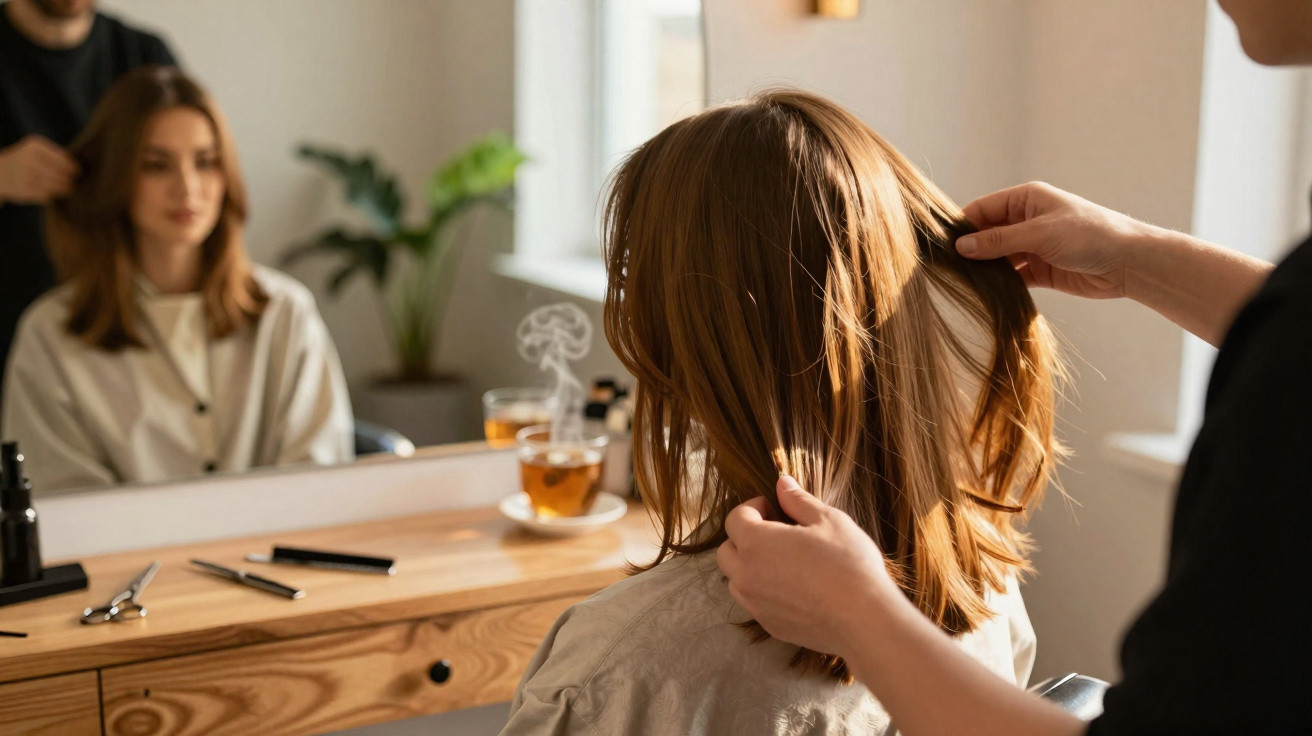
The hairdresser lifts a section, the scissors snap shut and hair drops to the floor. “More layers will make it look fuller,” she says warmly. You nod, although a small pang is already visible in the mirror: somehow, the ends now look… thinner. Once it is blow-dried, your fine hair suddenly sits flatter against your head, while the ends stick out in wispy strands. You had hoped for rich, bouncy volume and ended up with a ragged suggestion of nothing. It looked completely different on Instagram. In real life, you realise your hair is not playing along. Quietly irritated, you wonder whether the issue is you, your hair or the cut. The answer is surprisingly logical – and slightly sobering.
Why too many layers can make fine hair look thinner rather than fuller
Anyone with fine hair is keen to try every volume trick available. Layers are often presented as a classic solution: hair should fall more lightly, feel airier and gain more lift at the roots. On paper, that sounds appealing. In reality, the stylist divides your already limited amount of hair across several different lengths. Instead of one dense-looking edge, you suddenly have lots of small layers, each of which appears thinner on its own. The eye does not merely register the shape; it is especially drawn to fullness at the ends. And that is precisely where fine hair loses out.
You see it regularly in everyday life: a friend leaves the salon with a fresh layered cut, glowing at first – then, two days later, wears her hair only in a ponytail. Wearing it loose feels like “too little”, particularly at the nape, where it becomes see-through. The same word repeatedly comes up in surveys of salon clients: “straggly”. What is striking is that many people do not notice how much the layers visually fragment their hair until a few weeks have passed. At their next trim, the cycle begins again. This creates a loop of well-meant promises of volume and growing dissatisfaction with one’s own hair.
Physically, it is straightforward: fine hair has a smaller diameter, so each strand contains less substance. When that already limited mass is divided up by numerous layers, every level lacks density. The ends cannot build any weight, the hair does not sit together as well and it looks fluffier. Rather than one compact line, there are hundreds of small ends that fall in different directions. A blunt-cut bob can look denser at the edge than long hair with too many layers – even when the amount of hair is exactly the same. Our eyes favour clear shapes. Layers break up that shape, particularly in fine-textured hair.
Haircuts that genuinely make fine hair appear fuller
An effective approach for fine hair is to work with its baseline rather than against it. Many stylists favour compact, relatively blunt cuts: bobs, lobs or shoulder-length styles with only very subtle internal “soft layers” that are barely visible. The aim is for the ends to create one dense edge together, while only a minimal amount of weight is removed from within. Microlayers placed just in the lower third can add movement without making the hair look ragged. The emphasis shifts from “as many layers as possible” to “as clear a shape as possible”.
Another option is to limit the length. Beyond a certain point, fine hair inevitably loses presence simply because gravity becomes stronger than its natural structure. Many women find that a cut somewhere between the chin and collarbone suddenly makes it appear as though they have twice as much hair. It can feel like a bold move initially – we are emotionally attached to our centimetres. Yet there is often a sense of relief when the mirror reflects a cleaner, fuller image instead of long, transparent ends. Let us be honest: nobody willingly spends 20 minutes blow-drying volume into lengths that will only collapse again anyway.
One experienced hairdresser once put it this way:
“With fine hair, it is not about cutting more, but about cutting with greater precision. Every additional layer has to justify itself.”
In practical terms, it helps to give your stylist a few clear boundaries:
- Keep layers extremely light, with no visible “steps”
- Maintain a compact baseline, particularly around the nape
- Choose a length at which the ends do not look transparent
- Avoid wispy fringes and heavily thinned-out ends
- Create shape with a fringe or face-framing rather than lots of layers
That makes your haircut more of a strategy than a gamble – and your fine hair does not have to accommodate every trend.
Making peace with fine hair beyond the question of layers
It becomes interesting when you stop treating your fine hair as a “problem” that needs to be outsmarted with technique. Many people with this hair texture feel a genuine sense of relief once the pressure to know every trick disappears. Fine hair is lightweight, falls softly, is quick to style and can look very modern when it is cut intelligently. Once you let go of the notion that “lots of hair” automatically means “beautiful hair”, you see yourself differently in the mirror. Suddenly, the focus is on proportions, style and personality rather than centimetres and the number of layers.
There are, of course, common pitfalls. Take the ongoing battle with too much haircare: overly rich masks, leave-in products through the lengths, oil-shiny ends that weigh the hair down. Or the instinct to try every new volumising mousse on TikTok, only to discover in frustration that the roots feel sticky. Taking a gentle but honest look at your own routine often brings more calm. On many days, a lightweight mousse, a round brush and five minutes of blow-drying at the roots are all that is needed. And yes, realistically, many “special volume routines” do not survive three hectic Monday mornings in a row.
Once you understand why too many layers visually split up fine hair, you start asking entirely different questions. Instead of, “How many layers create volume?”, it becomes, “Which shape makes my hair look more compact?” or “How much effort am I realistically willing to put in?”
“A good haircut for fine hair feels as though you are working with your hair rather than against it,” says a stylist who specialises in thin hair.
- Accept your hair’s natural density instead of chasing illusions
- Choose cuts that emphasise clean lines rather than numerous visible layers
- Keep haircare lightweight so that your hair does not collapse under the weight of its own products
- Use styling where it has the greatest impact: at the roots and around the outline
- Allow yourself to ignore trends if they simply do not suit your hair texture
This way, “fine hair” stops being an ongoing project and becomes a part of you that you can work with confidently.
| Key point | Detail | Benefit for the reader |
|---|---|---|
| Too many layers | Fine hair is divided into several lengths, with each one appearing thinner and more ragged | Understands why the requested layered cut often produces the exact opposite of volume |
| Compact baseline | Blunt cuts, bobs and lobs with only slight internal layers create a dense edge | Gets specific haircut ideas that can be requested clearly at the salon |
| Realistic haircare & styling | Lightweight products, a focus on the roots, limited length and routines that fit everyday life | Saves time, stress and wasted purchases by putting real life ahead of idealised images |
FAQ:
- How can I tell whether my cut has been layered too heavily? If the ends look transparent, your ponytail is noticeably thin and you can barely see any shape without styling, the lengths have usually been thinned too much or layered too high.
- Can I still wear long hair with fine hair? Yes, up to the point at which the ends still look compact. This “comfort limit” is often somewhere between the collarbone and mid-back; extremely long lengths can quickly look transparent on fine hair.
- Which products are suitable for more fullness? Lightweight volumising sprays or mousses at the roots, plus texturising sprays through the lengths and ends. Use heavy oils, thick creams and rich masks only rarely and very sparingly.
- Does a fringe help with fine hair? A well-cut fringe or curtain bangs can frame the face and create the impression of greater fullness at the front without adding further layers to the lengths.
- How often should fine hair be trimmed? Around every 6–10 weeks, depending on the cut. Regular trims keep the edge compact, prevent ragged ends and make the hair appear fuller overall.




Comments
No comments yet. Be the first to comment!
Leave a Comment