
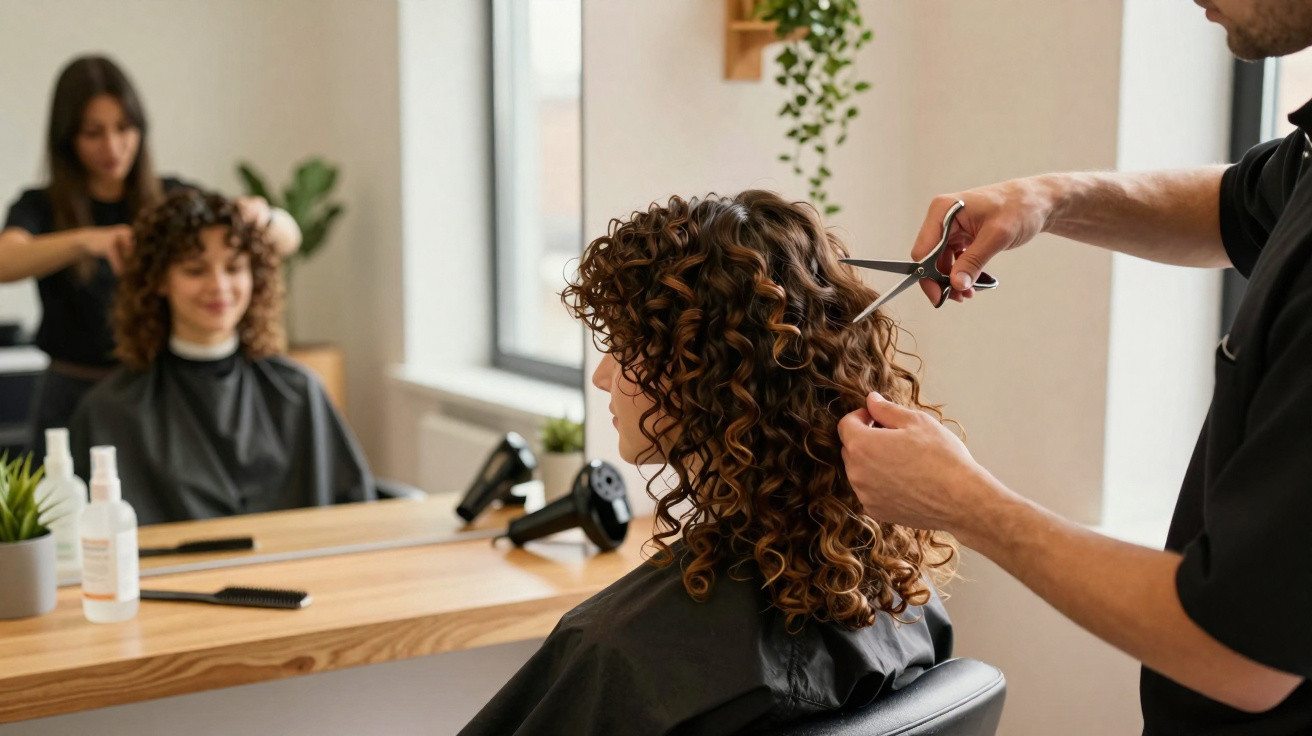
Curly haircuts can help spread the weight through the hair, lift the roots and make room for each curl to form more freely. Layers, rounded shaping and well-chosen lengths do not alter your natural curl pattern, but they prevent the crown from looking flat and stop the ends from carrying all the volume.
Why does a cut affect curl volume so much?
When hair grows out without a defined shape, the sheer weight of the length can pull the curls near the roots straighter. A considered cut removes bulk in specific areas and creates different levels, allowing the hair to regain movement while still keeping density through the ends.
- Short layers can help lift the top section;
- Rounded sides spread volume around the face;
- Ends that are cut too bluntly can create a triangular silhouette;
- Shorter lengths make fine curls feel lighter;
- Clearly defined outlines show off natural texture.
Which six cuts are recommended for curly hair?
Among the styles that emphasise curl volume and texture, there are short, medium and long options. The right choice should take into account shrinkage once the hair is dry, overall density and the area where you want the volume to sit.
A curly bob builds body around chin level; a long bob keeps more length at the shoulders; a shag uses pronounced layers and a fringe; a curly pixie concentrates texture on the top; a rounded cut distributes the hair around the head; and long layers keep the length while easing excessive weight.
How does each shape change how the hair falls?
A layered cut can be tailored to create different results. Short layers at the crown lift the roots, while longer layers help maintain the outline and lower the chance of too much width at the sides.
- Curly bob: sharpens the outline and focuses volume through the sides;
- Long bob: adds movement without taking off too much length;
- Shag: pairs a fuller top with layers and a deliberately disconnected finish;
- Curly pixie: keeps the nape and sides short, with texture left higher up;
- Rounded cut: spreads volume evenly;
- Long layers: reduce weight while preserving length.
Should curly hair be cut dry or wet?
Dry cutting makes it easier to see the true length of each curl and manage shrinkage more precisely. It can be particularly helpful when there are different curl patterns on the same head, as each section is adjusted based on how it naturally sits.
Wet cutting can also work when the stylist understands how the hair behaves once it dries. The key is not to overstretch the strands during the process, because a section that looks long when wet may spring up by several centimetres as the curl returns.
How do you maintain volume and definition after the cut?
When styling, avoid loading too much cream at the roots, as the product’s weight can cancel out the lift created by layers. Applying your styler through the lengths, scrunching the hair, and drying with a diffuser on a moderate heat helps maintain the intended shape.
The cut also needs refreshing once the layers lose their structure and the ends start holding weight again. Hydration, gentle detangling and friction-free drying protect the texture, while the chosen shape keeps volume balanced between roots, sides and length.






Comments
No comments yet. Be the first to comment!
Leave a Comment