
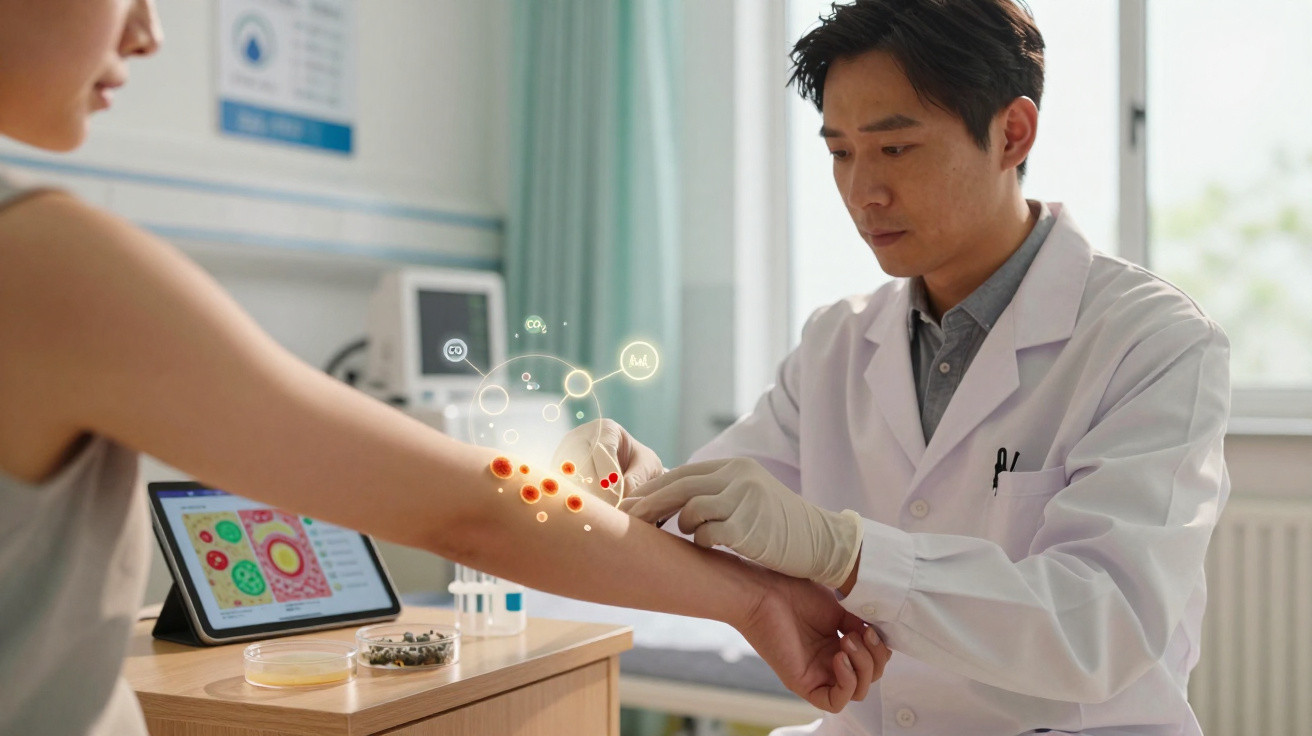
Scientists have found that a notorious hospital fungus has adapted to life on human skin by using carbon dioxide released at the surface as a food source.
This metabolic advantage helps it hold on at the very sites where infections can begin, withstand the pressure of treatment, and circulate through healthcare environments without being noticed.
Skin colonisation drives the threat
When it settles on the skin, colonisation can turn people into symptom-free reservoirs, enabling the fungus to transfer from person to bedrail without causing immediate disease.
A team at the Medical University of Vienna described this behaviour by monitoring how the organism stays viable on skin even when nutrients are scarce.
Dermatologist Adelheid Elbe-Bürger linked that staying power to a newly identified CO2-driven route that keeps the fungus metabolically active.
The same mechanism helps explain why skin colonisation becomes the starting point for transmission, while the risk of deeper infection may remain hidden at first.
Carbon dioxide becomes usable fuel
The researchers identified a single enzyme that allows Candida auris to turn tiny CO2 losses from skin into a growth resource. The enzyme, carbonic anhydrase, converts CO2 into a form cells can use as fuel.
By enabling that conversion, the pathway kept mitochondria working even when there was little sugar available on skin, and it also helped the fungus cope with drug-related stress.
When the enzyme was inhibited, Candida auris faltered early on, pointing to a possible way to prevent colonisation before infections take hold.
Resistance gains a new clue
Amphotericin B is still one of the limited number of medicines that can kill yeast cells outright, which is why resistance to it is particularly concerning.
The drug works by binding to ergosterol, a fat-like component of fungal membranes, and that interaction makes the membrane leaky.
"Candida auris uses minimal CO₂ concentrations to maintain its energy production and survive stress caused by antifungal drugs," explained Elbe-Bürger.
As amphotericin B resistance is uncommon in many yeasts, the CO2 connection highlights a fresh vulnerability hospitals may be able to target.
Skin bacteria lend support
On human skin, Candida auris exists alongside other microbes, and its neighbours can affect how much fuel is available. The team highlighted the skin microbiome-the community of bacteria and fungi on the body-as a local source of CO2.
Some skin bacteria produce urease, an enzyme that breaks down urea into ammonia and CO2, and urea is delivered to the skin daily via sweat.
Although blocking bacterial urease could reduce CO2 levels at the skin surface, any practical strategy would need to avoid harming beneficial microbes.
Mitochondria offer another target
Within the fungus, energy generation relies on a chain of proteins that pass electrons and build usable power.
One part of that chain, cytochrome bc1-a mitochondrial complex involved in electron transfer for energy-proved straightforward to weaken in testing.
In laboratory work, a compound that blocked cytochrome bc1 made Candida auris easier to damage and improved amphotericin B performance.
Such combinations could extend the usefulness of older treatments, although safety in people still needs to be demonstrated.
Colonisation happens in stages
The first phase of colonisation begins on the skin surface, where food is limited and CO2 remains low. When the researchers interfered with the CO2 pathway, the fungus struggled to establish itself on mouse skin and on donated human skin.
At later stages, once it reached deeper niches such as hair follicles, higher CO2 levels could partially compensate for the missing enzyme.
This split implies prevention should focus on the first day or two, when colonisation may still be relatively fragile.
Outbreak risk in hospitals
Containing outbreaks is more difficult because Candida auris can travel on symptom-free skin while quietly contaminating rooms and equipment.
The World Health Organization (WHO) has placed the threat on a global priority list of dangerous fungal infections.
In patients with weakened immune systems, invasive infections have been reported with death rates as high as 70% in some accounts.
Because the fungus often shows resistance to several drugs at once, hospitals can lose crucial time while treatment and isolation decisions catch up.
Infection teams use current tools
Hospitals already rely on isolation rooms, gloves and meticulous cleaning, as removing the fungus from skin can be slow.
Guidance from the Centers for Disease Control and Prevention prioritises screening using skin swabs and applying specialised disinfectants to rooms and shared equipment.
These measures are most effective when results are shared rapidly among staff, since colonisation can persist for a long time after discharge.
The emerging CO2 targets are not a replacement for these basics, but they suggest additional tools that could help reduce spread.
Treatment choices remain limited
For bloodstream infection, clinicians often start with echinocandins, which weaken fungal cell walls, although resistant cases continue to appear.
If these drugs do not work, amphotericin B may be used, but it can harm kidneys and requires close monitoring.
If CO2-powered energy production helps the fungus tolerate amphotericin B, pairing the drug with energy blockers could restore sensitivity.
Any combination approach still requires clinical trials, and clinicians must be cautious not to drive Candida auris towards even broader resistance.
This work connects skin survival and drug tolerance to the same energy pathway, making colonisation itself a practical point of intervention.
The next step is to test these inhibitors in patients and confirm they suppress the fungus without damaging human cells.





Comments
No comments yet. Be the first to comment!
Leave a Comment