
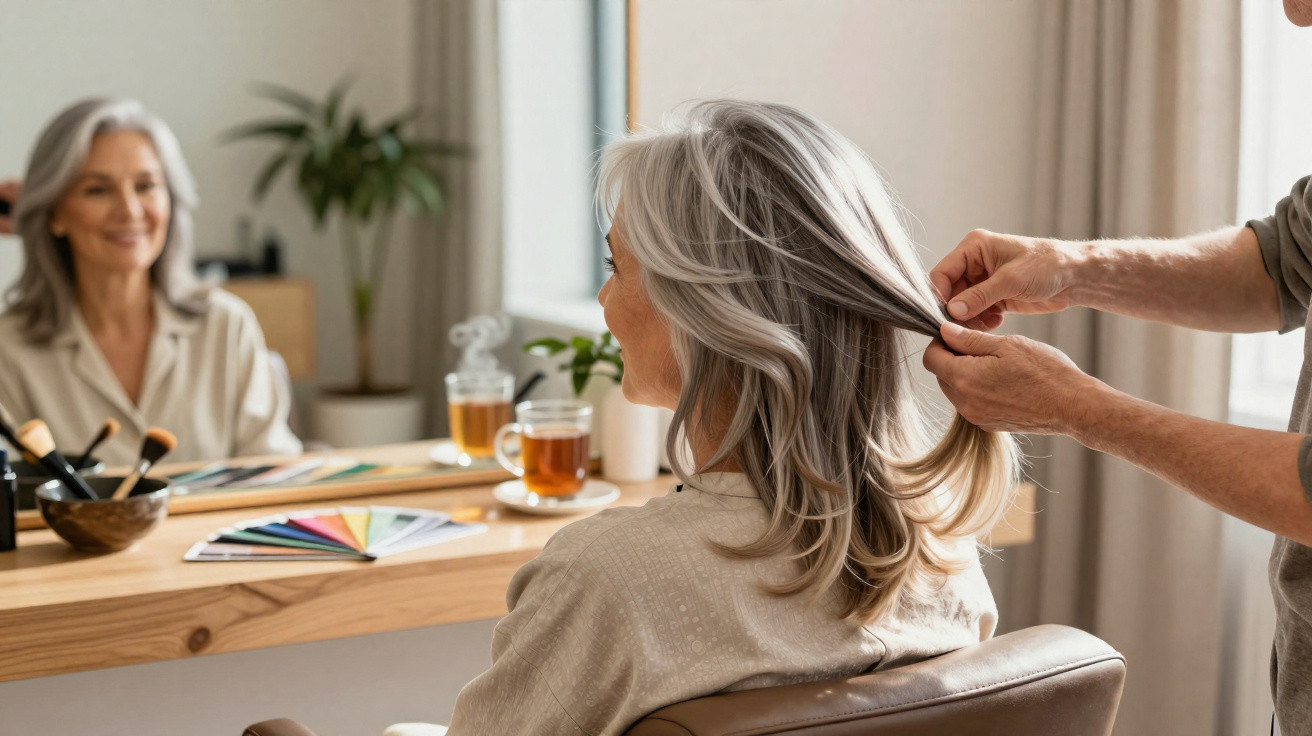
At 09:15 on a Tuesday, the salon is already in full swing. In the back, kettles hiss; at the stations, foils crackle; beneath it all, there’s the steady murmur of women swapping notes on holidays and hormone levels. In chair three, a woman in her early 50s twists a piece of hair between her fingers, watches herself in the mirror, and lets out a sigh. The top is turning silver at speed, the lengths are an old chestnut brown, and together it all looks… uneven. “I don’t want to look 25,” she tells the hairdresser. “I just don’t want to look tired.” The stylist smiles, lifts the salt-and-pepper roots with a comb, and says quietly: “You’re ready for lowlighting balayage.”
In the mirror, something changes.
Why lowlighting balayage suddenly makes sense after 50
If you’ve reached 50 and it feels as though your grey hair arrived overnight, you’re not imagining it. One week you’re disguising a couple of strands near your parting; the next, your temples are silver and your usual shade suddenly reads as dull. Traditional, all-over colour can start to look unforgiving, as if you’re arguing with your own face. That’s exactly where lowlighting balayage earns its place. Rather than trying to overpower the grey, it works with it-so the silver looks deliberate. Your salt-and-pepper becomes a colour story of its own, not a “problem” that needs fixing. You get a gentler grow-out at the roots, far fewer long appointments, and a face that looks noticeably more refreshed.
Stylists say they’re watching this change play out week after week. A colourist in Paris told me that, since 2020, a large share of her over-50 clients have stopped aiming to cover 100% of their grey. Instead, they request something “between blonde and gray” or “not too fake, but not too old either.” She’ll often show before-and-after photos: women arriving with stripy, grown-out box dye and leaving with a natural salt-and-pepper base threaded with slightly deeper ribbons. It doesn’t scream “great balayage”. It simply reads as: “she looks rested.” That’s the understated impact of the technique when grey begins to take over the hairline.
The reason it works is practical as well as aesthetic. As we age, skin tone tends to soften and facial contrast drops; a solid, dark block of colour that suited you at 35 can look severe at 55. Going fully light towards white isn’t always the solution either-it can drain your complexion. Lowlighting balayage introduces measured depth where grey is looking flat or too even. Colour is painted freehand in slightly darker tones, placed between and beneath the silvery strands. Your natural greys act as ready-made “highlights”, while the lowlights add dimension and movement. The overall effect stops shouting and starts whispering.
How “lowlighting” balayage actually works on salt-and-pepper hair
Imagine lowlighting balayage on grey hair the way you’d add shading to a pencil sketch. The colourist doesn’t blanket your salt-and-pepper with one solid shade. Instead, they study where the grey gathers-often along the front, through the crown, and at the temples-then place subtly deeper tones around those areas. The strokes are soft and diagonal, never rigid or stripe-like. A skilled colourist blends cool and neutral shades close to your natural base so it looks as though it’s always been there. The key is that your greys are respected, not erased. You leave looking unmistakably like yourself-just… refined.
A London stylist told me about a client in her late 50s who’d coloured her hair dark brown for years. Every three weeks, white roots would push through, and she felt locked into constant appointments. Together, they chose to end the root chase. The stylist first softened some of the old dark pigment, then wove in gentle lowlights around the client’s natural grey-particularly at the back, where the silver was reading as too solid. The front was left brighter, keeping more silver to frame her face. After two sessions, people said: “You look younger, did you sleep more?” No one could quite identify the hair. And the biggest win? She moved from colouring every 3–4 weeks to refreshing her balayage twice a year.
On the technical side, grey hair often behaves differently in terms of texture and porosity, which is why all-over dye can go too dark or fade in a strange way. With lowlights, only chosen pieces are coloured, so more of the hair’s natural character remains. Formulas can also be tailored: a cooler lowlight if your grey throws yellow, or a slightly warmer one if your complexion benefits from a touch more warmth. The grey itself acts like free, built-in highlights, which means less processing overall. That can be kinder to hair that’s becoming drier or more delicate. It’s a sensible middle ground between “I give up” and “I’m pretending I never went grey.”
The hairdresser’s method: from first consult to lowlight glow
It begins well before anyone reaches for a tint brush. A thoughtful hairdresser will sit you down and map your salt-and-pepper pattern, section by section: where is it mostly white, where is it mixed, and where does your old natural colour still dominate? Then comes the pivotal question-how much grey are you emotionally comfortable seeing? Some women are ready for 60% to show; others begin with 30% and build confidence over time. From there, the stylist selects two or three lowlight shades (never a single flat tone). Application is done in V-shapes and soft sweeps, leaving plenty of grey untouched. The aim is a blurred, watercolour finish, not crisp lines.
One of the biggest mistakes is trying to “try out” lowlighting balayage at home with a random box dye. That’s when things go patchy, especially on hair that’s already been coloured. Another common misstep is requesting very warm caramel lowlights against cool, icy grey-suddenly it can feel like you’re wearing someone else’s hair. Instead of naming a celebrity reference, tell your stylist what you want to feel: brighter, softer, less contrast. They can translate that into the right shades and placement. And if you’re hesitant, ask them to keep the lowlights deeper at the back and lighter around the face at first-it makes the mirror moment gentler.
A colorist I spoke to put it plainly: “Gray hair after 50 doesn’t need correcting, it needs curating. The lowlights are like punctuation marks; they guide the eye so people see your face, not just your roots.”
- Ask for a consultation before booking colour: photos, hair history, and time to talk are non-negotiable.
- Bring daylight selfies of your hair from front, side, and back so the stylist sees your true grey pattern.
- Start with subtle lowlights and build over 1–2 sessions; heavy changes in one go often feel “too much.”
- Choose a cut that helps the colour move: soft layers, a fringe, or a bob work brilliantly with salt-and-pepper.
- Plan maintenance: a gloss every 6–8 weeks and lowlight refreshes twice a year suits most women.
Living with your new salt-and-pepper: beyond the salon chair
It doesn’t finish when you step outside with freshly toned, swishy salt-and-pepper hair. During the first week, many women describe a strange mix of emotions: a jolt of surprise, paired with genuine relief. You spot yourself in a shop window and think, “Oh, that’s really me.” Then you notice how lowlighting balayage performs in different lighting-daylight, harsh office LEDs, a bathroom mirror at a friend’s place. The greys catch the light rather than bunching into blocks; the lowlights create a soft shadow near the roots; and the silver reads like a decision, not a mishap. That’s often when compliments start coming from unexpected directions: a teenage niece, a male colleague, a neighbour in the lift.
| Key point | Detail | Value for the reader |
|---|---|---|
| Respect your natural grey | Use lowlights to add depth and shape, not to erase salt-and-pepper | Hair looks authentic, modern, and easier to maintain |
| Think long-term maintenance | Balayage every 4–6 months, gloss in between, no more frantic root touch-ups | Less time and money at the salon, more freedom from regrowth anxiety |
| Choose the right colourist | Look for grey-blending experience, photo portfolios, and a real consultation | Reduces risk of flat, ageing colour and supports a smoother grey transition |
FAQ:
- Is lowlighting balayage only for women who are “fully gray”?
No. It works beautifully once you have at least 30–40% gray, even if it’s mostly at the temples or parting. The technique simply adapts to how much gray you have and where it shows.- Will lowlights damage my already dry, gray hair?
A careful colourist uses gentler formulas and targets specific strands, not your whole head. Combined with a bond-builder and nourishing masks at home, most women find their hair feels better than with repeated full dyes.- How often do I need to refresh lowlighting balayage on gray hair?
For most clients over 50, a refresh every 4–6 months is enough. Between visits, a toner or gloss every 6–8 weeks keeps yellow tones away and boosts shine.- Can I go from box dye to lowlighting balayage in one appointment?
Sometimes, but often it’s a two-step journey. Old pigment needs softening or lifted first, then the lowlights and gray blending are adjusted over a couple of sessions. This staged approach usually looks more natural and feels less shocking.- What if I try it and decide I don’t like seeing my gray?
You still have options. You can add more lowlights, switch to softer all-over colour, or grow out to a lighter shade that meets your gray halfway. Let’s be honest: nobody really does this every single day, but honest chats with your stylist at each visit help you course-correct.




Comments
No comments yet. Be the first to comment!
Leave a Comment