
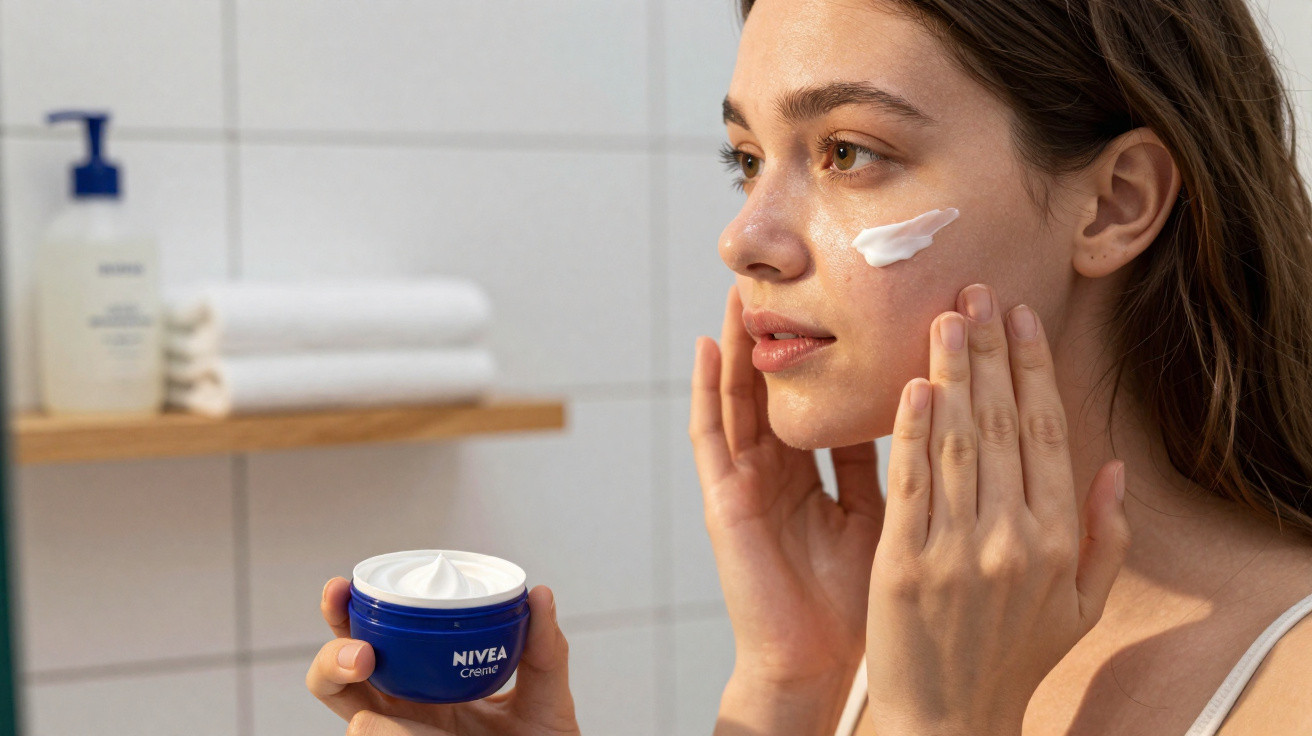
After seven days, a surprisingly clear contrast emerges.
The classic Nivea Cream in the blue tin sits in countless bathrooms. Many people reach for it on hands, all over the body, or as a one-stop moisturiser when travelling. But what happens if you use the old-school staple as an intensive facial product-consistently, and only on one side of the face? That’s exactly what this small at-home test set out to do, and it delivers some genuinely interesting results.
The starting point: a classic put under pressure
For more than 100 years, the blue-tin Nivea Cream has been among the best-selling skincare products worldwide. It’s seen as dependable, straightforward and affordable. At the same time, recent years have brought a crowded world of serums, acids, retinol and high-tech creams. It leaves many people wondering: does the original tin classic still stand a chance in modern facial skincare?
The cream is widely known for being:
- very rich and occlusive (it sits on the skin like a protective layer)
- useful for slowing moisture loss
- popular as a multi-purpose product-from dry elbows to after-sun care
Things get more interesting when it’s not used just here and there, but applied like a substitute for a sleeping mask-and compared directly: left side with cream, right side without.
The experiment: one week of Nivea on just one side of the face
For seven days, the same routine happens every evening. Both halves of the face are cleansed and treated in exactly the same way, with one key exception: one side gets a thicker layer of Nivea Cream at the end, almost like a film you’d apply as an overnight mask. The other side sticks to the usual skincare, without that famous blue-tin final step.
The evening routine, step by step
The routine is intentionally “skincare-savvy” rather than minimalist. That makes it easier to see whether Nivea adds anything as an extra finishing layer:
- Double cleanse: first an oil-based cleanser, then a gentle gel or foam cleanser
- Serum: for example, one with hyaluronic acid or antioxidants
- Eye cream around the eye area
- A light moisturiser or gel
- Then, only on one half of the face: a generous layer of Nivea Cream as an overnight mask
This creates a simple side-by-side comparison: an identical base routine, with an added oily, protective layer from the traditional cream on just one side.
The first few days: visible differences in the morning
After only a few nights, changes begin to show-especially first thing in the morning. The “Nivea side” looks smoother, plumper and less creased.
"The side of the face with Nivea looks better hydrated and feels noticeably softer in the morning."
The effect is most obvious in the usual dry areas:
- on the cheeks
- around the mouth and the sides of the nose
- along the outer edges of the forehead
In those zones, the skin treated with Nivea feels more supple in the morning, and fine dehydration lines look a little less noticeable. The reason is the strongly occlusive texture: the cream forms a layer that helps keep overnight moisture loss in check. That matters because the skin’s natural repair processes are particularly active during the night.
How Nivea works as a “slugging” cream
Using a rich, more oily cream as the final step-applied in a thicker layer-has long been a trend online. In the international beauty community, it’s commonly called “slugging”. The concept is simple: a dense layer helps seal in what you’ve applied underneath and reduces transepidermal water loss.
With Nivea Cream, the following mechanism is at play:
| Feature | What it does to the skin |
|---|---|
| Rich fats and waxes | sit on the skin’s surface like a protective mantle |
| Occlusive layer | reduces moisture evaporation overnight |
| Fairly simple formula | no high-tech actives, but a steady protective effect |
Especially during dry, centrally heated months-or when skin is severely dehydrated-this kind of layer can feel very comforting. It can ease tightness and support overall barrier comfort.
The downside: when the cream is simply too much
After a few days, the test shows that the results aren’t only positive. In the T-zone in particular-forehead, nose and chin-small blemishes can appear if you apply a generous amount of Nivea every evening.
"If your skin is on the oilier side or prone to breakouts, daily 'slugging' with Nivea can quickly lead to clogged pores."
While the protective film helps keep moisture in, it can also trap sebum and sweat more readily. Depending on your skin type, that may lead to:
- pores in the T-zone looking more noticeable
- small bumps and congestion under the skin
- a shiny, slightly greasy surface rather than a healthy glow
If you already have combination or oily skin, it’s best to use this approach thoughtfully rather than turning it into a nightly default.
How often does the cult cream make sense on the face?
Across the week, a clear pattern emerges: as an occasional intensive overnight treatment, the blue-tin cream works surprisingly well. As a daily ritual, it can become too heavy for many faces over time.
A practical rule of thumb could look like this:
- dry to very dry skin: 1–2 times per week as a thicker layer
- normal skin: every 1–2 weeks, particularly during the heating season
- combination or oily skin: only on very dry patches, not across the whole T-zone
If you notice increasing shine or small spots appearing, it’s worth spacing out applications or limiting the cream to specific areas-such as the cheeks or the skin around the mouth.
Who this method suits-and who it doesn’t
Well suited
- people with dryness-related fine creasing around the eyes and mouth
- skin that feels tight due to indoor heating or winter cold
- anyone already using an effective serum and wanting to “seal it in”
Less suited
- very oily skin that already becomes shiny quickly
- very sensitive or acne-prone skin
- people layering several comedogenic (pore-clogging) products at the same time
If you’re unsure, start with a small patch test on the face-one cheek for a few nights, for instance. That way you can see how your skin responds without committing your whole face.
What to keep in mind when using the blue cream on the face
To make sure the method actually works in your favour, a few details matter:
- apply only to clean, well-cleansed skin
- ideally layer it after light, water-based serums and fluids
- use it only in the evening, as it can feel too heavy under make-up
- cleanse thoroughly in the morning to avoid leaving residues of oil and sweat on the skin
If you use multiple active ingredients-such as fruit acids or retinol-take care not to over-stimulate the skin. The cream doesn’t add extra actives itself, but it can increase how long previously applied products stay on the skin.
What this experiment reveals about simple skincare
Comparing one side of the face with and without Nivea shows, on a small scale, just how strongly occlusive care can affect the look of skin in the short term. When more moisture is retained, fine lines can appear softer and the skin feels bouncier. On the flip side, too much oil and too much film can interfere with the natural balance between sebum production and gentle shedding.
For many readers, the most practical takeaway is likely a mixed approach: a well-formulated serum or a lightweight daily moisturiser as the foundation, with the blue cult cream used occasionally as a “booster” on nights when skin feels particularly dry or stressed. If you respect that limit, you can get a surprising amount from a simple high-street classic without overwhelming your skin.



Comments
No comments yet. Be the first to comment!
Leave a Comment