
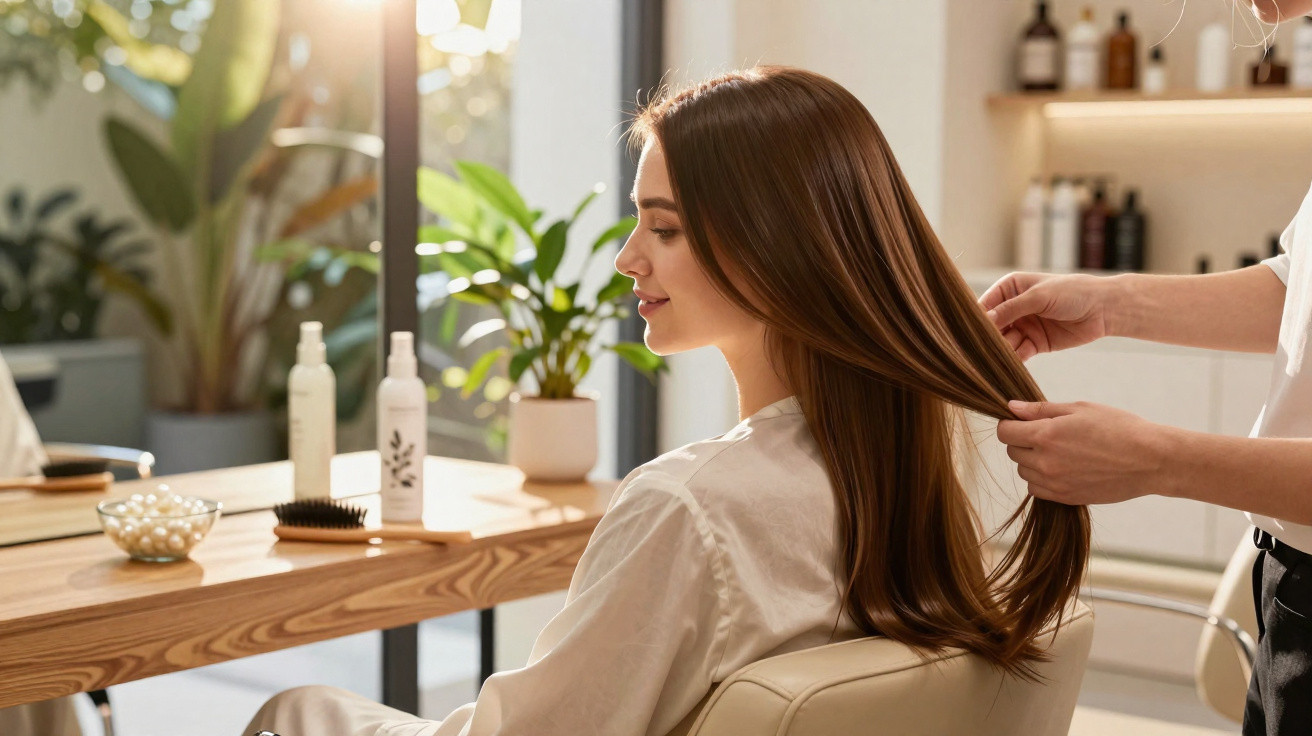
Salon buzz is shifting again: a fresh smoothing treatment is being billed as a way to achieve glossy, straighter hair without the harsher chemicals many clients now try to avoid.
From TikTok and Instagram to top-tier salon chairs, a technique called nanoplasty is starting to edge out the once-dominant Brazilian blowout. Its pitch is simple: smooth, strengthen and add shine in one appointment, while steering clear of some of the most disputed ingredients found in older straightening systems.
What nanoplasty actually is
Nanoplasty is a professional salon service designed to smooth hair while also improving its condition, rather than just forcing it into a straight shape. Brazilian blowouts became known for ultra-straight results, but they also drew criticism for formulas that included formaldehyde or similar compounds, particularly once heat was applied.
Nanoplasty is presented as an alternative approach. Instead of strong chemical relaxers, it typically uses a mix of amino acids, vitamins and collagen intended to sink into the hair fibre.
Nanoplasty targets the cortex of the hair - its inner core - to reinforce and smooth from within, not just coat the surface.
Salons offering nanoplasty commonly say the finish can hold for four to six months, depending on your hair type and your at-home routine. The headline promise is smoother, shinier, more pliable hair without formaldehyde-based formulas.
How it differs from a Brazilian blowout
For over ten years, Brazilian blowouts and comparable keratin services led the smoothing category. They altered hair structure with potent chemicals and then “locked in” the change using very high heat. Concerns often centred on fumes that could sting eyes and irritate airways, particularly for stylists exposed to the products day after day.
Nanoplasty frames itself as the softer option, aiming for a similar finish that can look more natural.
- Positioning: sits between an intensive treatment and a longer-wear straightening service.
- Formula: amino acids, vitamins and collagen in place of traditional relaxers.
- Result: sleek and glossy, but with some natural movement rather than rigid, pin-straight hair.
- Target hair: wavy, curly, dry or damaged hair that is prone to frizz.
If you dislike the “flat, lifeless” outcome sometimes associated with older straightening methods, nanoplasty may sound more appealing. The intention is for hair to appear tidy and well-finished while still swinging and bending, not lying like a stiff panel.
The goal is polished hair with fewer frizz issues, not a stiff “ironed” finish that gives away the treatment at first glance.
Who salons recommend nanoplasty for
Stylists often point clients towards nanoplasty when they want less daily effort without committing to permanent straightening or relying on frequent heat styling.
Ideal candidates
Nanoplasty is most often promoted to:
- People with frizzy or puffy hair who want more everyday manageability.
- Those with waves or looser curls who’d like a smoother, more relaxed pattern.
- Clients with long, delicate or previously damaged hair that can’t cope with aggressive chemical straighteners.
- Anyone spending 30–45 minutes a day with a flat iron who wants to cut that time significantly.
Because it can reduce the need for repeated high-heat styling, nanoplasty may also help minimise further stress from straighteners. That benefit is especially attractive if you’re already battling breakage and split ends.
Inside the salon: how a nanoplasty session runs
This is not a quick appointment. In many salons, nanoplasty takes several hours and is carried out in a set order.
| Stage | What happens |
|---|---|
| 1. Clarifying wash | Hair is cleansed with a deep-cleaning shampoo to remove build-up and sebum. Conditioner is skipped so the fibre stays “bare” and ready to take in the treatment. |
| 2. Product application | The nanoplasty formula, packed with amino acids, vitamins and collagen, is worked through section by section from roots to ends to ensure even coverage. |
| 3. Processing time | The product is left on for roughly 40–60 minutes, depending on hair length, thickness and texture. |
| 4. Rinsing & drying | Any excess is lightly rinsed out, then the hair is blow-dried straight. |
| 5. Flat-ironing | High-temperature straighteners, usually between 220°C and 230°C, are passed over small sections to “seal” the active ingredients into the hair. |
What you do afterwards also affects the outcome. Clients are commonly told not to wash or wet hair for two to three days to allow the result to settle. During that period, salons may advise against tight ponytails or repeatedly tucking hair behind the ears to prevent kinks.
Stylists see the post-treatment window as crucial: water, sweat, or tight hairstyles too soon can reduce the smoothness or create unwanted bends.
What kind of results can you expect?
Nanoplasty is usually talked about as a “smoothing” service rather than a “straightening” one, and the difference is important. The goal is a shiny, controlled look with fewer flyaways, not necessarily ruler-straight hair for everyone.
On very curly or coily hair, nanoplasty may relax the curl and cut down bulk instead of removing texture completely. On wavy or lightly curly hair, the outcome can look much closer to straight. Many clients report:
- Clearly less frizz, including in humid weather.
- Softer, silkier lengths that knot less.
- A blow-dry routine that’s simpler and faster.
- Increased shine that can make hair colour look more reflective.
The effect tends to wear off slowly over a number of months. As hair grows, roots show your natural pattern, while treated sections gradually drift back towards their original shape with repeated washing.
How safe and “gentle” is it really?
Nanoplasty is often advertised as formaldehyde-free and positioned away from the most aggressive chemical relaxers. That message reassures people who are cautious about older straightening services that created strong fumes when heated. Even so, “gentler” doesn’t mean risk-free.
The sealing stage still uses very high temperatures. Running a 220–230°C straightener over each section can strain the cuticle, even with protective ingredients in the product. If hair is already fragile, that heat step needs to be handled carefully.
Personal sensitivity is another factor. Some clients react to fragrance, preservatives or protein-heavy formulas. A consultation and patch test remain sensible before committing to any intensive in-salon treatment.
Cost, upkeep and realistic expectations
Nanoplasty typically sits alongside premium smoothing services in terms of price. Fees depend on the city and the salon’s level, but it can easily cost hundreds, particularly on long or thick hair.
Aftercare commonly involves:
- Choosing sulphate-free shampoos so the treatment isn’t stripped too quickly.
- Reducing exposure to chlorine and saltwater, or applying protective products before swimming.
- Leaving space between colouring or bleaching appointments, as both can weaken hair and shorten how long the smoothing effect lasts.
Stylists also tend to caution against expecting “permanent” straight hair. Nanoplasty changes the hair for a time, but it doesn’t restructure it as deeply as classic chemical relaxers. That flexibility can be a plus, yet those wanting a consistently polished finish may need top-ups two or three times a year.
Key terms and smart questions to ask your stylist
The terminology around smoothing treatments can be hard to untangle, with overlapping labels and bold marketing. Knowing a few basics can help:
- Cortex: the inner layer of the hair shaft responsible for strength, elasticity and much of the hair’s shape.
- Cuticle: the outer, scale-like layer that protects the hair; when it sits smoothly, hair reflects more light and looks shinier.
- Formaldehyde: a gas that can be released by some straightening products under heat; associated with irritation and strict safety rules.
- Smoothing vs straightening: smoothing reduces frizz and bulk; straightening aims to fully change the natural pattern.
Before booking nanoplasty, it helps to ask: how much experience does the stylist have with your hair type? Which exact brand and formula will be used? How often do they suggest repeating the service, and which home-care products will support the result?
Consider a common example: someone with thick, wavy hair who straightens it every morning. After nanoplasty, they may be able to air-dry and still get a neat, swishy finish, or they might only need a few minutes of low-heat styling instead of a full routine. For someone with very tight curls, the same appointment might simply soften the pattern and make blow-drying achievable in half the time, without fully removing their texture.
As nanoplasty spreads across more salon menus, it appears alongside other semi-permanent options such as keratin treatments and so-called “hair Botox”. Instead of searching for one miracle fix, many experts now favour a combined strategy: fewer heavy-duty treatments, stronger everyday care and a smarter approach to heat. Within that mix, nanoplasty is emerging as another option for people who want smoother mornings without feeling they’re punishing their hair to get there.

Comments
No comments yet. Be the first to comment!
Leave a Comment