
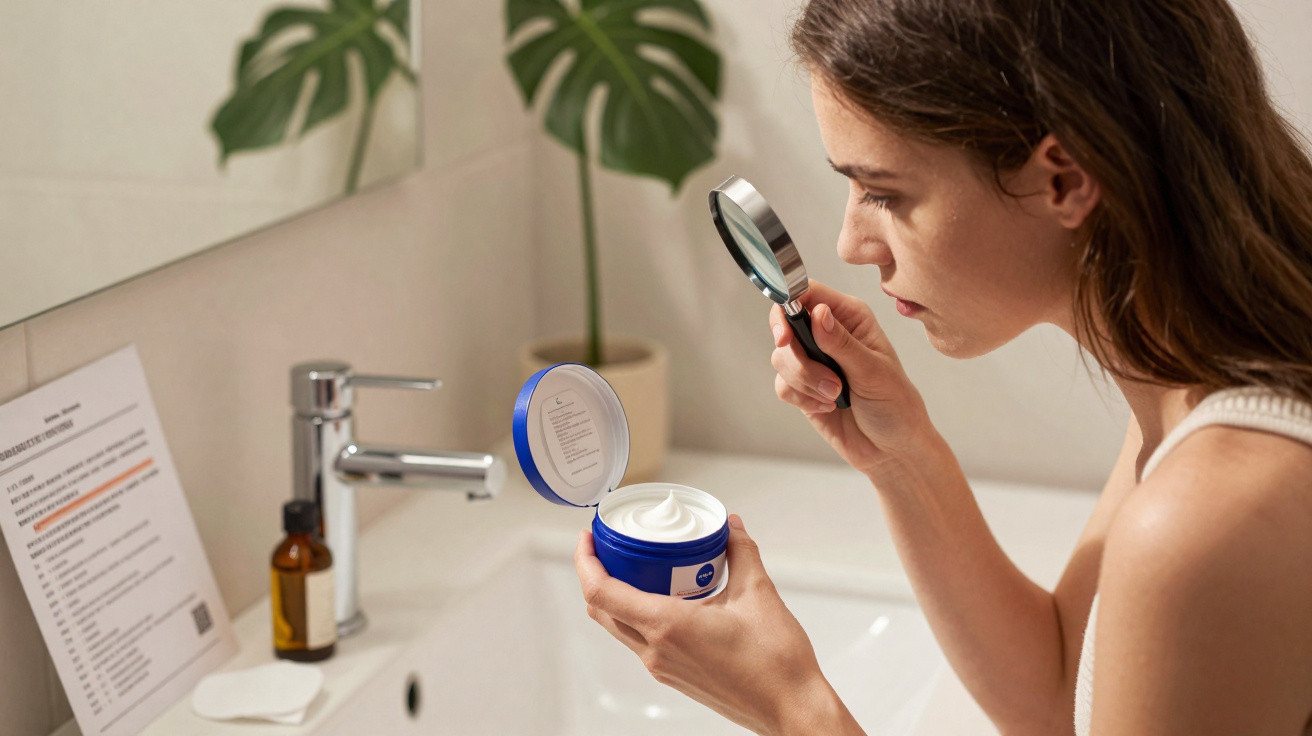
The woman at the pharmacy counter doesn’t even glance up as she reaches for the famous blue tin.
Her hand seems to find it on autopilot: Nivea Creme, dropped into the basket with a movement that could have been passed down from her mum. A couple of paces behind, a teenager scrolls on her phone, eyes widening as she murmurs to her friend: “Wait… have you seen what’s actually in this?”
This is 2025: nothing stays above inspection, and the cream that once smelled like childhood has landed right in the middle of a backlash.
Across social media, long-time Nivea loyalists leave angry replies beneath ingredient “breakdowns” shared by skinfluencers and cosmetic chemists. Suddenly, terms such as “mineral oil”, “paraffin”, “fragrance” and “potential hormone disruptors” are everywhere.
And the same question keeps resurfacing.
What, exactly, have we been rubbing into our skin for all these years?
What experts really say is hiding in that iconic blue tin
Pick up a tin of Nivea Creme, turn it over, and read the label out loud. For plenty of fans, that simple act was where the anxiety began. What had always been “the classic cream that works on everything” abruptly looked like a string of lab-sounding ingredients.
Cosmetic professionals started unpacking the list on TikTok and in Instagram carousels: mineral oil, petrolatum, paraffinum liquidum, microcrystalline wax, synthetic fragrance, plus preservatives that some research is now examining more closely.
The response was immediate. Comments poured in from people who’d grown up with the Nivea scent on their cheeks, now asking whether they’d been “tricked”.
In a viral Reddit thread, Nivea fans swapped the same uneasy blend of nostalgia and fury. One user wrote: “My grandma used this every night. Now I’m told it’s basically perfume in petroleum. I feel betrayed.”
Another posted before-and-after photos of her skin, saying she’d moved from Nivea to a fragrance-free, minimalist cream on a dermatologist’s recommendation. The redness on her cheeks looked noticeably calmer.
At the same time, others defended the brand with real intensity, stressing that Nivea Creme has been sold for more than a century and that millions of people appear to use it without problems. One comment captured that mood: “If it was so toxic, wouldn’t we all be dead by now?”
Very quickly, the argument stopped being the familiar “this broke me out” versus “this saved my skin”. It shifted into something broader: trust, transparency, and what we actually mean when we call a cream “good”.
Dermatologists who were willing to discuss the formula more candidly described a more layered reality. They noted that Nivea’s signature feel comes largely from mineral oil and petrolatum-petroleum-derived ingredients that form a thick, occlusive layer on the skin.
For very dry or compromised skin, that kind of barrier can genuinely help. The issue isn’t that these ingredients are automatically “evil”; it’s that many people believed they were buying a richly nourishing, plant-forward moisturiser… when in practice they were mostly getting a carefully constructed mix of low-cost occlusives and fragrance.
For many devoted users, the real “shock” wasn’t one headline-grabbing toxic ingredient. It was the realisation that the product wasn’t quite what their memories-or the marketing-had encouraged them to imagine.
How to read Nivea’s ingredient list like a pro (without freaking out)
A practical starting point is to decode the ingredient list calmly and systematically. No spiralling-just information. Begin with the first items on the list: ingredients are ordered by quantity, so what appears at the top is what your skin is exposed to most.
With many classic Nivea creams, you’ll typically see water first, followed by mineral oil (paraffinum liquidum), then petrolatum, glycerin, and a mix of waxes and emulsifiers. The takeaway is straightforward: this is a water-in-oil cream designed to sit on the surface and seal in moisture.
Fragrance tends to appear further down, yet even at low levels it can set off sensitive or reactive skin. A useful question to ask is: does my skin truly cope with this, or am I mostly attached to the smell?
A simple, practical tactic is to photograph the label and paste the names into an online cosmetic-ingredient database. The goal isn’t to frighten yourself; it’s to get brief, neutral explanations for each component. Once you do that, the tin feels a lot less mysterious.
If you’ve used Nivea for years without any issues, the sudden wave of ingredient analyses can feel like a personal accusation. You see phrases like “endocrine disruptor” or “occlusive” and feel your confidence wobble. On a human level, it’s like being told your family’s comfort meal is secretly ultra-processed.
Let’s be honest: nobody truly reads every label in the bathroom cabinet every day. We lean on routines, familiar brands, and products handed down by our parents. So when experts suggest “you might want to rethink that blue tin”, it can hit a nerve.
The most sensible reaction isn’t to defend the cream at all costs, or to throw it away in anger. It’s to pay attention to your own skin. Have you had unexplained cheek irritation you blamed on stress? Areas that never quite settle? Or perhaps… no issues at all.
Skin is personal. The online anger from many Nivea devotees often masks something deeper: the fear that self-care was built on half-truths.
One cosmetic chemist I spoke to put it bluntly:
“Nivea is not a villain. It’s just a basic petrolatum‑based cream from another era being judged by today’s standards of ‘clean’ and ‘transparent’ skincare.”
That line sits at the centre of the dispute. This isn’t only about safety; it’s also about expectations. A growing number of consumers now look for shorter, more readable ingredient lists, a clear approach to endocrine disruptors, and fragrance-free choices as the default.
If you’re unsure what to do next, a small decision checklist can make it easier:
- If your skin is sensitive or reactive, try patch-testing Nivea on a small area for several days.
- If you’re pregnant or aiming to be extra cautious, lean towards fragrance-free, minimalist formulas.
- If you enjoy Nivea but feel uncertain, keep it for hands or body rather than your face.
- If your skin does brilliantly with it, note that-and watch for any subtle changes if you switch.
That way, you move from vague worry to specific decisions based on your own experience, not just viral outrage.
So where does that leave Nivea fans now?
Step into almost any family bathroom and you’ll likely spot a half-used blue tin on a shelf, maybe with a slightly dented lid. That small object carries memories of chapped winter cheeks, beach holidays, and mums insisting “this will sort it”. The recent expert commentary doesn’t wipe out that emotional history-it makes it more complicated.
A lot of Nivea lovers now sit in an odd middle ground. They don’t necessarily want to boycott the brand or bin every product. But they are more watchful and less willing to accept “classic” as shorthand for “good for me”.
Some are trying alternatives: fragrance-free pharmacy creams, plain petrolatum jelly without perfume, or lighter moisturisers with ceramides and no “mystery scent”. Others keep using the tin, but with clearer expectations-perhaps steering it away from the most delicate parts of the face.
Most people have had the moment when a trusted product looks different once you understand what’s inside. Sometimes you move on. Sometimes you decide it still works for you. The reality of Nivea’s ingredients doesn’t force a single answer; it starts a wider conversation about how we want to relate to the products we put on our skin.
| Key point | Detail | What it means for the reader |
|---|---|---|
| Nivea’s real composition | Mainly water, mineral oils, petrolatum, wax, fragrance | Understand what your skin is actually getting, beyond the marketing |
| Purpose of the controversial ingredients | Occlusion, protection, pleasant texture, but a risk of irritation for some | Decide whether these ingredients suit your skin type |
| Alternatives and strategies | Minimalist, fragrance-free creams, or targeted Nivea use (hands, body) | Adjust your routine in a practical way without panic or guilt |
FAQ
- Is Nivea cream dangerous to use? The current scientific evidence doesn’t label classic Nivea cream as “dangerous” for the general population, but certain ingredients-especially fragrance-can irritate sensitive skin or trigger allergies.
- Why are experts criticizing Nivea’s ingredients now? Skincare expectations have shifted: people expect more transparency and there’s greater awareness of endocrine disruptors and the impact of fragrance, so older formulas are being re-evaluated.
- Should I stop using Nivea on my face? If your skin is reactive, acne-prone, or easily irritated, many dermatologists tend to favour lighter, fragrance-free moisturisers. If Nivea suits you well, you can keep using it, but pay attention to any subtle changes.
- Is mineral oil really that bad? Cosmetic-grade refined mineral oil is widely considered safe and very stable. Most criticism focuses on the fact it’s occlusive and doesn’t offer additional skin benefits beyond sealing in moisture.
- What’s a simple alternative to Nivea cream? Consider a fragrance-free cream with glycerin, ceramides and perhaps a light occlusive such as petrolatum, sold in pharmacies or chemists, with a short, easy-to-read ingredient list.



Comments
No comments yet. Be the first to comment!
Leave a Comment