
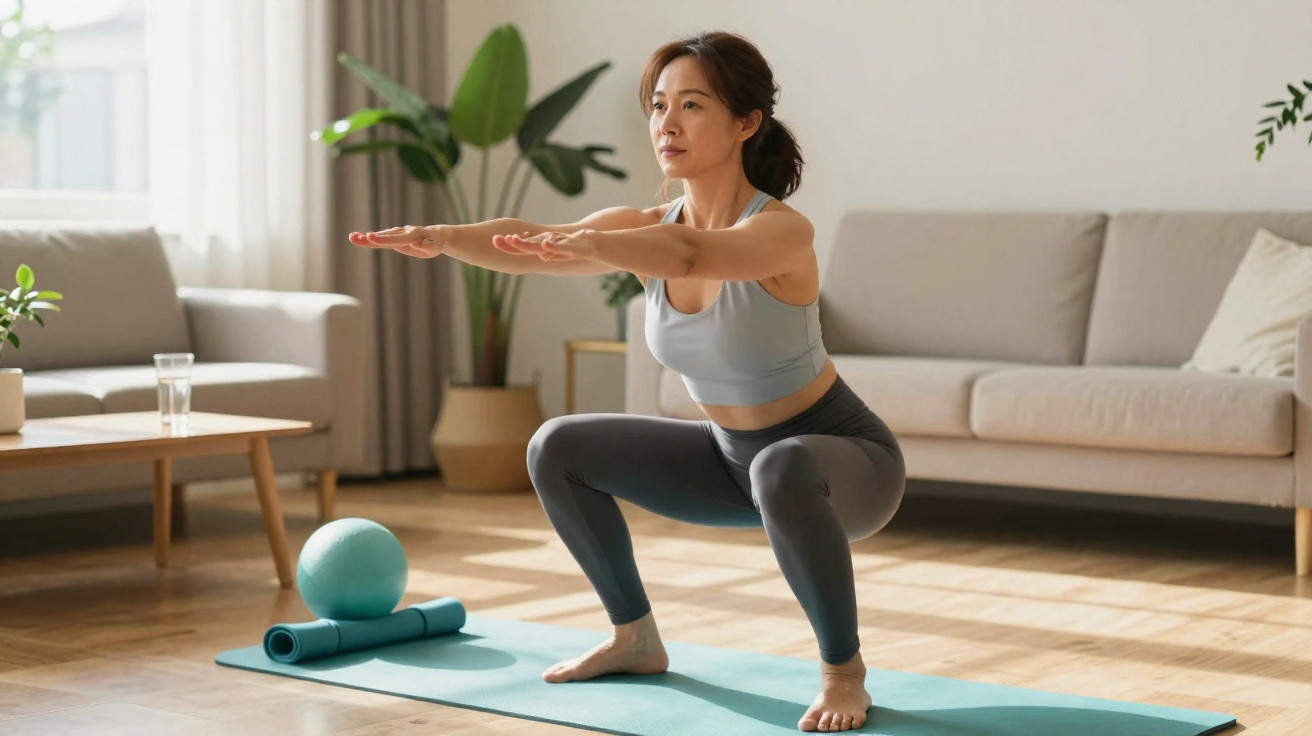
Many people notice it from their 50s, and even more so in their 60s: stairs feel tougher, standing up from the sofa takes longer, and that familiar twinge in the back shows up more often. Yet you don’t necessarily need a punishing fitness regime or expensive kit to push back against this decline. A straightforward Pilates-style movement using only your bodyweight can help you stay fit, mobile and independent for noticeably longer.
Why one single movement pattern can make such a difference as we age
Ageing doesn’t look the same for everyone. If you’ve spent years moving very little, you tend to feel the consequences sooner. Muscle mass drops, bones become more fragile, and everyday tasks leave you tired more quickly. At the same time, research shows that even moderate-but consistent-exercise can slow parts of the ageing process.
That’s exactly where the bodyweight squat comes in-often simply called a squat. It’s a cornerstone of Pilates-inspired strength work and functional training. Coaches frequently recommend it for people over 50 because it trains almost all the key muscle groups you rely on in daily life.
"Bodyweight squats train the exact movements we need to stay independent in everyday life."
In reality, every sit-to-stand is a squat: getting up from a chair, the sofa, the toilet, or out of the car. If you can keep performing that movement with good technique and solid strength, you’re more likely to stay self-sufficient-physically and day to day.
How Pilates makes the classic squat more “age-friendly”
Pilates places strong emphasis on posture, joint alignment and purposeful breathing. Rather than forcing your way through as many repetitions as possible, the priority is how well you move. That focus is precisely what makes the Pilates approach to the squat so valuable for older adults.
The emphasis is on:
- keeping the pelvis and spine in a neutral position
- engaging the deep abdominal muscles with intention
- moving in a controlled, steady way without jolting
- breathing gently, but with clear timing and control
Done this way, you support and protect your joints rather than overloading them, while also improving body awareness. That, in turn, can reduce the risk of falls-an especially important point later in life.
Step-by-step: how to do the Pilates squat from 50 onwards
1. Set up your starting position
Stand tall and organised:
- feet about hip-width apart, toes pointing slightly forwards
- weight evenly distributed across both feet
- pelvis neutral (not tipped into a deep arch, and not tucked under)
- ribcage relaxed, shoulders dropping down away from the ears
- arms resting loosely by your sides
Imagine the crown of your head being gently drawn upwards, without tightening your neck. Keep your spine long.
2. The lowering phase
As you inhale, begin bending your knees slowly:
- hips, knees and ankles bend at the same time
- your hips travel back as if sitting onto an invisible chair
- your torso stays as upright as possible, tipping only slightly forwards
- your knees track in line with your feet-they don’t collapse inwards
If balance is challenging, reach your arms forwards to around shoulder height. This acts as a counterbalance and makes the position feel steadier.
3. The rising phase
As you exhale, press back up to standing:
- drive your feet firmly into the floor
- straighten the legs as your glutes and thighs work actively
- deliberately engage the deep abdominals to support the spine
- bring the arms back down to your sides in a controlled way
Return to the upright start position. The movement should look smooth-no momentum, no dropping into it.
How often should you do squats to stay young?
Fitness coaches typically suggest the following for healthy people over 50:
- 3 sets
- 12 to 15 repetitions per set
- short rests between sets
At the start, training two to three times per week is completely enough. Once you feel confident, you can add squats to a daily routine-for example, in the morning after brushing your teeth or in the evening while the television is on.
| Fitness level | Recommendation |
|---|---|
| Beginner | 2 sets of 8–10 repetitions, 2–3 times per week |
| Advanced over 50 | 3 sets of 12–15 repetitions, 3–5 times per week |
| Very fit | daily squats, optionally vary slightly (tempo, depth) |
"Consistency beats intensity: it’s better to do a manageable programme every day than total exhaustion once a week."
These areas of the body benefit most
The Pilates squat is a genuine all-round tool. It primarily strengthens:
- front of the thighs (quadriceps) – crucial for climbing stairs and standing up
- glute muscles – stabilise the pelvis and lower back
- back of the thighs (hamstrings) – support strength for walking and straightening up
- deep core muscles – reduce strain on the spine and help protect against back pain
- calves – support steadiness and balance
You also train coordination: synchronising legs, trunk and breathing sharpens body awareness. Practised regularly, you’re less likely to trip-and you can recover more quickly if you do slip.
Joint protection: how to avoid common mistakes
People with knee or hip issues are often wary of squats. In many cases, the exercise isn’t the problem-technique is. Common errors include:
- knees pushing far beyond the toes
- knees collapsing inwards
- the back rounding excessively
- dropping down with momentum rather than control
If you maintain a neutral spine, keep the knees aligned with the feet, and move mindfully, you may actually reduce stress on the joints. If you’re unsure, it can be worth getting brief guidance from a physiotherapist or a Pilates teacher-especially at the beginning.
Easier options for beginners and people with pain
Not everyone can squat deeply straight away. That’s fine-the movement adapts well:
- Chair version: sit down onto a stable chair and stand up with control, without pushing off with your hands.
- Half squat: only lower as far as feels stable and pain-free.
- Hold instead of bouncing: pause for 5–10 seconds in a half-bent position, then stand back up.
Over time, you can carefully increase the depth. Your body will adapt-step by step.
Why this daily squat is seen as an “anti-ageing movement”
As we get older, we lose muscle mass if we don’t actively use it. This process is called sarcopenia, and it affects almost everyone. Regularly challenging your legs and core slows that loss, which can have several knock-on benefits:
- greater strength for everyday tasks
- lower risk of falls
- improved bone density through mechanical loading
- higher energy use, which can help keep weight steadier
There’s also a psychological boost: when stairs or gardening start to feel easier again, you often feel younger and more confident. That mindset strongly shapes how old you feel.
How to combine squats sensibly with other activities
The Pilates squat works best when it’s part of a small, realistic daily routine. Helpful additions include:
- brisk walking or light jogging two to three times per week
- balance work, such as standing on one leg while brushing your teeth
- gentle stretching for hips and thighs after training
If you like, anchor squats to habits: for instance, ten repetitions every time the kettle boils or when you get home. That way, you build a consistently effective “fountain of youth” for muscles and joints without much effort.
Helpful terms explained briefly
Neutral spine: the spine’s natural double-S shape-neither an exaggerated arch nor a rounded back.
Functional training: exercises that mimic everyday movements and work multiple joints and muscle groups at once.
Bodyweight training: strength exercises where your own body provides the resistance-without dumbbells or machines.
If you understand these basics and practise the Pilates squat regularly, you create a solid foundation with minimal time investment-making it easier to face getting older with greater physical confidence.
Comments
No comments yet. Be the first to comment!
Leave a Comment