
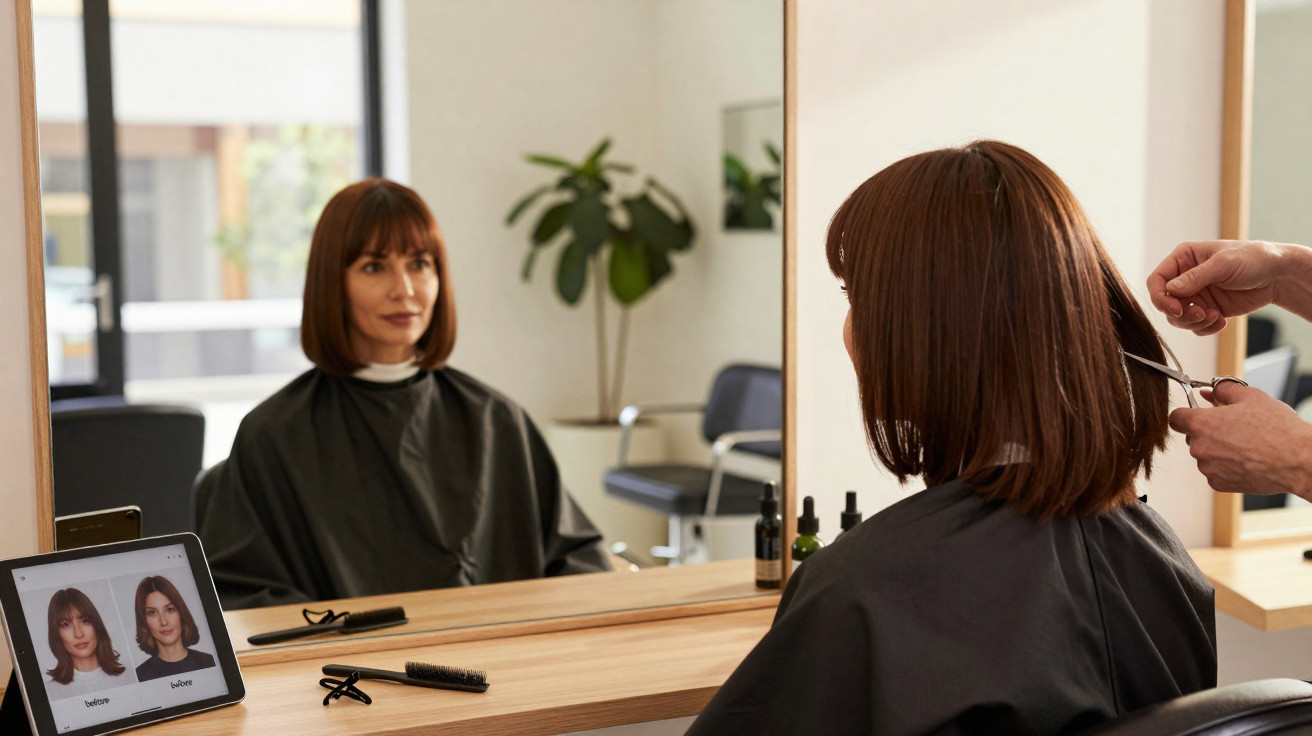
The salon feels cosy, filled with the steady whirr of hairdryers and the sort of near-whispered truths people only share under a cape.
In the chair facing the mirror, a woman in her mid-forties keeps twisting the ends of her bob between her fingers. “I asked for something fresh,” she tells the hairdresser, “but every time I cut it, I feel older. Not younger.” The stylist gives a small smile, tips her chin up, and watches how the hair sits along her jaw. “It’s not the length,” he replies quietly. “It’s the wrong kind of bob for your face, your hair, your age. That’s all.”
He scrolls through photos on his phone-one, then another-showing the same woman wearing five versions of a bob. In a couple she looks crisp and lifted; in others she seems worn out, almost weighed down. Same person, same shade, same length-just slightly different shapes. One small change shifts everything.
The 5 bob haircuts that age you after 40
Any seasoned stylist will tell you that a bob isn’t automatically flattering-particularly once you’re past 40. The bob that looks “right now” on Instagram can, on the wrong person, sharpen features, pull the face visually downwards, or spotlight exactly what you’d rather blur. The issue isn’t your age; it’s whether the cut works with your proportions, your natural texture, and the life you actually live.
The professional I spoke to-a London-based hairdresser who works with dozens of women over 40 each week-insists there are five bob styles that reliably leave clients underwhelmed once the initial salon finish has faded. “They walk in full of hope,” he says, “and three weeks later they’re back with hats and dry shampoo.” When a bob hits the jaw at the wrong spot or lies too flat across the cheeks, every hint of tiredness can suddenly look amplified.
In his view, the repeat offenders are nearly always the same: the pin-straight jawline bob, the ultra-blunt one-length bob, the under-the-chin “helmet” bob, the very short boxy bob, and the high-maintenance wavy bob that only behaves straight after a blow-dry. Each can look incredible on a 25-year-old in a campaign. On a real woman with a real schedule, they can come across as severe, heavy, or simply unworkable. That’s the moment when reality clashes with what you expected to see in the mirror.
Consider the classic jawline bob: perfectly straight, finishing exactly at the widest part of the face. In theory it’s elegant; on a Pinterest board it’s immaculate. But in day-to-day life, that hard horizontal line can cut across features that you’d prefer to keep soft. He explains that after 40, volume and elasticity shift-quietly, but undeniably. If the cut stops precisely where the face is broadest, it creates a “frame” that exaggerates that width.
He recalls a 47-year-old client who arrived with a photo of a celebrity bob: razor-straight, no layers, ending right on the jaw. She left delighted. Three weeks later she returned looking drained and said, “I look stern in every Zoom meeting, like I’m scowling.” The shape had dragged everything down and removed movement. The hair was flawless. She didn’t feel like herself.
That’s the common thread he sees in these less-forgiving bobs: they’re built for controlled light, pro styling and carefully chosen angles. Real life is looser, more humid, more unpredictable. If a blunt bob finishes at the wrong level, it can draw attention to smile lines and under-eye shadows. If the back is too square, it can make the neck look thicker and visually shorten it. And if it needs 25 minutes of effort to look “intentional”, it will look accidental on most weekdays. Let’s be honest: almost nobody does that every day.
How a bob after 40 can lift your face… or pull it down
When a new client over 40 sits down, he doesn’t start by discussing colour or products. First, he asks her to look straight into the mirror and smile. Then, using a comb, he maps an invisible diagonal-eye corner to mouth corner to jaw. “Here’s your lift line,” he tells her. “Your bob should follow this energy, not fight it.” When the cut respects that direction, it tends to open the face rather than close it in.
In practical terms, he avoids a shape that lands like a heavy bar across the cheeks or jaw. He’ll usually position the length slightly above or slightly below the widest point of the face, but not directly on it. With fine hair, he’ll open up the nape to introduce air and movement rather than leaving a dense, solid block. With thick hair, he’ll remove bulk behind the ears so the hair can curve and flow instead of simply sitting there. Small technical choices, big visual difference.
He’s blunt about one thing: the most ageing bobs are often the ones that ignore how your hair naturally falls. If you force naturally wavy hair into a stiff, blunt shape, every frizz and kink can look like an error. If you try to turn very straight hair into a piecey, wavy bob that needs constant curling, you’ll end up annoyed. “The best bob doesn’t fight your texture,” he says. “It negotiates with it, gently.” When that “negotiation” fails, it shows on the face.
From his perspective, there are three major ageing traps women fall into with bobs after 40. One is a flat front: hair clinging to the cheeks, with no root lift and nothing happening at the temples. Another is heavy ends: all the weight collecting at the bottom like a curtain. The third is strict symmetry: a ruler-straight bob that’s identical on both sides, which can make the face appear just as rigid. Each of his five least flattering styles typically hits at least one of these-sometimes all three.
Saving your bob: small tweaks that change everything
To soften a bob that’s turned harsh, his go-to fix is simpler than most clients expect: raise the back, lighten the front. If a jawline bob feels severe, he shortens the nape by about 0.5–1 cm so the hair naturally falls forwards on a gentler diagonal. That tiny graduation can immediately break the “helmet” look. After that, he lightly refines the ends around the chin so the edge reads as soft and airy-more like a brushstroke than a felt-tip line.
When someone regrets choosing a very blunt, one-length bob, he’ll add micro-layers that don’t look like obvious layers-just movement. A handful of careful snips around the cheekbones can shift the focus upwards and away from the lower face. You know that moment when a photo suddenly feels like you again, simply because your hair isn’t plastered to your cheeks? That’s the goal of these tiny adjustments: nothing dramatic, just a bit of space.
He’s equally insistent about the parting. A dead-centre part paired with a heavy, straight bob can highlight asymmetry and make expression lines look deeper. Moving the part slightly, or creating a soft zigzag, can make the whole face look more relaxed. When clients say their bob makes them look “hard”, he’ll often change the part before he touches the scissors. “Sometimes,” he laughs, “it’s not the cut that’s wrong, it’s the line on the scalp.”
Many women arrive convinced the culprit is ageing, not the haircut. They compare themselves to photos from their thirties and sigh that everything used to “sit better”. He gently pushes back. The mistake he sees repeatedly is choosing a bob from a moodboard rather than from the mirror. “On a screen,” he explains, “you don’t feel your hair density, your cowlicks, your morning rush. Those matter more than you think.” On a busy weekday, a bob that relies on a round brush, straighteners and texturising spray to look right will almost always let you down.
A lot of the least flattering bobs share one thing: unrealistic upkeep. The wavy influencer bob that looks charming online often depends on 20 minutes with a curling iron, specific products and cooperative weather. In real hair and real humidity, it can fall flat or frizz fast. Meanwhile, the very short, boxy bob-sharp through the back and high on the neck-needs a tidy-up every three to four weeks to stay in proportion. Push it out to eight weeks and the shape drops, making the neck look thicker.
Emotionally, the toughest part is the mismatch between what a woman wants to feel and what the cut delivers. Women over 40 often come in hoping to feel lighter, more current, more at ease. A bob that’s too blunt and too straight can create the opposite: boxed-in, pinned-down, sharpened. Most people know that moment-leaving the salon smiling, then catching your profile in a shop window and feeling your stomach sink. He notices it in posture: shoulders tighten, chin dips. The wrong bob doesn’t only age the face; it drags down the mood.
That’s why he always asks about real routines. Do you tie your hair up for the gym? Do you wear glasses that rest on your ears and alter how your hair sits? Do you tuck one side behind your ear all day? Those tiny habits determine whether a bob will support you or constantly resist you. A helmet-like bob with no layers can puff over glasses arms. A jaw-hugging bob can keep springing forwards if you’re always tucking it back. Everyday gestures quietly undermine-or reinforce-the cut.
He comes back, repeatedly, to the same principle: a flattering bob after 40 has a touch of imperfection. A hint of asymmetry, a soft irregular wave, a few face-framing pieces that don’t match perfectly. “Perfection is harsh on a mature face,” he says. “Softness, movement and little ‘accidents’ make you look alive.” That’s exactly where the notorious least flattering bobs miss the mark: they’re overly controlled-too drawn-on, too tidy.
He also laughs when clients admit they feel guilty for “not styling properly”. “The haircut should do 70% of the job on its own,” he tells them. “Styling is the last 30%, not the magic trick.” If a bob only looks good after a professional blow-dry, it isn’t truly flattering-it’s a costume.
“A good bob after 40,” he sums up, “doesn’t try to make you look 25. It makes you look awake, present, and like yourself on a very good day.”
To steer clear of the least flattering effects he sees time and again, he gives clients a few non-negotiables before they commit to any bob:
- Never cut the bob ending right at the widest part of the face.
- Avoid ultra-blunt, one-length cuts if your hair is very thick or very fine.
- Don’t copy a high-maintenance wavy bob if you hate heat styling.
- Be wary of strict symmetry: a soft side part or subtle angle is your friend.
- Ask your stylist to check how the bob looks when you smile and when you look down.
A bob that grows with you, not against you
Walking out of that salon, what stayed with me wasn’t a rigid checklist of bobs to ban. It was how this hairdresser reads each woman as something in motion-more like a story than a still image. At 40, 50, 60, the right bob isn’t simply about hiding time. It’s about choosing what you want to emphasise when you enter a room-or join yet another video call. Maybe it’s your eyes. Maybe it’s your jaw. Maybe it’s just your energy.
The least flattering bobs he listed are often just cuts that ignore that story. They sit on the head rather than living with the person wearing them. A heavy jawline bob on someone who laughs a lot will bounce and flap whenever she talks. An ultra-precise, boxy bob on a parent chasing children all day will look skewed by 10 am. And a bob that assumes your hair behaves like it did at 25 will keep reminding you that it doesn’t.
Choosing a different kind of bob-lighter around the face, with tiny layers you barely notice, and a length that dodges the widest point of your features-isn’t “giving in” to getting older. It’s working with it. Sending this piece to a friend or sister can spark the honest mirror chat: not “What will make me look younger?”, but “What kind of bob makes me like my reflection more, right now?” The answer is rarely a rigid, blunt, least-flattering cut. More often, it’s something softer, kinder, and more like you.
| Key point | Detail | Why it matters to you |
|---|---|---|
| Avoid the ultra-blunt bob | A single, very straight length can weigh down the lower face | Understand why an overly sharp bob can make features look harsher |
| Play with the length | Cut just above or just below the widest point of the face | Learn where your bob should finish to create a slimmer visual effect |
| Respect your natural texture | Match the type of bob to fine, thick, straight or wavy hair | Choose a realistic cut that wears well in everyday life |
FAQ:
- Which bob length tends to flatter most after 40? Many stylists recommend a bob that finishes slightly above the jaw or just below it-rather than stopping right at the widest part of the face.
- Can a very short bob suit someone over 40? Yes-provided it’s softly textured, not a stiff, boxy shape that can make the neck look thicker and the features look harder.
- Are blunt bobs always a bad choice? Not necessarily, but a completely blunt edge can read as heavy; a touch of softness or light layering at the ends usually feels fresher.
- What’s a good bob option for fine hair after 40? A lightly layered bob from chin to collarbone, with gentle graduation at the back, often adds volume without looking wispy.
- How often should you trim a bob to keep it looking flattering? Around every six to eight weeks is ideal; after that, many bobs drop, lose their shape and can start pulling the face down.




Comments
No comments yet. Be the first to comment!
Leave a Comment