
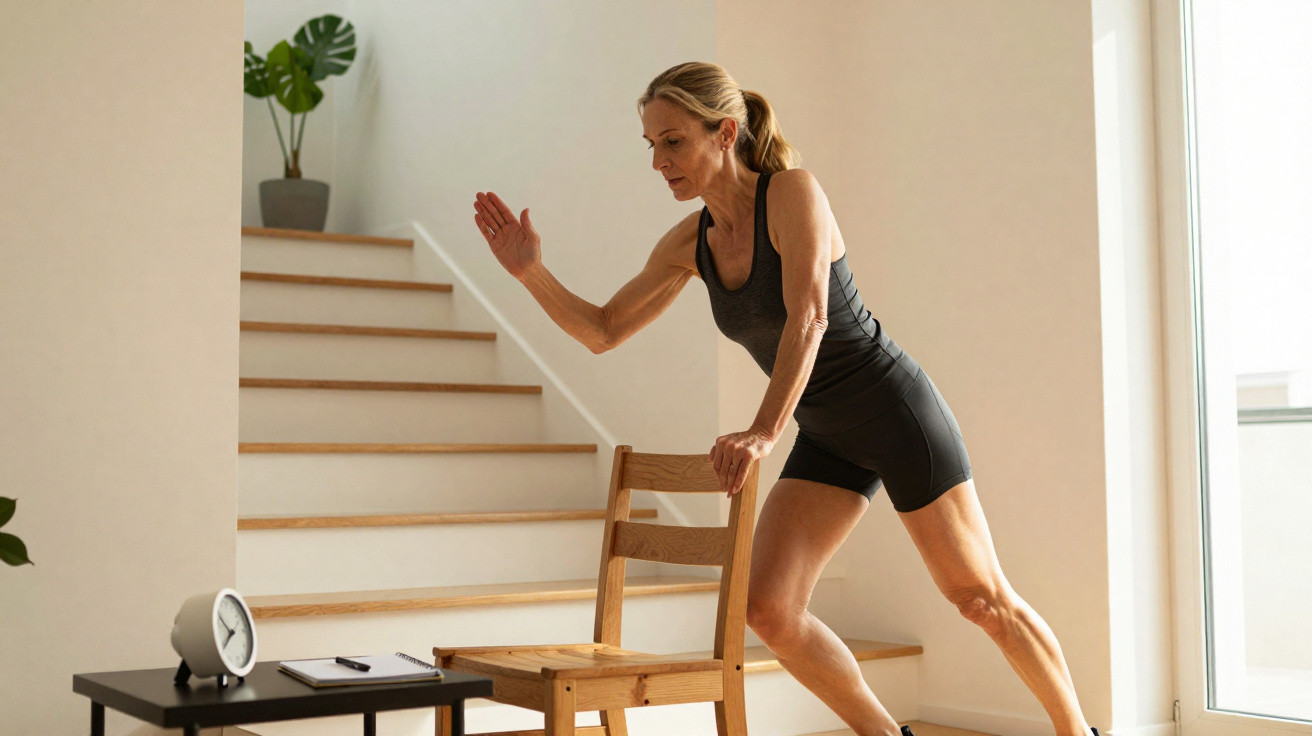
Climbing stairs and standing up from a chair may seem like everyday actions, yet they require leg strength, balance, coordination and the ability to support your own body weight. From the age of 50, trainers often emphasise these exercises because retaining these abilities helps keep daily activities manageable as ageing gradually begins to affect muscle mass and power.
Why do these movements become more important after 50?
Strength loss does not suddenly begin at 50, but it generally progresses with age. The National Institute on Aging states that age-related reductions in muscle mass and strength, known as sarcopenia, are among the factors that can impair physical abilities over time.
This is where functional movements become especially valuable. Raising yourself from a chair relies chiefly on the quadriceps and glutes, while climbing stairs repeatedly involves lifting the body against gravity. Both movement patterns occur regularly in everyday life, whether using stairs, getting up from the sofa or rising from bed.
Which muscles are used when climbing stairs and standing up from a chair?
These exercises place much of their demand on the lower limbs and trunk control. Although they do not work every muscle as intensely as a complete resistance-training programme, they engage muscle groups that are vital for mobility and independence:
- quadriceps to straighten the knees;
- glutes to extend the hips and lift the body;
- hamstrings to assist movement and stabilisation;
- calf muscles when climbing and pushing off on steps;
- trunk muscles to maintain posture and balance.
Why is standing up from a chair used to assess strength?
The movement is so closely linked to functional leg capacity that the CDC uses the 30-second chair stand test in its fall-prevention strategy for older people. The assessment records how many times a person can sit down and stand up without using their arms, and it is used to evaluate lower-limb strength and endurance.
This also explains why repeating the action can be useful as exercise. Standing without using your hands to push yourself up requires the legs to generate enough force to move body weight. As the movement becomes easier, increasing repetitions, slowing the lowering phase or using suitable resistance can make it more demanding.
How can these exercises be added to a routine safely?
People who can already perform these movements without pain can begin with a small number of repetitions and gradually build up the volume. The aim is not to do everything quickly, but to retain enough control for the knees, hips and trunk to work through the full available range of movement. A straightforward routine may include:
- sitting down and standing up from a sturdy chair for several repetitions;
- gradually reducing hand support when it is safe to do so;
- climbing a few flights of stairs at a comfortable pace;
- using the handrail while balance is not yet secure;
- adding repetitions or sets as the movements become easier.
For people with significant pain, dizziness, a recent history of falls or difficulty standing without support, progression needs to be tailored individually. Ageing itself results in major differences in fitness between people of the same age, so reaching 50 does not create one suitable level of intensity for everyone.
Are stairs and a chair enough to maintain strength?
Climbing stairs and standing up from a chair are useful ways to turn everyday movements into leg-strengthening stimuli, but they do not have to replace more comprehensive strength training. Current recommendations for adults include muscle-strengthening activities for the major muscle groups on at least two days each week, while older people also benefit from combining them with aerobic and balance exercises.
The value of these movements lies precisely in how they carry over into daily life: legs able to lift the body from a chair, manage steps and control the descent remain necessary well beyond the age of 50. Keeping the quadriceps, glutes, balance and mobility trained narrows the gap between “exercising” and preserving the movements that determine how much a person can move around and do independently each day.


Comments
No comments yet. Be the first to comment!
Leave a Comment